
Magnesium (Mg) needed for growing excellent grapes
I often receive questions about why the leaves of a grape vine turn yellow long before fall.
Although there are about 20 reasons why these symptoms show on leaves, I think the most common reason for yellowish leaves on a grape vine, is Magnesium (Mg) deficiency.
Not all grape vines show symptoms of Magnesium deficiency, but it is becoming more and more evident in vineyards as we learn more about the importance of Magnesium for optimum grape quality.
What is the function of Magnesium in a grape vine?
Magnesium form part of the chlorophyll molecule. As you can recall from school, chlorophyll is a green pigment found in most plants, hence the green colour of chlorophyll-containing tissues such as the leaves of your grape vine.
As we all know by now; the leaves (and green parts) of the grape vine is where the carbohydrates are manufactured and transported to the rest of the grape vine. These carbohydrates are necessary for optimum growth, the immunity of the grape vine and for the proper development of the berries.
The symptoms of Magnesium deficiency:
More often, the symptoms of Magnesium deficiency is overlooked when growing black or red grapes, as white varieties show Magnesium shortages more prominent.
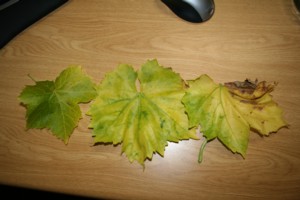
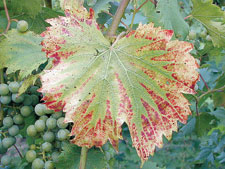
Deficiency symptoms are seen on the older basal leaves and start with leaf margin yellowing that moves inward. The leaf veins stay green the longest and the areas between become pale green and often creamy white. In red grapes, there may be a reddish colouring that develops between the veins (like the picture below).
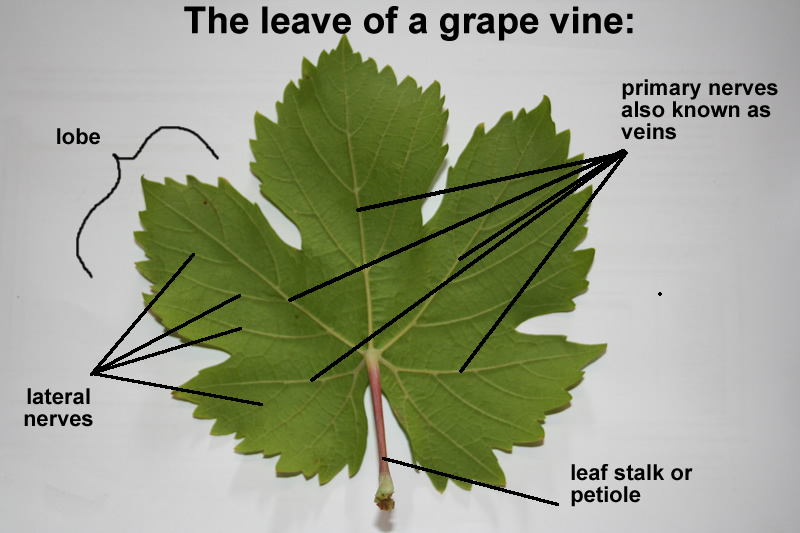
If you are not familliar with these terms, have a look at the picture below:
Not only does Magnesium deficiency affect the leaves and the manufacturing of carbohydrates, but it can also lead to premature fruit drop at harvest (more reason to keep a look out for the symptoms!).
How to correct Magnesium deficiency:
The most common mistake grape growers make, when they diagnose a grape vine with a Magnesium deficiency, is add tons of Magnesium to the soil or foliar.
Over the past 20 years I have been growing grapes, I have found that most of the time, it is not a shortage of Magnesium that cause the problems (symptoms), but more often it is a pH problem or Potassium (K) / Magnesium imbalance.
The problem starts when you are growing grapes on more acid soils. Magnesium is tied up to the soil particles of acid soils and become more and more unavailable to the grape vines, the lower the pH gets.
Now, the first thing you do before planting your grape vine, is to correct (raise) the pH of these soil, right? But most of the times, grape growers don’t take into account that by adding elements like lime and Potassium to correct the pH, it can cause even more Magnesium to become unavailable to the plants!
Soils with very high levels of Potassium (K) (many of the organic growers will have this problem), will have little available Magnesium. Why? Because Potassium will displace Magnesium cations (Mg ++), making less Mg anions available to the plant.
In other words, if you have a low pH soil (below 5.5 pH), and you want to raise the pH without binding the Magnesium, you should apply dolomitic lime (high in magnesium) at the rate of two to four tons per acre – BUT before you run out to by some lime, I do recommend you let your soil be analyzed first. Magnesium soil test values between 100-250 ppm are considered adequate for growing grapes.
If the Magnesium deficiency symptoms are picked up during the growing season (normally between flowering and veraison), a petiole analysis (leave stalk analysis) of the grape vine is the right way to determine what is going on inside the grape vine. A foliar spray of Magnesium sulphate will temporary correct the issue. The most common recommendations are 15.0 to 20.0 lb. of magnesium sulfate/100 gal. sprayed as a dilute spray at 200 gal./acre.
Then again; get your vineyard soil analyzed do the corrections there, as Epson salt can cause foliar and fruit damage if mixed with other products.
I hope that this article shed some light on the subject of the importance of Magnesium when growing your grape vines.
Have an excellent day my friend!
Danie
P.S. Did you like this tip?
Join the more than 2000 happy grape growers by becomming a member of the Complete Grape Growing System Today!

Tagged with: how to grow grapes
Filed under: growing grapes • how to grow grapes
Like this post? Subscribe to my RSS feed and get loads more!

Goodday, Absolutely Love the info you provide TKS,
I have 10 acres of new Pinot Noir and Chardonnay planted aprox. three weeks in British Columbia (Okanagan Valley Kelowna) Canada.
Question: Fertigation, I want to add 20-20-20 to the drip, in my estimation it would be 5lbs/gal. or liter, 30 min drip. would this be correct?
Or are there some common formula’s for multiple applications?
TKS Again always looking forward to your next report.
Cameron
Hi Danie,
The color is rust if shown in sunlight. I have treated every week
with fungicide the product you mentioned in the study, also Sevin and Sulphur. Just let it go and keep treating?
It is hard to keep battling.
I will wait your reply. Thanks!
GRace
Hi Danie,
I have a healthy vine with huge leaves twice bigger than the palm of my hand and it is green but recently I have notice that some leaves have pink-orange blothes if shown under sunlight. It is flowering so I cannot remove leaves at this time. The leaves are not showing of yellowing. The blotches starts in the middle of the leaves. Please advise if what prevention I can do. I know this are not disease but probably on PH. The other vine are doing good.
Regards,
Grace
hi
really your article very useful to grape growers
thank you for such a good article
My vines immediately put out fruit on the first fines, I only allowed 3 vines to grw.As they grew, no more frut appeared.
Will the vines produce more fruit in time ?
Norm
Dear Danie
Thank you very much for the information that you send it regulary
I fonud the information that i recived it is very helpfol to me
Thanks again and i will send to you some photos to my grape vine
with my best regards
A.E.Benal
Dear Danie,
Great article on Magnesium!
First, a Note to Morris (above letter)
Hi Morris,… Give Danie a little time. He runs a large vinyard full time and then does his “Grape-Vine”. Emergencies are the norm in farming. Many questions are difficult to answer with the information given. There are many, many, variables in the plant/soil/climate/etc/etc equations. Maybe he will answer your question with another blog,?? Also, maybe someone on the blog could help you.
Now back to Danie,
The chlorophyll photosynthesis process is an amazing part of God’s creation. A year or so you mentioned that magnesium was the only metalic element in chlorophyll, which suprised me because I assumed that Iron was what made chlorophyll green, since spraying iron on pale leaves made them turn green. Also, dark green vegetables are reported to be high in iron. I researched this an found that Yes, you are correct.
So now that I know that chlorophyll has only Mg, what does the Fe do for the plant and why does Fe make the plant Green? Also, iron and magnesium deficiencies look about the same to me.
Where I am in the upper piedmont the soil varies greatly in short distances so in my opinion soil tests only tell you what the soil is in that location. Tests are fairly expensive, and past the NPK and ph, they charge $5.00 for each additional element. Learning to read the leaves for plant nutrition can save a lot of time and money.
Another question about Mg is this- In cool rainy overcast spring can I spray my strawberries, etc with Mg to make them sweeter.? This spring my strawberries did not sweeten up possibly because they could not “pull” enough Mg to form sugar.???
Watermelon growers had this secret for 30+ years. Will this work on other fruits and vegetables and GRAPES??
So Danie,thanks again for your report and the Mg leaf pictures!!!
Fritz
Inman, SC
Hi Fritz,
Thanks for the reply and support 😉
Iron is necesessary for chlorophyll synthesis but is not a componant of chlorophyl itself.
Yes, the symptoms are almost the same, with only one diffenrence:
Iron (Fe) defesioncy normally goes hand in hand with HIGH pH soils where lots of free lime, tends to bind bicarbonates – especially in wet soil conditions.
I’m not sure if Mg spray will increase the sugar content of grapes – although I doubt it
Hi Danie
Your article on magnesium defeciency was very interesting, as are all the emails received from you. Please would you advise me what the cost is in SAR for you book.
egards
Gloria
Gloria,
Thanks for the kind words 🙂
From the order page, there is an option to buy the Grape Growing System in your own currency (ZAR), and depending on what the exchange rate is at that time, the cost will differ. The fixed price is US$47.95 however.
DANIE: Your column on magnesium was interesting, but THAT is not my problem. I sent you a brief note a few days ago with one specific question. If you do not have time to answer it, please at least say so. I cannot repeat my query, and won’t trouble you again. Thank you. Morris
Well Morris, what more can I say than I’m sorry for not replying sooner!?
As Fritz said, I’m only one guy and I really try hard to get to everyone’s emails. Can you even imagine how many emails I get in one week? My Grape Vine has more than 13 000 subscribers!
I will find your mail and reply to it soon
Daniel,
1) Can you suggest natural ways of ameliorating the soil,
2) Also are there any other appropriate fertilizers commercially produced for other plants that we could use on grapevines (to kill two birds with one stone)?
3) I can’t get my soil tested (I live in Japan) and it is too costly, so is not worthwhile. I grow grapes to improve the appearance of our home, and am trying it to grow alongside up a pipe onto a balcony, and another grapevine over an arch fronting our patio (in a sunny location at the corner of our vegetable patch.)
Last year, the vines looked very healthy (as this year), but we had terrible green beetle problems (we handpicked them off the vine, but it was impossible to get rid of them all). On one of the vines, it bore fruit but they were disappointingly not sweet, until the final bunch of the year. On the second vine, there were more bunches of grapes, but they were ALL tiny, and so also disappointing. We have one Delaware and another one I forget which, but that’s all that our nursery provided. I have been following your columns, and am trying to watch the canopy advice and pruning tips, but I figured my main problem is fertilizing and ameliorating the soil. Do you have any suggestions for general natural way of improving the vines?
Aileen, I’ll try to answer answer this as simple as possible.
1. I suppose your soil is too compact if you refer to amelioration. Adding organic material to the soil will improve the structure of the soil and will promote more the microbe count.
2. Normally, if you grow grapes for home use, a well balanced 10-10-10 fertilizer, 3 times a year (start of spring, after fruit-set and post harvest), that many people use for their gardens, will be enough for your grape vine.
Remember Aileen, unlike bananas and pears, grapes will not ripen after picking the fruit. You have to wait until the desired sugar levels before picking.