subscribe
Who else wants to learn how to grow grapes? This grape growing blog is your free resource to growing grapes.

Archive for February 2007

Ring-bark a grape vine

Hello GrapeViners,
I have something really interesting to share with you today. Do you know what ring-barking is?
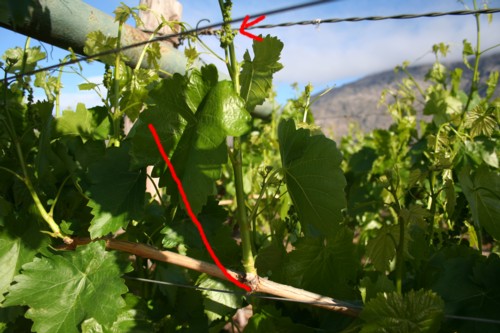
Look at the picture below:
Research has shown that the direction of sap flow in a grape vine is in the direction of the red arrows. Sap from the roots of the vine, goes upwards through the core and young wood, also known as the xylem. It picks up carbohydrates as it moves through the leaves and green parts of the vine and transport it back to the routes and older parts of the vine, through the phloem (inner bark).

What happens is when you ring-bark, is that the phloem is cut off with a ring-bark knife, so the sap flow downwards is much slower and therefore much more carbohydrates is available to the green parts of the vine.

Now, let me just warn you about ring-barking! This is a very delicate procedure and you must cut only the phloem of the stem and do not penetrate the cambium too deep, otherwise you will damage the grape vine – even kill it.

Before ring-barking can take place, you will have to remove the bark from the stem of the grape vine, exposing the inner-bark or phloem (no. 2 in picture). Take a knife and cut through the phloem around the whole ambit of the vine, until you reach the place where you started. The cut should only be deep enough to penetrate the cambium (1-2 mm) – you will see some sap-flow coming from the wound – DO NOT CUT TO DEEP!

Now you probably ask: “Why on earth do you ring-bark?”

Well my grape growing friend, this one of the methods I use to enlarge berry size on varieties like Thompson, Crimson and La Rochelle. The reason you get larger berries lies in the slower or much less carbohydrate flow downwards – does is make sense? More is available to grape clusters!

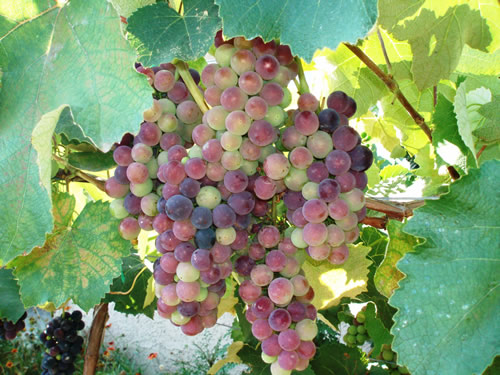
Have a look at the berry size of this La Rochelle bunch – that’s an average of 28-30 mm (XXL!!)

Picture taken with my cellphone, so the quality isn’t that good – sorry!

When to ring-bark and when not and some important things to remember:

  • Never ring-bark a young vine – the diameter of the vine should be at least 30 mm
  • Always ring-bark a day or two AFTER you watered the vine – this will ensure that the vine can handle the “shock” of ring-barking
  • Never ring-bark a grape vine that struggles to grow – remember you are actually hurting the vine
  • In the picture where the numbers are, 1 was last years’ ring-bark and no 2 this year’s ring-bark. Always ring-bark BELOW the previous year’s ring-bark.
  • Don’t cut to deep – PLEASE
  • Ring-barking shortens the life of a grape vine, so if you aren’t a commercial grape grower, don’t ring-bark (although trying it for one year won’t kill your vine IF it is done correctly)
  • Ring-bark at +- 10mm berry size, just after fruit-set has finished – don’t ring-bark to early, as this will have no effect on the berry size.

You might be wondering what happens to the ring-bark wound you made on the stem of the vine. Yes, it is a wound, but the grape vine has a unique way of healing itself and it is called callusing. Callusing is when the grape vine replace damaged membranes with new ones and if you have a close look at the picture of the ring-bark I made last year, you will notice the callosity that formed on last year’s ring-bark.

OK dear grape growers, know you have some kind of idea what ring-barking is all about. Just remember that this procedure should be done with extreme caution and it is NOT for the novice grape grower.

Take care and I will talk to you soon!

Danie

The Grape Guy

My-Grape-Vine

(Wanna know some more great grape growing techniques? Get you copy of the “Complete Grape Growers Guide” Today!

Succesful cuttings made by Joel!

Hello once again my fellow grape growers and subscribers of My-Grape-Vine!

Today I want to share a fasinating story with you.

It’s about a subsciber of My-Grape-Vine.

Meet Joel (for privacy reasons I will not reveal Joel’s email adress), owner of a dwarf Merlot grape vine (shown in the picture below).

Joel joined My-Grape-Vine in mid December, and bought the Complete Grape Grower’s Guide on 21 December. After quite a few emails, here and forth, sending pictures of the grape vine, me “e-pruning” (nice word isn’t it) the vine and sending it back, Joel decided to make some cuttings from the vine.

Now, Joel lives in the USA, GA and wanted to know how to prune the dwarf vine, so I suggested what I should have done.
To get to the point, Joel made some cuttings from his vine, and with the help of the Complete Grape Growers Guide and a little personal inisiative he succeded in rooting his VERY OWN grape vines!

Well Joel, I personally wants to congratulate you again, as I know how much it means to you, and i want to share this information with all of the subscribers of My-Grape-Vine.
Here are some of the emails we send to each other. Like I always say; “Success can only be found in the actions you take!”

Here is Joel’s story and I quote this:

From Joel:

Well it’s winter time here in Georgia and I didn’t have anything to do except to attempt to root the cuttings from the Dwarf Merlot I showed you. I have not pruned it as yet but I thought it would be cool if I could root the original cuttings I had last fall. I used rooting hormone and placed the pot of cuttings between the furnace and water heater in my basement. Needless to say I was shocked at what I saw one night (See Pictures). I am planning to root the cuttings from the pruning before placing the original plant back out on my deck.

I replied, congratulating ……………

From Joel:

Hey! Hey! Yeah I’m pretty thrilled at the results. I can’t wait to prune the rest of the plant and start some more. Where in the heck am I going to put all these!!!!! LOL Like I said this started out in a pot down in the basement (dark most of the day and not heated) placed between the furnace and water heater (heated??). I placed the plastic bag over the top held by a rubber band. I would pull the bag and rubber band back slightly with two fingers and blow to inflate the bag. I watered the cuttings, from the bottom, by pouring water in the saucer that the pot was sitting in. The soil would gently take up the water and not disturb the rooting hormone like it would if you were watering from the top and allowing the water to leach thru the soil. The best thing about bottom watering is that I did not have to take the bag off every time I wanted to water it. ……………………….

Per your suggestion, I think I will move it to a brighter room. I will begin the hardening process in March prior to planting. I like the rooting platform made from wood and a 10 gal aquarium on the site you have linked from your page. I’ve got an aquarium that has been stored in the basement for years. I think I will try this method for the next cuttings.

Joel Replied:

Hey! Thanks for your time and enthusiasm! I have never met anyone on the internet that has taken so much personal interest in my success as you. It’s very encouraging to say the least. If you give all of your customers/readers the same way you will surely be a whopping success on the internet. You kind of remind me of Steve Irwin. It’s like you are the Crocodile Hunter of the Grape Vine!

Thanks Joel for the kind words, I personally loved Steve and thanks for sharing this interesting story with all of us, and once again – WELL DONE MY FRIEND!

Now, the point I want to make by posting this on my blog is:

  • After you purchase the Complete Grape Growers Guide, I will never just write you off and say “thanks, I’ve got your money, now get the hell out of my life!”. It’s more than just selling the book (by the way, YOU can sell almost anything YOU like on the internet, these days). Your success is just as important to me as it is to you.
  • I am a man of my word; whenever I can help you, I WILL try my very best. Even if it means asking someone else’s opinion (like I’ve done with Grant, another happy owner of The Complete Grape Growers Guide. Grant had some difficulty with his water quality, so I went to see an irrigation specialist in my area, to get more precise info.)

Quote from the closing arguments in the last mail I received from Grant

Thanks again Danie to you and your expert water friend, you have been very helpful. I will be ordering your book and promoting it to other grape growers in my wine region of Western Australia (Geograph).

Regards,

Grant

To all your grape growing success my friends!

Have a grape (great) day!

Danie

Author of the Complete Grape Growers Guide – teaching YOU how to make cuttings, train, prune and grow your very own grape vine!

Please leave your comments on this post,

Compost – changing the soil you grow your grapes on

What is Compost? A good description for compost can be decomposed organic material that is produced when bacteria in soil break down garbage and biodegradable trash, making organic fertilizer.

Gardeners and farmers use compost for soil enrichment. The relatively stable humus material that is produced from a composting process in which bacteria in soil mixed with garbage and degradable trash break down the mixture into organic fertilizer.

Why is compost so important in our everyday grape growing and gardening? I once heard these terms and just love them.

Reduce – Reuse – Recycle

Reduce
Composting reduces the amount of waste each of us sends to the landfill. 30% of the material we send to landfill is organic and could be composted at home. Making your own compost in your backyard will save you hundreds of dollars over a few years. Think about it this way. In the past, organic materials have been dumped in landfills or burned. The more waste there is to remove, the more money has to be spend – simple as that. By making a compost pile, you will reduce the amount of money spend for waste removal by a huge 30%! Did you know that YOU nearly throw away 600 pounds of compostables each and every year!

Reuse
Unfortunately, we humans don’t like to reuse. We rather buy new ones because it’s much easier. Isn’t that true? Why should I even consider making my own compost? I’d rather buy my fertilizer from the nursery down the street. The world is falling apart because of waste we humans dump on landfills. The air is polluted with dangerous toxins we breath every single day of our lives. Not many of us like to go through our garbage to see what is reusable and what not. The best way to overcome this problem is to have a recycle bin in your kitchen, where you can throw away organic waste to be recycled.

Recycle
Every single day we take out the garbage, we take out lots and lots of organic material. So what is organic material and can it be recycled into compost? Let’s have a look. Organic materials include yard debris, wood materials, food and food processing by-products, manure and agricultural residues, land clearing debris, used paper and paper bags, leftovers from last nights party (except for the hangover off course J). All of these products can be recycled in compost that you can use to fertilize your grape vine and your garden!

Did you know that compost is more rich in nutrients than peat moss, we so often use?

The benefits of using compost

Let’s have a look at what compost can do for your grape vine and garden.

Applying finished compost will:

  • return nutrients to the soil,
  • hold moisture in gardens and on lawns,
  • contribute to watershed health by controlling run-off and
  • naturally fertilize your soil and
  • improve and provide structure to the soil.

Inside our soil there are literary millions of organisms at work each day. Each teaspoon of garden soil hosts 100 000 000 (100 mil) bacteria and nearly 800 feet of fungal threats? Improving the organic life inside your soil will:

  • Improve soil drainage
  • Suppress soil-borne plant diseases
  • Improve soil tilth and friability

Loosen heavy clay soils

You must always remember that compost isn’t a fertilizer and nitrogen (N) and phosphorus (P) are mostly in organic forms. Nutrients from compost is slowly released to the grape vine and other plants, therefore it doesn’t leach from the soil as much as normal fertilizers. Compost contains many trace nutrients that are essential for plant growth and for the home grape grower and gardener, this is more than enough for a single year.

Adding compost to your soil

When adding compost to your soil, you must make sure that the compost is well matured. The acquired characteristics of a mature compost or compost pile are:

  • dark brown color
  • it should be a humus like, crumbly and loose texture
  • it must have an earthy smell
  • it should be free of feedstock-readily
  • the size of the mature pile should be 1/3 of the original size

When adding compost, it is best to mix the compost with the top 6 inches of your soil. This will loosen the structure of clayish and compacted soils and will improve the water and nutrient retention of sandy soils.

Making your very own compost isn’t that difficult, but you need to know the basics. Lots of information is available on the Internet, but if you need a hands-on guide to make the worlds best compost I do recommend the following e-book.

Click on the book to get more information

Have a grape (great) day
Danie
“The Grape Guy”
http://www.my-grape-vine.com/