subscribe
Who else wants to learn how to grow grapes? This grape growing blog is your free resource to growing grapes.

how to grow grapes

I’m back! :-)

Dear grape growing friends,

It’s been a while since I posted on my blog, and I do apologize for the time I was “absent” – no I didn’t abandon you guys!

1st of all, there were some major changes in my personal life (which I’m sure you are not interested in) and 2nd I have been working real hard on finishing the membership videos of My Grape Vine.

The good news is that I have just upgraded both the main site www.my-grape-vine.com as well as the membership site for people who have joined The Complete Grape Growing System.

Those of you, who are members already, can head over to the membership pages and enjoy the more than 2 hours of training videos I have uploaded to your pages!

Anyway, I promise to be more ”active” on my blog from now on, because I will have more time to spend online.

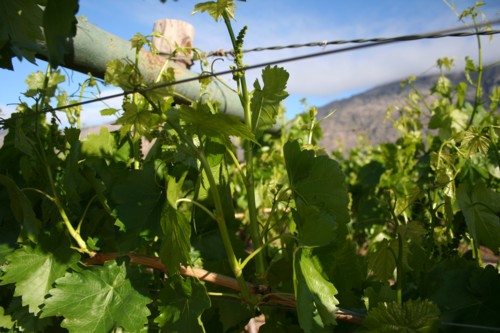
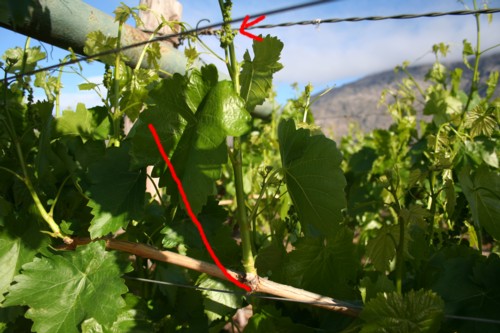
Let’s start at looking at John’s vineyard;

A perfect example of what can be done in the first growing season

His email: “…… Your information allowed me to become very successful in my first growing season. Thanks!  John B…….”

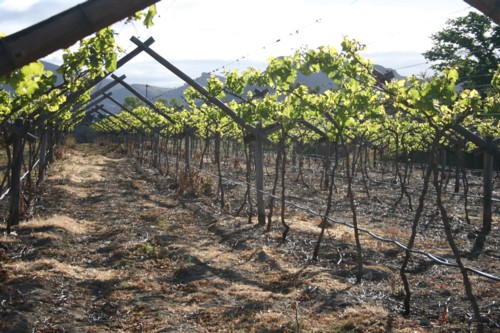
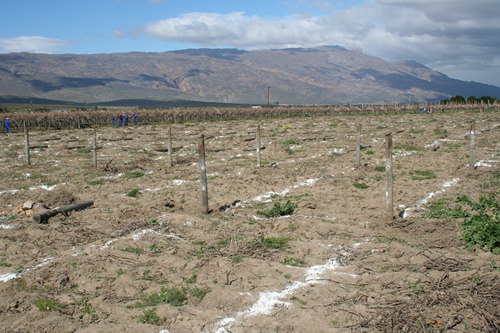
From the pictures you can see that these are still young grape vines, but already John managed to get the vine on the trellis wires AND started to develop the frame work of the vines. (See how he managed to split the vines on the trellis wires in 3 different locations).  I’m not sure where he will develop the cordons (arms) of the vines (I haven’t asked him yet :-) ), but one thing I’m sure of;  he will have a strong enough frame work next year to produce his first crop – not many grape growers can say that!

Anyway John, as I said in the email: ” You did an excellent job and I’m so proud of you!


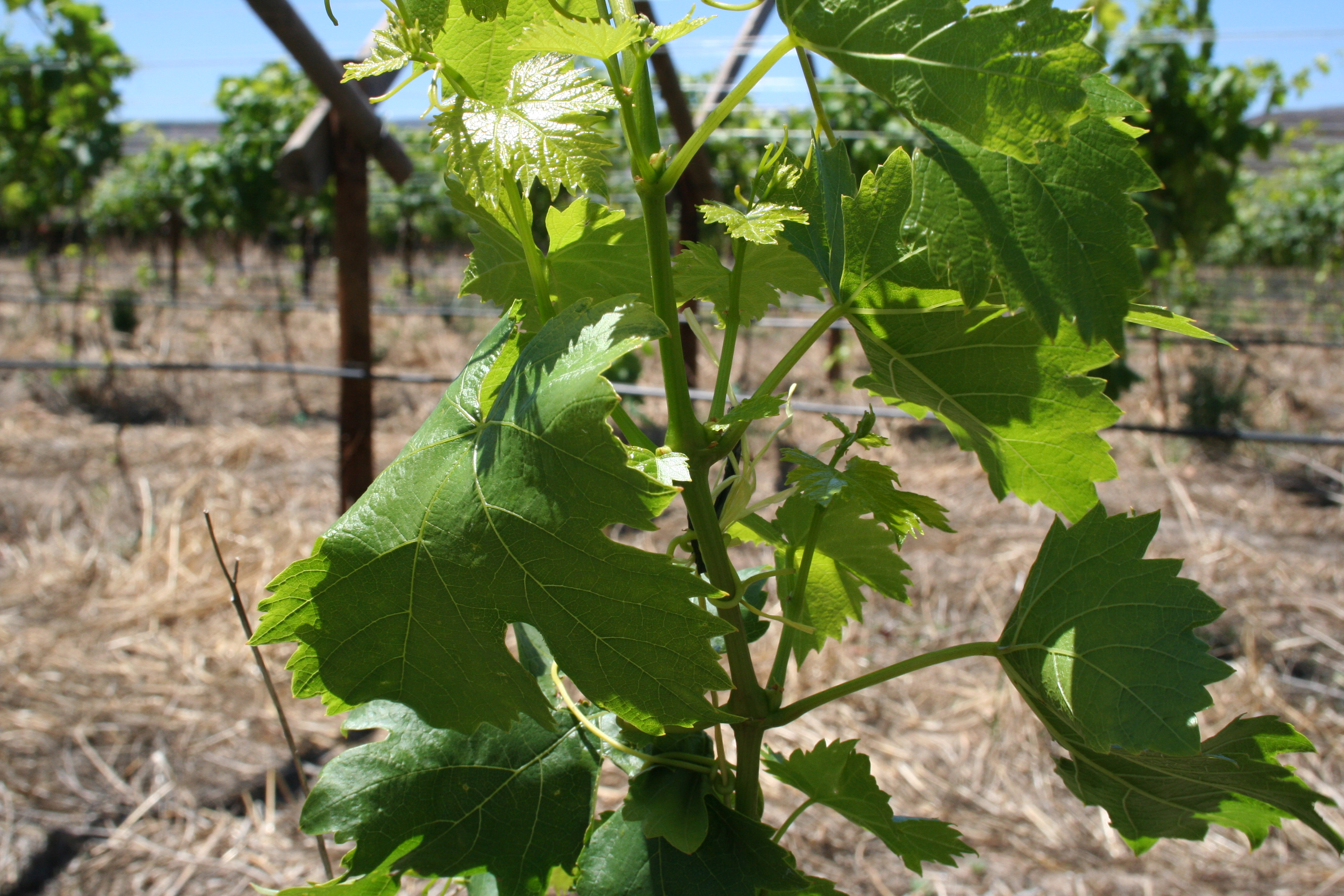
To members of the Complete Grape Growing System: To get these results in year one, you need to train your grape vine to the top wire first and then develop the lateral shoots – remember to keep the vines clear of all lateral shoots below the 6 inch zone – this is crucial.  Just another tip:  when some of the laterals grow too long, you can trim the end of the lateral – this will allow more energy to be available to other lateral shoots.

Not a member yet?  Join right now – visit

My Grape Vine


Okay friends, this is all for now.  I will update the blog by the end of the week again.

Good luck and happy grape growing

Danie

www.my-grape-vine.com


Controlling Powdery Mildew On Grapes

Powdery mildew is the main fungal disease that most grape growers confront every seasons.   The fungus that cause powdery mildew is called Uncinula Necator.

Many grape growers struggled to keep powdery mildew under control in vineyards, as once your vines are infected and the symptoms are visible, the disease already is in an advance stage of development.

The symptoms are visible on all green parts of the grape vine.

On the berries:

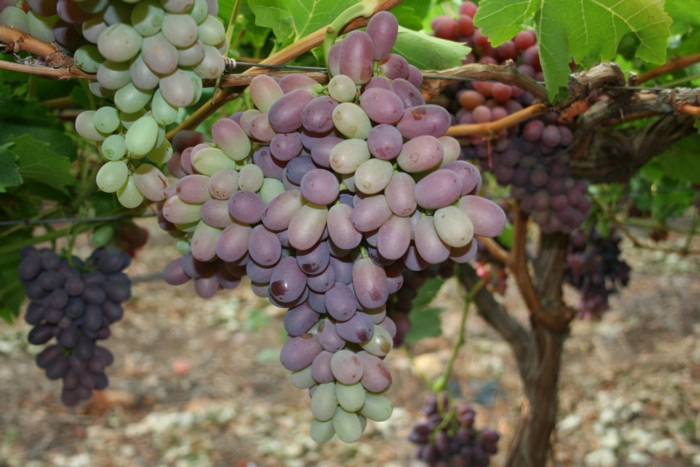
A white powdery substance covers the berries – it looks like a white dust that can be rubbed off.  These “dust” particles are the actual spores of the powdery mildew fungus.  Infected berries will have what appears to be a net-like pattern when the “dust” is rubbed off with your finger.  They most probably will crack open and dry up.  If the infection takes place early and the fungus disease spreads too fast, it can cause total crop loss!

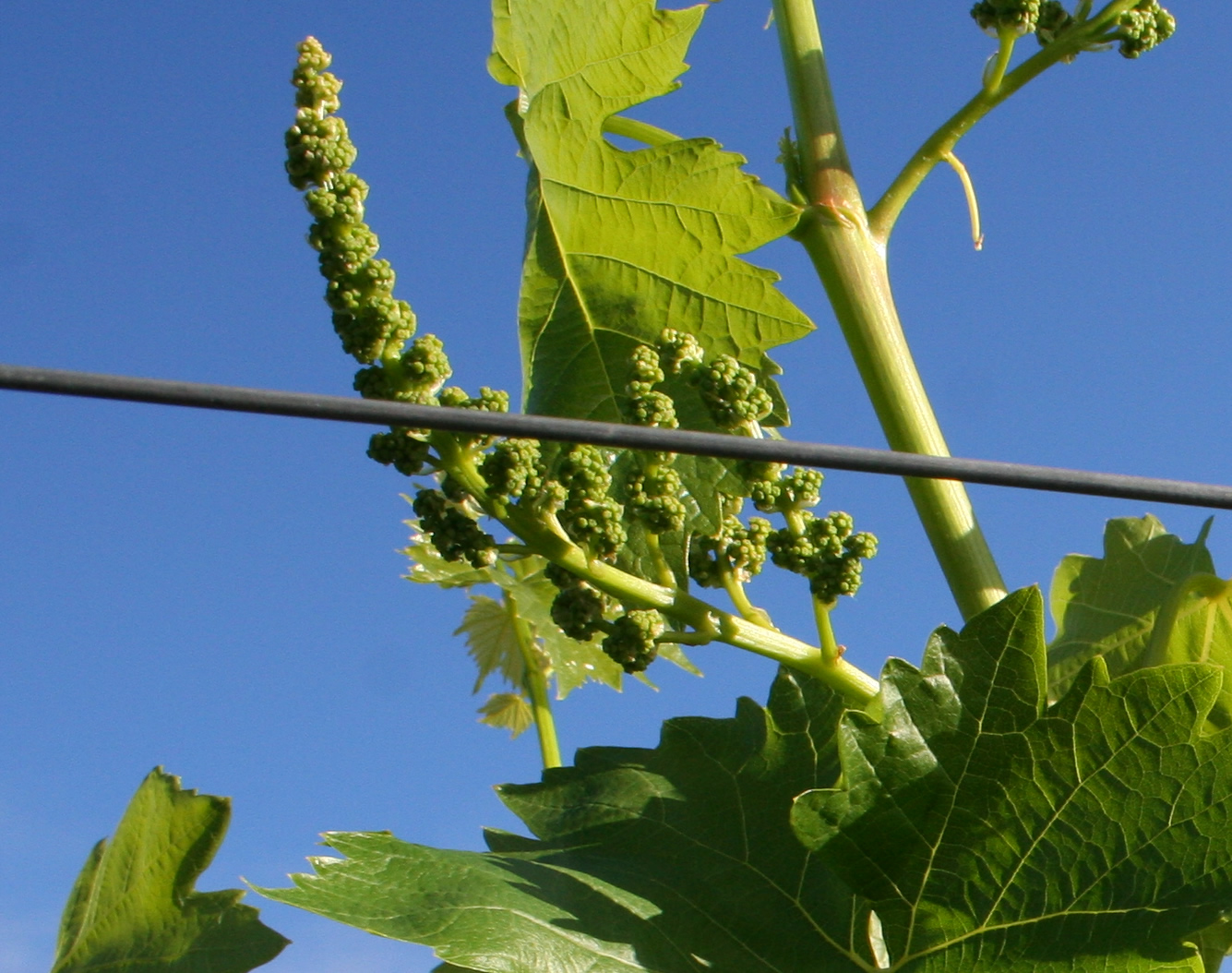
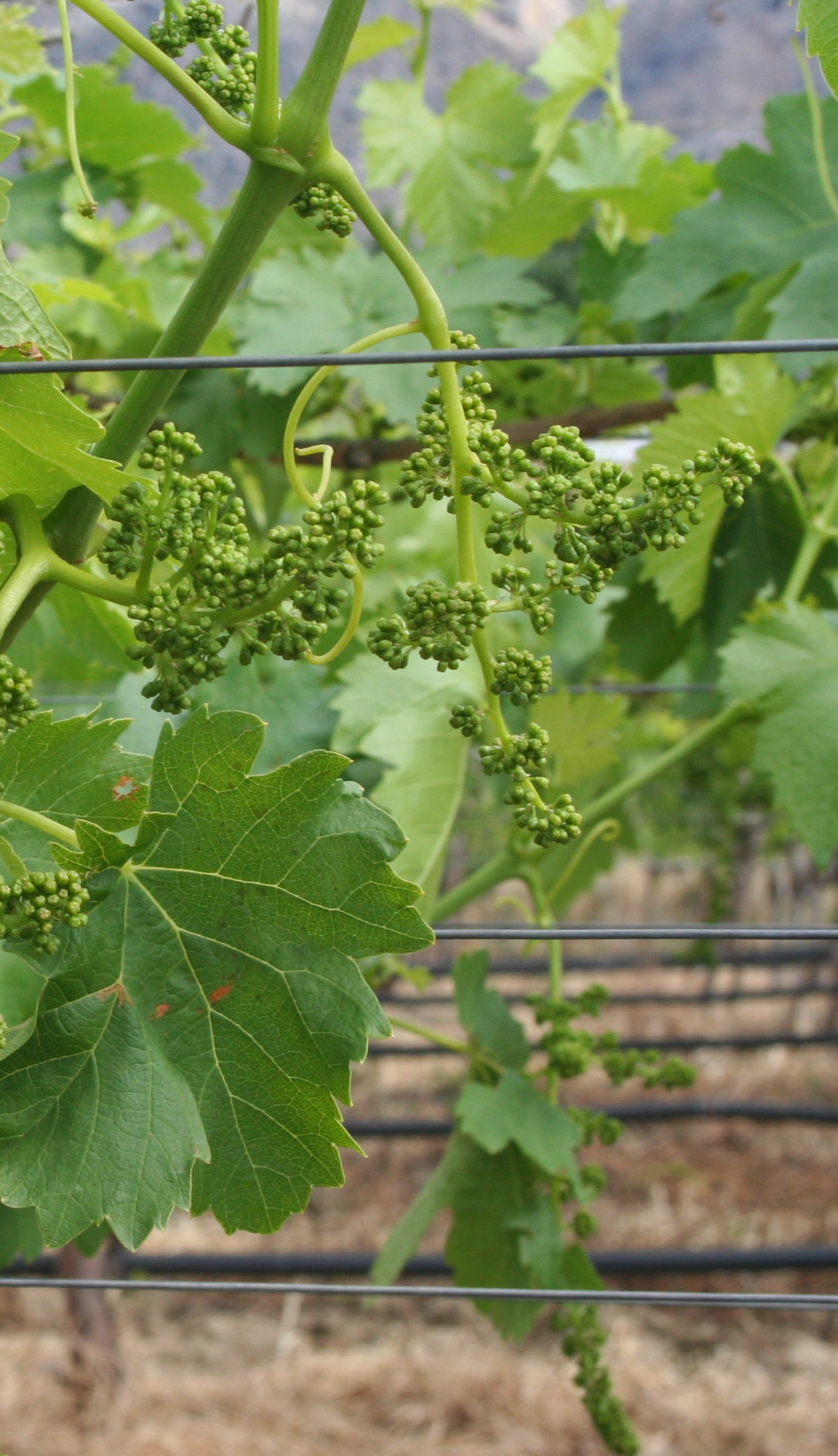
Berries are extremely susceptible from the immediate pre-bloom stage through fruit set.  This is the most critical time to keep powdery mildew under control.  Severe powdery mildew infections on the clusters is usually a result of poor fungus control and canopy management throughout this period.

On the canes (in the dormant season), you can see old infections because they will show up as brown areas. As the fungus grows on the grapes and vines and begins to produce spores you will see that the tissue that is infected with have an ash grey powdery look.

On green shoots, the same powdery “dust” will be visible.  The fungus will infect the green tissue, and will reduce photosynthesis and overall grape vine vigor.

On the leaves:

Powdery mildew on the leaves of a grape vine, appear as a white dust on the upper and lower part of the leaves.  With severe infections, discoloration and drying out of the leaves are visible.  No need to say how bad this is for berry size, sugar development and overall growth of the vine!

I often get emails asking about continuous powdery mildew infections, year after year.  There is only one explanation for this – the fungus spores over-winter on the grape vine and in the following growing season, once the conditions for inoculation is ideal, the infection will start again.  As you can imagine, this is a vicious circle, that will give you many headaches!

What is the ideal conditions for the inoculation?

For the powdery mildew, fungus to develop and spread there needs to be free water (from rain, over-head irrigation and even high humidity) and heat.  Spore cells, or cleistothecia overwinter within cracks in the bark of the vine and when rains of approximately 0.1 inch (10 mm) or more occur in spring, and if temperatures are at least 50 °F (10° C), these spores are released and will infect the nearby leaves, canes and bunches.  The higher the temperature, the more spores will be released.  The optimum temperature is mid 80s ° F or mid 20s ° C and higher is the optimum temperature for high spore release.  When the temperature reach the high 90s (+30′s ° C), the development or spread of powdery mildew will be restricted.

Controlling Powdery Mildew:

Chemical control:  With the wide range of fungicides now registered for use on vines, the question arises as to which is best and when is the most appropriate time to apply.  Where powdery mildew control is poor this is usually due to inadequate spray  coverage or the interval between sprays being too long rather than reduced fungicide efficacy. 

As said earlier, grape berries are most susceptible to powdery mildew during the period from just before flowering to 4 to 5 weeks after fruit set, and failure to control the disease during this period can result in serious crop loss.  The best control is achieved by applying a fungicide with an active ingredient called strobilurin or DMI fungicides during this period.

Organically:  Controlling Powdery Mildew organically is much harder.  The most important point to remember is that moisture and heat is needed for the fungus to spread. 

Maintaining proper airflow and sunlight penetration into the vine will ensure a “drier” micro climate inside the vine.  Direct contact with sunlight will also kill powdery mildew spores and reduce the chances of crop loss.  This can be achieved with good canopy management (suckering, leave pulling, tying of shoots, removing of water shoots etc. (consult the Complete Grape Growing System for details, it’s all there!).

I hope this article will help you solve Powdery Mildew problems on your grapes.

Remember:  Maintain a proper canopy, keep your spray applications up to date and be on the look-out for the symptoms I’ve shown you.

Take care

Danie (The Grape Guy)

www.my-grape-vine.com

Was this helpful.  Now learn how to grow your grape vine the correct way.

For only $47.95, you get instant access to all the grape growing information you need, PLUS get some bonus videos of how to prune and train a grape vine.  The Complete Grape Growing System is a digital product.  You will not receive any physical products.


For the wine lover …..

For any wine enthusiast wine is more than just a liquor, it is a valuable beverage that triggers a certain chemistry and plays a fundamental role not just from the commercial point of view but intellectually, universally and socially speaking. The very history of wine is dating back to times when only the most well educated and wealthy people enjoyed it plentifully.

However, a wine enthusiast found among the poor and the illiterate was not rare either, as the pleasure of this sense stimulant is widely applicable to anyone, regardless of personal and social status. Presently, wine relates to so many areas that it is almost impossible to exhaust it as an object of study.

First and foremost, wine has a chemical composition that makes it the perfect accompaniment for food: fatty dishes would not be the same without the mild acidity and the taste contrast that wine creates. You don’t have to be a passioned wine enthusiast to actually be aware of the way it complements the taste of food.

Furthermore, since meals are often a pretext for social interaction, wine is often the bond or the missing link in faulty communication. It relaxes the mind, eliminates the tension and stimulates creativity. Any wine enthusiast knows that as long as drinking remains rational, the pleasure is maximum.

The taste buds are the ones to sense the pleasant sensations triggered by wine and the combination of sweetness and acidity is the balance on which wine quality actually relies. It is not seldom that a wine enthusiast is happy to discover some fruity flavor in the liquor; usually such flavors contribute to the sweetness of the wine, depending on the general characteristics of the fruit that create them. Rich dimensions can be found in wine owing to the possibility to combine the taste of grapes with that of certain other fruits like pears, strawberries, elderberries and the like.

If for an amateur it is difficult to tell how white and red wine varieties are created, a wine enthusiast will most certainly know the difference. If red wine is made by the fermentation of the entire grapes, the white wine is the fermentation product of grape juice only: there is no fruit meat or skins left to the composition. Such knowledge may seem basic, but there are lots of other details that a wine enthusiast will share with others, since the topic is so wide and comprehensive that it could not be covered easily.

Take care
Danie
The Grape Guy
www.my-grape-vine.com

Training a grape vine on an arbor

In this video presentation I want to show you how to train new grape vines on an arbour.
Enjoy

(The size of the video is 31 Meg)

To visit the Grape Coaching Program, just click on the following link http://www.grapecoachingprogram.com/

Have a great day!
Danie The Grape Guy

Wine cellar secrets

Most of us only dream of building our own wine cellar where we can process the grapes that we have been working so hard on during the season. But what not many grape growers realize, is that many private wine cellars and wine makers, made their first wine in their backyard or garage. They started out small and build their way up to a point where their wine is actually in demand!

Have a look at this short video – these guys build their cellars inside a cave!

If you are serious about making your own wine or even if you are passionate about collecting wine, then there are a few things you need to know before you invest money in this. You don’t have to spend allot of money to make your own wine, or even build your own wine cellar!

One of the best books on cellar construction is How to build your own wine cellar. This is must reading for anyone considering building their own cellar.

This book will help you to build your own wine cellar. It is a construction guide for home wine cellars and invokes modern readily available materials and standard construction techniques.

This is the edeal for the “do-it-yourselfer” or hired carpenter and isn’t difficult to do. The book also reviews wine purchasing, bin construction and design, wine tasting groups and much more …

How to build your Own Wine Cellar” is a full guide for your wine cellar. If you are going to build your wine cellar you must read it first.

Growing grapes and dogs!

Grape Growers, have a look at this!

It is amazing what some poeple do. They now use Golden Retrievers to find Mealy bugs!

Have a look at this video, it is quite amazing how they treat those dogs!

Click here to watch this video

Enjoy
Danie

PS: Have you joined the My Grape Vine Forum? If you have grape growing questions, go to the forum and ask for help there – regularly check all new posts and answer them myself.

Click here for the forum

What is a spur?

How to prune a grape vine spur

I often get the question: “Danie, how do I prune a spur?”

Without knowing how to prune a spur (short bearer) the correct way, you can spoil your potential crop – did you know that? So, I went out into my vineyards and took some really nice pictures that will explain how to prune a spur.

But before I explain how to prune a spur, you need to know that a grape vine ONLY produce grapes on one-year-old shoots that was pruned on two-year-old canes and not on cordons (arms) or in most cases water shoots (a shoot that developed on 3 year and older wood).

In the picture below, you can see spur that was pruned last winter no.1 (while the grape vine was dormant). During the past growing season, two shoots developed from that spur; no. 2 and no. 3. These two shoots were the bearers during this year’s harvest.

Although they are dormant at this stage, they are still alive and needs to be pruned in order to produce more grapes next season. Inside those little buds you seen in the pictures, are already formed grape bunches – off course you cannot see them with the naked eye, but believe me, they are there! That is why I always hammer on allowing enough sunlight into your grape vine – this helps develop those little grape clusters inside the buds.

OK, so if you look at the picture again, you will notice two red lines. This is where you will prune in order to have a new spur.

In the picture below, I have pruned the old spur back and as you can see, a new spur was pruned with two buds that will develop shoots the next growing season. The shoots that will develop from this spur will bear grapes next season.

If you understand what I am explaining to you, it will make sense that spur I pruned in the above picture, will become an old spur (no 1) next year – during dormancy, after next year’s growing season.

I hope that you now have a better understanding of what a spur really is.

For further, and more in depth pruning techniques, as well as cane pruning techniques, I recommend The Complete Grape Growers Guide.

Have a grape (great) day my friends!

Danie

The Grape Guy

Glen’s vineyard

Hello grape growers!

I am so excited, I just had to put this on my blog! Here is a blog that shows you a really great looking vineyard!

Glen from Slovenia bought the Complete Grape Growers Guide in February this year. He planted his 403 grape vines in April and trained them with the help of my e-book and just look at the results! Excellent grape vine training.

Notice the development of the grape vines and how he removed the lateral shoots exactly like it should have been done. Almost every single grape vine has grown more or less the same length and they all look very, very healthy! This is what I call a complete vineyard.

Glen, I personally want to congratulate you with a well developed vineyard and this shows you what can be done with a little effort and the right knowledge!

Here is a quote from his email:” Your book seems to be invaluable, I only planted my 403 vines, well, started on the 18th of april (quite Late really) and all have taken, Most of them 98% are between half a meter and a meter high (See pic P6180008) they seem to be growing like wild fire using your first year pruning technics.”

Want to grow grape vines that look like Glen’s vineyard? The Complete Grape Growers Guide is your answer!

Happy Grape Growing my friends

Danie

PS: To get your copy of the Complete Grape Growers Guide, click here.

Summary of how to grow grapes in your backyard

History of grape growing

Drinking wine is a pleasure that has been enjoyed since almost 4000BC. The science of viticulture, or grape cultivation, began with the need to domesticate wild vines. Viticulturists needed to breed domestic plants with higher fruit yields, since wild grapes invest little energy in fruit production. Wild grapes were also dioecious, meaning that there are male and female versions of the plant. Early viticulturists selected a rare mutant vine with perfect flowers (that is, functional male and female components) to ensure all their vines bore fruit. Today many varieties of common species of grapes are cultivated and used for wine production.

Soil preparation

It is important to carefully select the planting site. Grapes can grow in a wide variety of soil types and pH ranges, certain conditions induce better growth and yields. First, grapes prefer well-drained and slightly acidic soil. The best pH is typically between 6.0 to 6.5, but grapes will grow in soils with pHs ranging from 5.5 to 7.5. If your soil is a little basic, you can add in sulfur or ammonium sulphate to decrease the soil pH. Ideally, grapes should be planted on a south-facing hillside, although in a home garden you may not have this luxury. You should choose a site in your garden that receives full sunlight – grapes do not like the shade. You’ll need to ensure that the soil at your selected site is worked over well before planting to remove any perennial weeds. Addition of peat moss or manure to the site will also help to improve soil quality.

Planting methods

The way you plant your grape vines is really important for their health and productivity. Vines need to be planted approximately eight feet apart in rows that are between eight and ten feet apart. If you are planting on a sloped site, ensure that the rows run perpendicular to the slope. If your site is exposed to a strong prevailing wind, orientate your rows in the direction of the wind to minimize damage.It’s preferable to choose one- or two-year-old, dormant, bare-root vines from a reputable provider. Soak the roots of the vines for several hours prior to planting. When planting, ensure that the hole is slightly larger than the root system of the plant and that the vines are set at a depth equivalent to the one they grew in at the nursery. If your vines are grafted, ensure that the grafting union is approximately two inches above the soil. Once you have planted the vines, you’ll need to remove all but the most vigorously growing cane and cut this back to just one or two buds.

Training your grape vines

To facilitate cultivation, harvesting, pest control and to maximize yield, grapes are trained to a specific system. There are many different training systems, however the single curtain and four- or six-cane Kniffin systems are most suitable for home gardeners. The four-cane Kniffin system trains four fruiting canes to two trellis wires whilst the six-cane Kniffin system trains six canes to three wires. The six-cane system is best for less vigorous grape varieties. Using the single curtain system, the main trunk of the vine is attached to a horizontal wire approximately six feet above the ground. Two cordons (extensions of the main trunk) grow along the wire to the left and the right of the trunk, with five or six fruiting canes on each cordon.

Pruning your grape vines

Annual pruning of your vines will be necessary to ensure optimum yield and sufficient vine growth to produce next year’s crop. The best time for pruning is late Winter or early Spring, during the vine’s dormant phase. You’ll need to keep a few things in mind when pruning; fruit is borne on one-year old canes, the most productive of which are between 0.25 and 0.30 inches in diameter. The most productive buds occur in the middle of the cane, so it is best to prune canes to between eight and 16 buds. New farmers may find the advice of an experienced viticulturist helpful.

Harvesting your grapes

Harvesting should occur when the grapes are fully ripe. Color isn’t always a reliable indicator of maturity, so taste-testing is essential! Cut the grape clusters from the vine with a sharp knife and handle the grapes by their stems. Grapes do not handle or store well, so enjoy the fruits of your labor as soon as possible!

This is only a summary of how to grow grapes. For a more complete and much more helpfull explenation of how to really sky rocket your grape crops, you need the get YOUR copy of the Complete Grape Growers Guide – Click Here

Have a grape day

Danie

The Grape Guy

http://www.my-grape-vine.com