subscribe
Who else wants to learn how to grow grapes? This grape growing blog is your free resource to growing grapes.

Archive for February 2009

Should I prune back my grape vine?

Hi there friends,

I would like to share this email I received yesterday with you.  Maybe you have the same situation Leo has.

Here is the mail.

———-

Danie,

I have a question for you to see if I’m on the right track.

My grapevine didn’t grow very well last year, but thanks to your guide I ordered this winter, I now know what went wrong / what I did wrong.  Anyway, my grapevine is halfway up the training string, about 2 feet from the bottom wire of the trellis and the buds are swollen and show signs of bud break. 

I know your guide clearly says to prune back if you didn’t achieve the first year’s goal, but should I really prune back to the ground and start all over again?

Thanks for all your support and well done – your program is just awesome!

Leo

———-

First of all, thanks Leo for the kind words…

This is quite a common question asked by new vineyard owners and should be, because this is where so many go wrong!

If you didn’t succeed with getting your young grape vine to at least the bottom wire of the trellis during the first year, then YES, it is best to prune back and start over again.  Start by looking for the reason why your grape vines didn’t do that well and eliminate that problem as quickly as possible.

Second, prune the grape vine back to three buds above the graft union (if it is grafted vines off course :-) ) and 3 to 5 buds for non-grafted vines.  New shoots will develop from those buds and you then need to choose one or two to train as the stem of your grape vine.

THERE IS ONE EXCEPTION THOUGH:

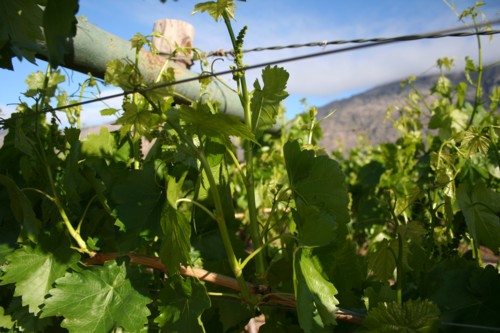
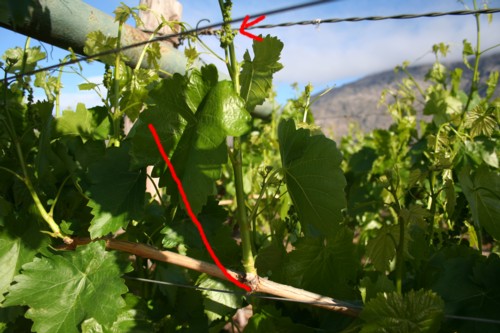
The picture above is a young vine in one of my vineyards that came loose from the training string and the wind twisted it and it broke off about halfway up the training string (where the arrow 1 is). 

The difference between this vine and Leo’s vine is that it was a strong growing grape vine, that would have reached the top wire of the trellis easily.  Now the question is; should you prune back this vine as well.

You can clearly see all the lateral shoots (arrow 2), I removed from the vine.  In other words, it is a strong vine.  If this is your situation you don’t need to prune back all the way to the ground.  Simply train a new training string from where the vine broke.  I normally consult people to look at the diameter of the vine – if it is as thick as a pencil or more, then your vine is strong enough to be trained from half way up the training string.  Or at least prune it back to where it is the diameter of a pencil.

The key is to develop a strong root system first, then go ahead and start constructing the frame work or cordon.

So Leo, in your case I would prune back the vine to 3 buds and start over again – at least this time you know what to do and not make the same mistakes as the previous growing season!

Good luck and I hope this article gave you some insight the whether you should prune back your grape vine or not.

Have a lovely weekend

Danie

www.my-grape-vine.com

If you like this tip, you would love

The Complete Grape Growing System!

Join Right NOW!


Growing Grapes: Your first year’s goal

In the northern hemisphere, it will soon be spring and your grape vine will show signs of life after the cold winter.  Hundreds of new grape growers will start a vineyard of their own, with great anticipation of having their own grapes one day.


This is great, as there is absolutely no other plant, that responds to personal care, than a grape vine; just ask those who successfully started their own vineyards the past growing season.


BUT, unfortunately, there will also be those who will miserably fail as well.  Those who think that by sticking a cutting into the soil is enough to ensure a productive grape vine – think again.  Although growing grapes is not that hard, you need to have a set of well-planned goals for the first growing season.


With this article, I want to give you some ideas of what can be done and what you should strive to achieve during the first growing season.  This will help you plan ahead and set your goals for the upcoming growing season.


Where you will plant your grape vine:

Except for choosing the correct variety, the location where you will plant your grape vines are probably the most important step into becoming a successful grape grower.  I see so many well prepared soils, great looking trellises and good looking cuttings, planted in a spot where a grape vine will for sure not become a productive plant.


Then what is the perfect site for planting a grape vine?  Let’s start by looking at the soil.  

PH:

Fortunately a grape vine can be grown on a relatively wide range of pH.  The ideal pH for growing grapes is slightly acidulous;  between 6.0 and 7.2, although you can go as low as 5,5 and as high as 7.8.


But why is the pH so important to us?


When the pH of your soil is below 5, one major negative thing happens inside the soil.  Clay particles in the soil will start to dissolve and aluminum (Al) ions will be released.  These Al-ions prevent much needed magnesium (Mg) and calcium (Ca) cations from binding to the soil and will be inaccessible to the grape vine.  In other words, what I’m trying to tell you, is to take a soil sample or two and let it be analyzed and do correctional fertilization in advance.


Soil structure and texture:

The structure of a soil is The soil structure is the relevant position of individual soil, silt and clay particles to each other and include the pores these individual particles forms as well.  Soil structure has a major influence on water and air movement, biological activity and root growth.  Grapes do best on deep, well drained soils.


The soil texture is the relative proportion of clay, silt and sand particles in the soil.  Clay particles are very small, and binds to each other, making the soil impenetrable for roots, air and water.  These very clayish soils tends to compact with irrigation, so keep in mind to ad lots of organic matter to the soil.


Choose a sunny spot for your grape vines:

Grape vines need lots of sun for it to be productive – period!  Plant your grape vine in spot where it will have direct sunlight for at least have 80% of the day.  Without enough sunlight, the buds on the grape vine will become unfruitful and will not bear any fruit.  

To give you an example; just next to my house, I have a 1.3 hectare Crimson Seedless vineyard – a beautiful vineyard with a good yield as well.  My wife has got a lovely garden and I also love trees, but right next to the vineyard, stands an old tree that over shades about 5 vines in the vineyard.  This past growing season, these vines only produced 5 bunches per vine, as to the rest of the vineyard that produces 16 to 20 bunches per vine.


Luckily there are 2000 more vines in the vineyard that can produce grapes, so I just leave the tree as it is, BUT what if you only had those 5 grape vines?  See where I’m heading?  Keep those trees away from your grape vines!


Preparing the soil and planting hole:

Now, I’m not going to go into this too much, as I’ve written an article about this some time ago, but don’t underestimate the importance of properly preparing the planting hole.  This is where your grape vine will spend the rest of it’s life.  So do take care when planting your grape vine.

Achive this during year one and you are well on your way

to becoming a great grape grower!  :-)

(yes, it is possible!)


Training your grape vine:

Now this is where so many fail.  Your goal for the first year should be to get the vine on the trellis wires as quickly as possible.  Achieving this, will ensure that you can start developing the cordon or structure of the grape vine as soon as possible.


The sooner your structure is developed, the sooner you will have a grape crop to share with your friends and family.


DO NOT ALLOW A ONE-YEAR-OLD GRAPE VINE TO PRODUCE GRAPES!

If you allow a young vine to have grapes, you will only set back the much needed growth and your grape vine will not be strong enough to start developing the structure of the vine in year two.  A one-year-old grape vine will not produce usable grapes anyway – so remove all grapes during year one.


Diseases and weeds:

The young grape vine’s biggest enemy are weeds and diseases like powdery mildew and downy mildew.  Get rid of all weeds BEFORE planting the grape vine; this will make chemical weed control much easier.  Follow a 10 day spray program to prevent diseases attacking your young vine.


Right, I hope this article guided you into the right direction. 


Remember:  Plan ahead and think of what your grape vine will look like in about 5 years from now – then make your decisions.

Danie

www.my-grape-vine.com


Let me guide you and show you exactly what to do;

From planting your grape vine to pruning it in winter!

Join the Complete Grape Growing System Right NOW.

The Grape Guy’s Birthday Celebration

Hi everyone,

Hope you are doing well.  What a great weekend this will be? 

  • On Thursday I celebrated my birthday,
  • yesterday was Friday the 13th (not so lucky for some!)
  • and today is Valentine’s day 

I just want to say thanks for reading my blog. 

For those who are members of the Complete Grape Growing System, I’ve added another bonus to your membership page.

When you log into your membership page at http://www.my-grape-vine.com/members, under the “More Bonus Info” link, you will notice that I have added a FREE e-book called “The Good Wine Guide” that you can download and enjoy.

Here is a screenshot or the page.

Hope you have a wonderful weekend my friend.

Take care

Danie

Niel and Suzana’s Grape Vines

As promised, although a bit later than anticipated, here it is:  Niel and Suzana’s grape vines.

Niel’s Grape Vine:

Niel is from New Zealand and is a member of the Complete Grape Growing System.  A few weeks ago, he send this email:

Hi Danie
Awesome book!
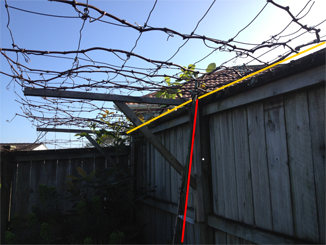
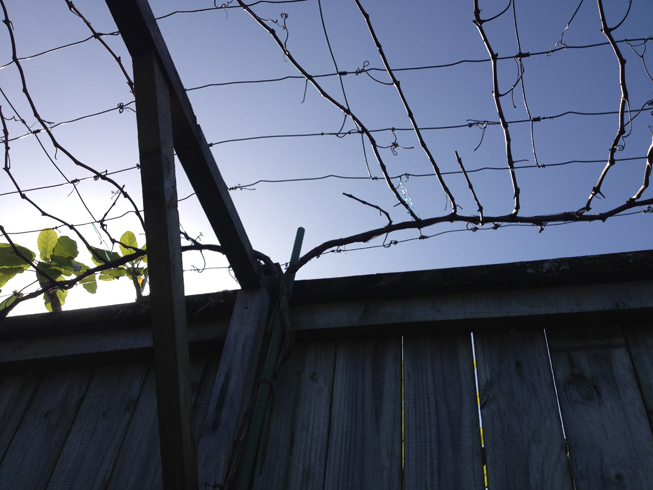
My section is very narrow so your favourite way to grow grapes , doesn’t suit my property. So I have grown on four wire structure my fence you see in the pictures run north facing so I get all day sun . I have 3 varieties planted so far, two modern varieties only 2 year from planting they are developing nicely. But the variety I’m going to show you is very old not sure what it is as I planted it from a cutting. This is now its 3 year from planting.
Questions:
1. I have this vine growing really well from the centre of the vine it extends 7mt in each direction is this too far to produce consistent bunches of grapes ?
2. Because this is a cutting, do the bunches look OK , they don’t look plentiful with grapes , because this vine is only 3 years is it still too young to produce larger bunches ?
Just need some advice to check I’m on the right track or will I need to graphed on some new varieties to plant and use current plant as root stock this winter  ?. Thanks Danie
Regards

First of all I didn’t upload all the pictures he send me, it’s great looking grape vine Niel got there, especially if you take into consideration that it is only 3 years old – well done! 

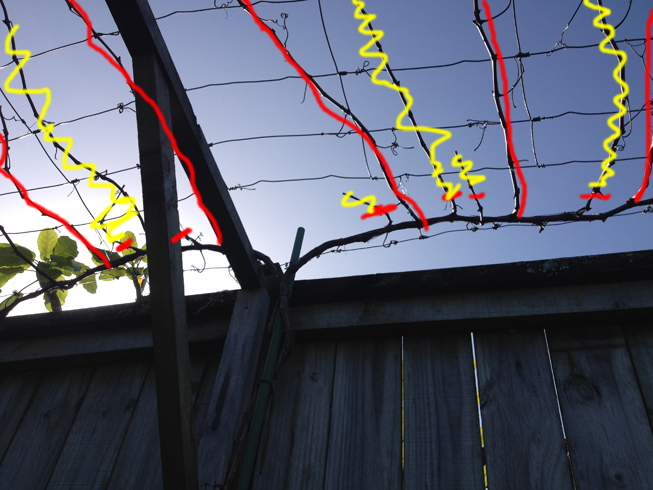
I can see how he adapted the info from the grape growing system, to suite his specific needs and to develop the framework of his grape vine.  This is the beauty of the system isn’t it?  It shows you the basics of how it’s done, that will trigger your own creativity for developing ANY grape vine, and then take you one step further into becoming a successful grape grower. 

To get to Niel’s questions:

  • 7 meters (about 23 feet) to each side is quite a long stretch I must admit.  Why?  When you start out as new grape growers, you should always keep in mind what the vine will look like in 20 years’ time.  Although I think Niel will be fine with the trellis he constructed, this is a mistake so many grape growers make; allowing too little space for a properly developed grape vine. 

Another problem with growing a grape vine, the size of what Niel is doing in his backyard, is what we grape growers call “die back”.  A grape vine always tends to produce better/more shoots at the end of the structure or cordon – in other words, in Niel’s case, from about 3 to 7 meters. 

When the vines are still young, you will most probably not see symptoms of “die back”, but as the vines grow older, and the frame work of the vine gets bigger and more woody, Niel may experience “die back” of canes and buds near the stem of the vine.

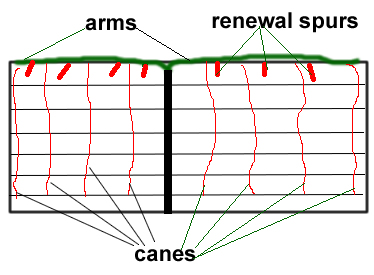
This isn’t ideal, because you should always have the option renewing a arm or cordon, in case something happen to it (cold damage, or diseases ect.).  There should be canes and renewal spurs of good quality, close to the main stem of the grape vine

My advice to Niel and if you have a similar situation, is to planting a few more vines so you can keep the structure of the vine closer to the main stem of the grape vine.

  • Will Niel’s vine produce bigger and more grapes in the future?  Well, I certainly hope so, though I can’t see any reason why not!  Remember, a three year old grape vine is still considered a young vine, so don’t allow the grape vine to produce a full crop at this age.  I know the temptation is big to have a full crop as quickly as possible, but your focus, the first couple years, should be to develop a well balanced grape vine, with a structure that can support a full crop.

Niel, thanks for sharing your pictures with us.  You’ve done a great job so far, keep it up!

Suzana’s grape vine:

Suzana if from Torrence, USA, and has been a member of My Grape Vine since who knows when?  She and her husband, together with a team of really enthusiastic grape growers are taking care of a project to reestablish a vineyard at their church.

I just love getting emails from Suzana (she even send me a Christmas card this year!).  Last week I received a call on my cellular phone from an “unknown number”.  Guess what?  On the other end of the line was Suzana!  Although the connection wasn’t that good, we managed to have a very pleasant conversation and we could share some great grape growing info – it was really a pleasure speaking to this kind lady.

OK, here’s a couple of pictures from their project and some emails she send me.  I’ll elaborate a bit more at the end of this post.

Enjoy this lovely project!!

11 Dec ’07


I’m excited to have subscribed to your Program!
 
We,  here at xxxxxxxxx Church , are approaching the time when we need to take our cuttings from Dorothy’s grapevines to have the vineyard start again on church property, after some 40 years.
 
How dormant do the vines need to be to take the cuttings?  Do I wait until all leaves have fallen?  I’ve enclosed 2 pictures taken yesterday.  Some leaves are still green, others are yellow & orange.  The vines on the top of the trellis have less leaves.  How will I know when it’s time to prune and take our cuttings?  Also, the vines are all tangled up.
 
Thank you for your guidance.
 
Suzana


Hi, Danie,
 
I wanted to share with you photos of our “nursery”.  We chose to transplant our sprouted cuttings in May from the collective pots into individual pots instead of a propagation bed, in order to make things easier at the time we plant into the ground with the modified gable trellis for support.  It’s been an ongoing effort to keep those gregarious tendrils apart…  the taller stakes are 6′ tall.
I welcome any and all comments you may have.  You are an inspiration — I’m so glad I landed on your website when I was first doing my research!
Blessings, Suzana


This is awesome results.  I’m so proud of you guys.  Anyway, planting the vines in pots is a good idea if you work on a small scale.  If you plan a bigger vineyard, go for planting bags or bare root cuttings.  Moving around 600 pots per acre is quite a job!

15 Sep ’08

Hi, Danie,

The vines are in!  Hallelujah!   The holes are 3 feet apart.  There is one common wire at the bottom of the trellis V, then 4 wires on each side spaced 8 1/2 inches apart.  We will be using your alternative method for this gable trellis to train our vines.  Only a couple of the 34 vines have not quite reached the bottom wire.

Blessings, Suzana


The vines went dormant (most of them, as it seems to have been a relatively mild winter where she live). And this is how she pruned them.

One very important thing to remember (and this is what we spoke about on the phone as well), is to not try to develop the frame work of the vine from lateral canes if they are to weak.  Rather prune the vine back to just above the wire where you want the cordon to be and develop it the next growing season.

Suzana did a great job here


Another question that came up:  “When should I prune back a young grape vine to the ground?”

I explained to Suzana, that if you successfully trained the grape vine and followed the training methods I teach closely, the chances of needing to pruning way back to the ground is almost zero.

You should be able to develop at least one shoot to reach the top cordon wire.

If your young grape vine didn’t grow well during the past growing season, and didn’t come close to the support wires, most of the times it is better to prune the young vine back to 3 buds and start over the next growing season.

I hope these pictures and emails gave you some ideas on what can be done if you follow sound grape vine training methods.

Would you also like to become as successful as Niel and Suzana?  Then join the Complete Grape Growing System Right now for just $47.95.  If you are outside the US, you can even pay in your own currency.


Thanks for reading and happy grape growing my friend.

Danie

www.my-grape-vine.com