subscribe
Who else wants to learn how to grow grapes? This grape growing blog is your free resource to growing grapes.

Archive for July 2010

How to use a refractometer when growing grapes

Hi friends,

I hope you are having a wonderful week! 

With this article, I want to reply to an email I received from Suzanna, one of the subscribers of My Grape Vine.  Suzana became a member way back in 2007 when I first started the website and blog and established a great looking vineyard.  Her question is about the use of a refractometer to determine the ripeness of grapes.

With the help of the Complete Grape Growing System, Suzana and her friends at St Mark’s Presbyterian Church will be collecting the fruit of their labor soon! 

To listen to an interview with the ladies, just click on the link below

http://www.stmarkspresby.org/archive/032509_ladiesvine.html 

Well done ladies!

Now, Suzana is thinking of buying a refractometer to help them determine the ripeness of their grapes, but she is not sure how to use this instrument.

Okay, so before I tell her how to use one, I am sure there are some readers that don’t know what a refractometer is and how it works.

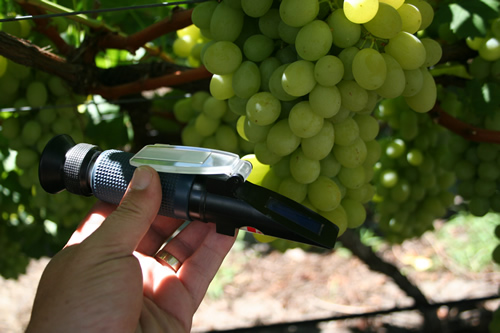
A refractometer is an instrument that measures the amount of sugar in an aqueous solution.  There are various models available on the market – from digital to the traditional analog one’s.  It works on a basis of critical angle principle where light goes through a lens and prism, projecting a shadow on a glass reticle inside the instrument.

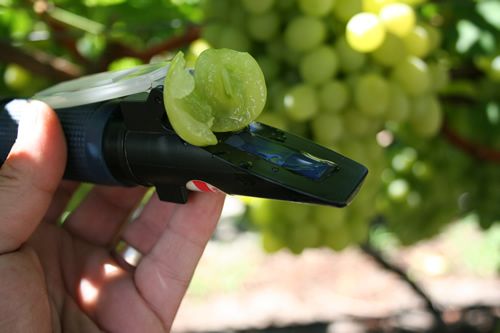
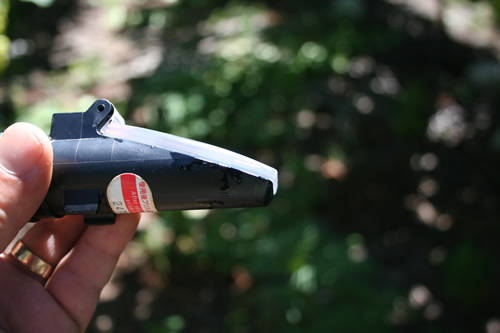
Without getting too technical – A sample of grape sap is pressed out on the prism and covered with the cover plate (the small perspex like thing on top of the refractometer). 

VERY IMPORTANT:  Ensure that there are no solids, like pips on the prism when you close the cover plate, otherwise it will break and you can throw away the refractometer.

The amount of sucrose in the sap, either reflects the light or pass it through the prism, and then shines the amount of light coming through on a scale inside refractometer. 

IMPORTANT: Because temperature plays a big role in this process, it is advisable that you get a refractometer that automatically compensate for the difference in temperature.  Although they are a bit more expensive, I really do recommend you get one of these.  For those who buy from Amazon.com, here is a link where you can order yours online -

Hand Held Refractometer with Automatic Temperature Compensation

When looking through the eye-piece you will see a white and blue (some black) area on the scale.  The line between these two areas on the scale is what the sugar contents of the sap is.

This scale is measured in Brix (°Bx)- 1 degree Brix corresponds to 1 gram of sucrose in 100 grams solution.  In the picture below, the reading is just below 17 on the scale.  This means that there are +- 17 grams of sucrose in every 100 grams of sap.  In other words; the higher the number, the more sugar there is in the sap.

Now, the question is:  At what Brix reading should I pick my grapes? 

Mostly, it depends on what you will do with your grapes.  For making wine, a reading of 22 and above is the best as this will ensure enough sugar for good fermentation and flavour.  As for eating, I would say round about 17 to 19 degrees is more than enough. 

The problem when waiting too long for the Brix reading to get higher, is that the berries become softer and loose it’s crispiness and chances of rotting becomes bigger as the sugar increase as well. 

The old trustworthy method of tasting the grapes alongside using the refractometer, will help you decide when to pick your grapes.

I hope you enjoyed this article and you will now know how to use a refractometer.

Take care and enjoy the rest of the week.

Danie

Find out why Suzana and thousands of other grape growers are successful

Join the The Complete Grape Growing System right now.

The Complete Grape Growing System is an online product.  All the grape growing info I have will be at the tips of your fingers within 5 minutes from now. 
You will not receive any physical product with your order. 

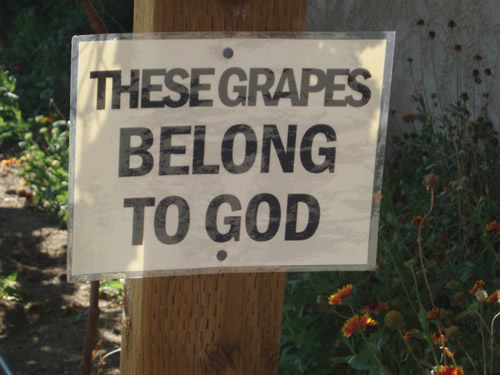
Suzana had some trouble with kids picking their grapes before they are ready.  Here is a sign she put up in her vineyard – LOL  :-)

Loved it …….

Growing Grapes In A Pot

Hi dear grape growing friends.

Hope you are having a wonderful weekend.  After the previous blog post, I received quite a few emails about planting distances and row directions, but one that often pops up is the question about growing grapes in a pot. 

As I said in an earlier blog post; to grow grapes in a pot, is not the ideal way of growing a grape vine, but I do understand that, in the city, available gardening space is limited,

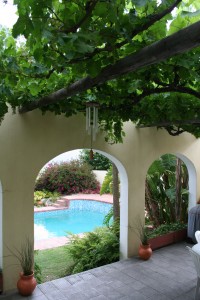
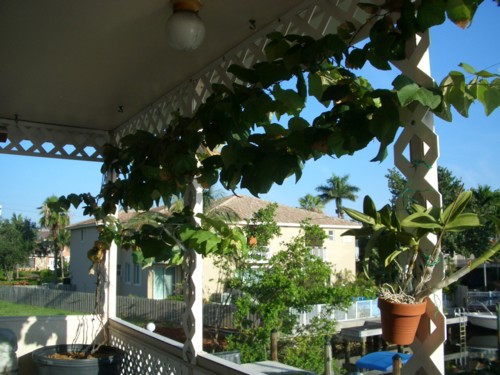
I will try to give my opinion of what to do and how to manipulate the grape vine to stay under control on a stoop or balcony, but first, here is an email and pictures from Alex.

Dear Danie:

I found your website while doing some research on grape growing.  I enjoyed your site, your newsletter and your “personal touch”.

Now for the rest of the story.  I have always enjoyed gardening and my hobby for many years was growing exotic tropical fruit trees when I lived in a house in Hialeah, Florida.  Now I live in an apartment in North Miami Beach, Florida but my love for plants has not diminished.

Last year on my way back from Europe, I bought a grape vine in upstate New York.  I never had experience with grapes and did not know if they would even grow in Florida, but I wanted to try it anyways and of course, hoping for the best.

Last July I planted it in a large pot on my balcony.  Unfortunately, I had to plant it on the North side of the property, so it doesn’t get the full sun.  It only gets some sun it in the morning and in the late afternoon.

The variety that I planted is “MARS”.  As you can see by the pictures, the vine is growing nicely and this year it has given me a small cluster. 

Last year I did no trimming at all to the vine at all, because I had no knowledge of it and that is why I started researching.  This year I will trim it, but I need your advice on what or how to do it.

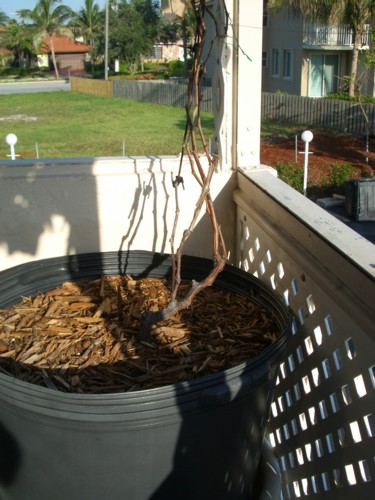
It now has three or four canes coming off the main vine right at the pot about 10 inches from the soil as you can see on the photo. 

 I plan to cut all the canes off except for the biggest one so that it can become the main stem.  Is this appropriate?

Also, I do not know if the rest of the vine should be pruned using the cane method or the bud method.  Your comments on this will be greatly appreciated.  Because of the space limitation, I plan to prune it to where it only has 3 or 4 canes growing on the wires I have placed between the uprights on the balcony.

When would be the best time of the year for me to do this trimming?  Also, since I am brand new at grapes, I do not know when to pick the grapes that are now growing on the vine.  How can I tell when they are ready to pick.  Of course, this would be for table eating and not for wine making.

Again, I want you to know that I enjoy your newsletters and emailing with you and I thank you in advance for any help and information you can give me.

Alex

Okay friends, I will start by thanking Alex for the email and the pictures.  As he rightfully said; his grape vine is doing great - there are no visible symptoms of diseases or anything out of the ordinary.


Let’s quickly have a look at the variety he chose: Mars is a black/blue seedless grape with big berries (for a seedless grape) and grows quite vigorously (as you can see from the picture).  One known problem with Mars is, it takes some time to become productive – Alex, that is why you didn’t get any grapes last year, and only one bunch this year.  However, as the variety grows older, it will produce more fruit (good news for Alex).


The grapes taste a bit assiduous, so it’s better to leave it on the vine until it has fully ripened and the berries are soft – normally about two to three weeks before Concord grapes ripen.


As for pruning:  I did some research on the variety and found that, because of it’s vigour and fruitfulness later on, it is best to prune with spurs (bud pruning as Alex called it).  Easier said than done?? :-)


Okay, let me try to explain what to do:


If it was my grape vine, I would move the vine to the middle of the balcony (luckaly it is in a pot!), right next to one of the middle pilars and split the vine to grow to both the left and the right..  Why? 


When you look at the pictures, you will notice there is quite a long distance from the one side of the balcony to the other.  The little light hanging from the roof indicates that that pilar is the middle of the balcony (right?).  If you are to make a cordon or arm from one side of the balcony to the other side, it would be quite a long cordon!  Remember, we must always try to keep the “old wood” on a grape vine as few as possible, as the sap flow to ripen canes and grapes and to feed the rest of the vine is much slower in old wood.  The longer the cordon or arm, the further is it is away from the main stem and the slower the sap flow will be.


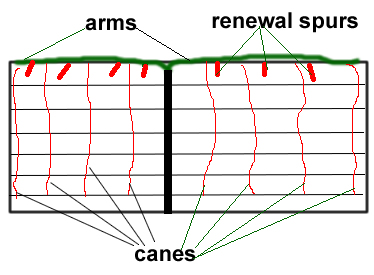
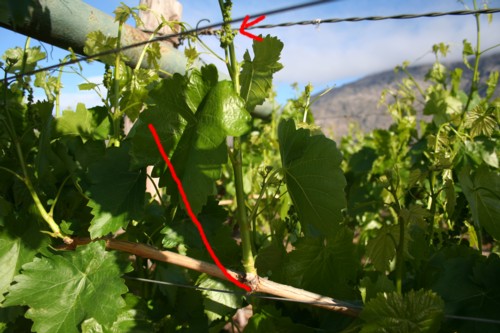
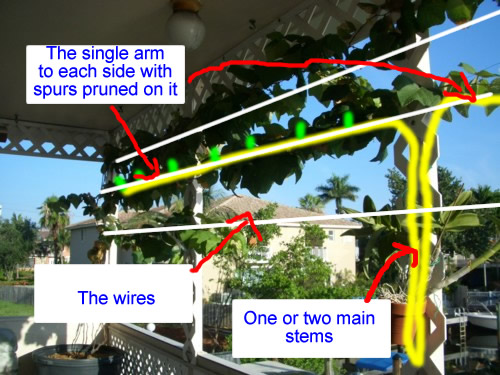
If you split the vine or in Alex’s case, use two of the existing canes to develop two arms (one to each side) on the middle wire, the distance for each arm from the main stem is only half the lenght it would have been – does this make any sence?


Because of the limited space Alex have, I would only devlop one arm to each side and prune spurs on the this arm.  These spurs will be the fruit barers and the place where new shoots develop in the future.  Remember that space is limited here and the vine will become too big for his balcony with more than one arm to each side.  If however you have a more space, you can develop more than one arm to each side.


The initial training of a cane on this wire is done in summer and then in winter (early spring), you need to prune a single cane on each of the two wires.  From these canes, shoots will develop and then in the next pruning season you can start to prune spurs from these shoots.  (For those of you who are members of the Complete Grape Growing System, refer to the pruning and training section – year 1 and 2)


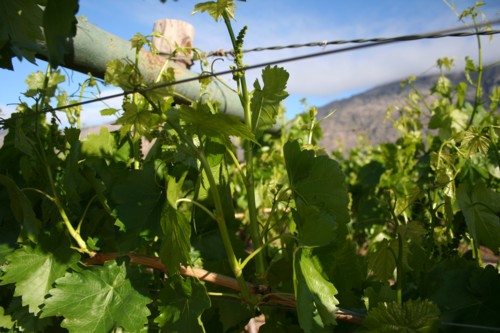
Here is a picture that will explain it in more detail.


I hope this will give you more ideas of what to do when you grow a grape vine in a pot.


Enjoy the rest of the weekend.

Danie

www.my-grape-vine.com


Want to learn how to train and prune your grape vine the correct way?

Then join the hundreds of succesful grape growers using

The Complete Grape Growing System

The Complete Grape Growing System is an online product.  All the grape growing info I have will be at the tips of your fingers within 5 minutes from now. 
You will not receive any physical product with your order. 

Planting distances and row distances for grape vines

Hi grape growing friends,

With the Soccer World Cup fever at it’s highest here in South Africa, and my farm workers on annual vacation leave, I took some time off with my family as well.  I traveled to a few places aroud our beautiful country and just enjoy all the visitors to South Africa and the great football.  I hope some the readers of my blog were here and would love to hear what your comments are – maybe break the rule, to never talk about anything else than growing grapes on this blog, and put up a post for this??  Great game by Spain yesterday!  I think it will be a cracking final on Sunday.

Anyway, now I’m back in business and back in front of my PC, bringing you some fresh grape growing info to start the second half of the year.  With that said, let’s look at planting distances and row distances for grapes.

Gardening space is normally a big problem for home grape growers, so they cramp three to four grape vines into a 10 squire feet area in their garden.  Of course this seems logical; they hope to get a bigger crop because they planted more grape vines, but unfortunately, this is where it all goes wrong!

Planting a row of grape vines or a vineyard, starts with proper planning.  Before you even buy the cuttings, asses the area where you will plant the vines and measure the length of the row you will construct.  If you plan to plant more than one row, then measure the width of the area as well.

During the first couple of years (year 1 to 3), grape vines that were planted with too little space between the vines, will most probably not show any stress or symptoms.  As the vines grow older, the rooting zone and the canopy area gets bigger and sooner or later the adjacent vines will start to grow into each other.

When this happens, the canopy of the vine will compact and prevent proper airflow and sunlight penetration into the vine.  Not only is this bad for disease control, but will also have a huge influence on the fruitfulness of the grape vine.

I’ve personally seen the effect this has on a grape vine.  One of my friends decided to plant his vineyard 1.2 (+-4 feet) between the vines x 2.8m (+- 9 feet) between the rows. At first the vineyard was doing just fine, but round about year five, the production of the vineyard dropped by almost one third and in year six, it dropped even more! 

We assessed the problem and decided that the problem was nothing else than unfruitfulness; the variety (Sugraone), he grew is genetically an unfruitful variety itself, which made the problem even worse.  He decided to removed every other grape vine in the row, changing the planting distance to 2.4m x 3m (8ft x 9ft).  The next season, the vineyard produced a normal crop and since then went on to become one of his top producing vineyards on his farm.

Now you may ask; “Then what is the best planting distances?”  To answer the question, you will have to look at how you will train and prune the grape vines; how vigorous the variety grows and if you will use tractors and implements in your vineyard.  For varieties you prune with spurs, I would recommend the absolute minimum between the vines to be 1.2m to 1.5 m (4ft to 5ft) and for cane pruned vineyards 1.8 to 2m (6 to 7 feet).   The reason why I recommend a greater planting distance for cane pruned vineyards, is because it takes up more space on the canopy wires and we usually prune vigorous growing and unfruitful varieties with canes.

As said earlier, the distance between the rows depends on the way you will cultivate the vineyard and your variety so you will need to know the width of the tractor or spray pump and add about 15 to 20 % for the movement of the implements in the rows.  If you will not be using tractors and other implements in your vineyard, the same rule as for planting distances applies to row distances.

What is most common planting distances for grapes?

I would recon it would be 8 to 9 feet between rows and 6 to 8 feet between vines giving you round about 600 to 800 vines per acre.

Here is an email I received from Judy:

Danie,
     Wow! What a wealth of information you have.. I recently moved to Carson City, Nv,from Torrance, Calif. I am at 2,800′. I have a home on a nice acre of desert soil.   I have planted 4  bare root Thompson seedless. I had potted the plants until I replanted a few weeks ago… .  I dug 4, 3′ holes and filled them with my compost, potting soil, mixed with the desert soil.. I know 3ft., holes are a bit deep, but, I figured it wouldn’t hurt..  I also planted them 4ft. apart.. It will be only one row.. I still have concord to plant.. How far away should the concord be planted.. Will they cross?  I’m 67 and  digging these holes aren’t easy, but, I figure it’s good exercise.. If you have any information that would help me in this climate.. It;s 101 today.. I eventually want to add  more Thompson and Concord. Thank You for your time,
                              Sincerely,
                              Judy

First of all, thank you Judy for the email.  You have inspired me to write this article so here is what I think you should do.

1st: 101′F is no problem for a grape vine, they will adapt to these conditions easily.

2nd:  You will plant only one row, so the distance between rows is no problem :-)

3rd:  The varieties you will grow are Concord and Thompson and both these varieties are cane pruned (long bearers).  Thompson Seedless itself, is a variety that is known for it’s vigour and unfruitfulness, so if you read what I’ve said before, I would recommend a planting distance of not closer than 6 to 7 feet. 

I know this is bad news for you, as you will have to make new planting holes, but rather do it right from the start than to have a row of grape vines that does not produce a proper crop.

Just to show you how we lay out our vineyards before we plant the posts and vines; her is a picture of one of my vineyards.  You will see the chalk lines on the ground; this is where the the canopy posts will be planted.  The planting distance I will use is 3m (between rows) x 2m (between vines).

Right, so I hope you guys have a learned something new from the article and again thanks for reading my blog and supporting the effort I put in.

Good luck to the Netherlands and Spain for the final match on Sunday!.

Cheers for now, and I will talk to you soon.

Danie

www.my-grape-vine.com

 Remember, once you planted your grape vine, it will be part of your life for many years to come;  so doing it right the first time is important!

The Complete Grape Growing System is an online product.  All the grape growing info I have will be at the tips of your fingers within 5 minutes from now. 
You will not receive any physical product with your order.