subscribe
Who else wants to learn how to grow grapes? This grape growing blog is your free resource to growing grapes.

Archive for May 2009

Magnesium (Mg) needed for growing excellent grapes

I often receive questions about why the leaves of a grape vine turn yellow long before fall.

Although there are about 20 reasons why these symptoms show on leaves, I think the most common reason for yellowish leaves on a grape vine, is Magnesium (Mg) deficiency.

Not all grape vines show symptoms of Magnesium deficiency, but it is becoming more and more evident in vineyards as we learn more about the importance of Magnesium for optimum grape quality.

What is the function of Magnesium in a grape vine?

Magnesium form part of the chlorophyll molecule.  As you can recall from school, chlorophyll is a green pigment found in most plants, hence the green colour of chlorophyll-containing tissues such as the leaves of your grape vine.

As we all know by now; the leaves (and green parts) of the grape vine is where the carbohydrates are manufactured and transported to the rest of the grape vine.  These carbohydrates are necessary for optimum growth, the immunity of the grape vine and for the proper development of the berries.

The symptoms of Magnesium deficiency:

More often, the symptoms of Magnesium deficiency is overlooked when growing black or red grapes, as white varieties show Magnesium shortages more prominent.


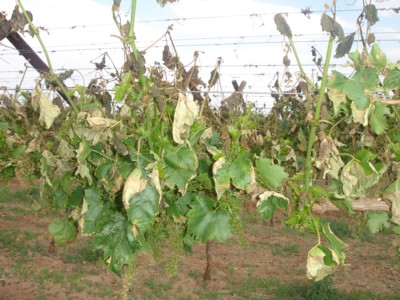
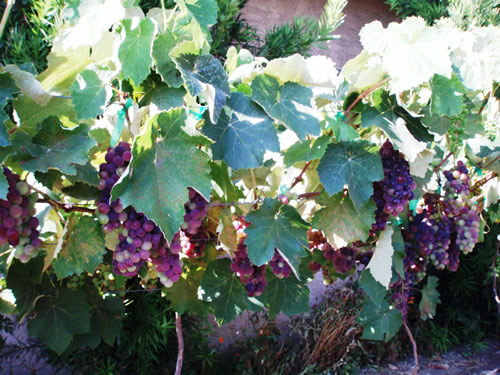
Deficiency symptoms are seen on the older basal leaves and start with leaf margin yellowing that moves inward. The leaf veins stay green the longest and the areas between become pale green and often creamy white. In red grapes, there may be a reddish colouring that develops between the veins (like the picture below).


  If you are not familliar with these terms, have a look at the picture below:


Not only does Magnesium deficiency affect the leaves and the manufacturing of carbohydrates, but it can also lead to premature fruit drop at harvest (more reason to keep a look out for the symptoms!).

How to correct Magnesium deficiency:

The most common mistake grape growers make, when they diagnose a grape vine with a Magnesium deficiency, is add tons of Magnesium to the soil or foliar.

Over the past 20 years I have been growing grapes, I have found that most of the time, it is not a shortage of Magnesium that cause the problems (symptoms), but more often it is a pH problem or Potassium (K) / Magnesium imbalance.

The problem starts when you are growing grapes on more acid soils.  Magnesium is tied up to the soil particles of acid soils and become more and more unavailable to the grape vines, the lower the pH gets.

Now, the first thing you do before planting your grape vine, is to correct (raise) the pH of these soil, right?  But most of the times, grape growers don’t take into account that by adding elements like lime and Potassium to correct the pH, it can cause even more Magnesium to become unavailable to the plants!

Soils with very high levels of Potassium (K) (many of the organic growers will have this problem), will have little available Magnesium.  Why?  Because Potassium will displace Magnesium cations (Mg ++), making less  Mg anions available to the plant.

In other words, if you have a low pH soil (below 5.5 pH), and you want to raise the pH without binding the Magnesium, you should apply dolomitic lime (high in magnesium) at the rate of two to four tons per acre – BUT before you run out to by some lime, I do recommend you let your soil be analyzed first.  Magnesium soil test values between 100-250 ppm are considered adequate for growing grapes.

If the Magnesium deficiency symptoms are picked up during the growing season (normally between flowering and veraison), a petiole analysis (leave stalk analysis) of the grape vine is the right way to determine what is going on inside the grape vine.  A foliar spray of Magnesium sulphate will temporary correct the issue.  The most common recommendations are 15.0 to 20.0 lb. of magnesium sulfate/100 gal. sprayed as a dilute spray at 200 gal./acre.


Then again; get your vineyard soil analyzed do the corrections there, as Epson salt can cause foliar and fruit damage if mixed with other products.

 I hope that this article shed some light on the subject of the importance of Magnesium when growing your grape vines.


Have an excellent day my friend!

Danie

www.my-grape-vine.com


P.S.  Did you like this tip? 

Join the more than 2000 happy grape growers by becomming a member of the Complete Grape Growing System Today!

Are My Grape Cuttings Still Alive?

Hi friends, I hope you had a wonderful week!

This is now the second post, where we take our 2009 growing season in retrospect and since we had some problems with cuttings we bought last year, I thought it would be a good idea to include this post.

This week I will try to answer a question I so often get from growers all over the world – 

“How do I know if my grape cuttings are still alive?”

In the picture below is a cutting that looks dead;  with a brown, corky bark and no signs of life.  For someone with little or no grape growing experience, this will for sure be the case, but I guarantee you that it is still alive!

How can I be sure?


Take a sharp carpet or pocket-knife and scrape the bark from the cutting to reveal the cambium (the thin layer just beneath the bark). IMPORTANT: DO NOT CUT THE CUTTING, simply scrape off the bark, otherwise you may damage the grape cutting and it will not be your grape vine one day!


From the picture below, you can see that the cambium is a dark green colour.  This is your proof that the cutting is still alive. 


If the colour of the cambium is a pale green of brown, it means that the cutting is either dying or dead already.

Okay, I hope you find this info helpful and that from now on, you will not wonder if the cuttings you are about to plant is still alive.

Take care and happy grape growing.

Danie

www.my-grape-vine.com

P.S.  Did you like this tip?  This is just the tip of the iceberg!  For a Complete Grape Growing Course, join the Complete Grape Growing System Today for only $47.95!

Training Peter’s Young Grape Vine

Hi friends,

I received quite a few emails about training a young grape vine, so I made a video for you!

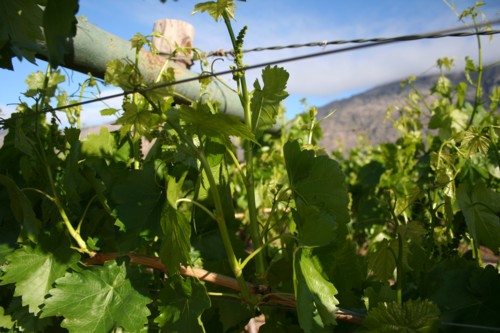
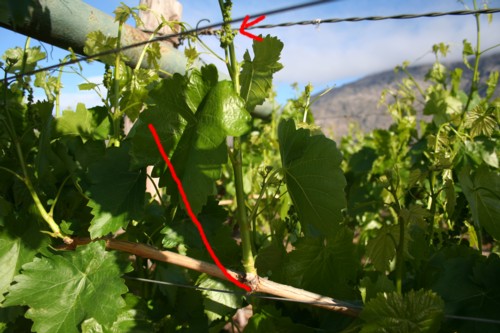
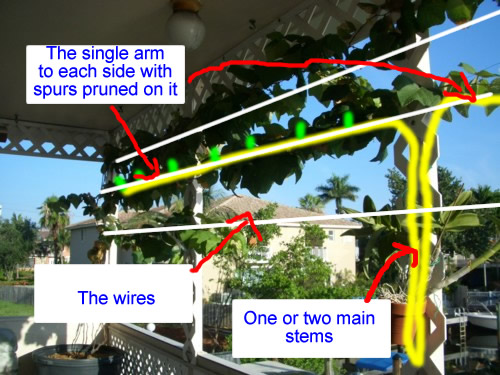
This short video, will show you how to train a young grape vine to develop the permanent structure of the vine.  Enjoy!!


On slower internet connections, this video may take a while to upload.  Please be patient..

The Complete Grape Growing System!

Join Right NOW and start the right way!


Our grape growing season in retrospect – Week 1

Hi dear grape growing friends!


It’s been a while since I updated my blog, but with our grape harvest coming to an end next week, I will have more time to spend with you; and for those who though I abandoned My Grape Vine – “NO, NEVER!

Besides the fact that it has been a year of excellent quality grapes, it’s been quite a difficult harvest time as well.  With grapes weighing much less than the previous year, the total number of cartons we packed is about 9% less than 2008 (some of my friends reported a 19% reduction in cartons).

The biggest problem this year was the sugar/acid ratio in the grapes.  The grapes struggled to reach the correct sugar content for export, some colouring problems and a few diseases that was hard to manage.  All of this made it an interesting but challenging harvest, so say the least!

Over the next couple of weeks, I will take our past growing season in retrospect and share with you some of the things I’ve learned (yes, one never stop learning in this business!).  I hope this will show you what to look out for, what to do and how to prevent it.


Managing weeds, ground covers and grass in a vineyard.


With the high rainfall in November and Desember, the weeds in our vineyards was a huge headache!  If you ever planted a young grape vine, I am sure you will agree that the biggest enemy of a young grape vine is grass and weeds.  Weed infested vineyards don’t as well as weed-free vineyards.  You need to minimize competition for water and nutrients from weeds and grass growing adjacent to your young grape vines.

When planting your grape vine in your backyard, or into an established lawn, it is recommended that you remove a square patch of sod to keep the weeds away from the roots of the vines.  This will ensure that your young vines don’t need to compete with the grass or weeds and keep the square weed free at all times.


Mulches or ground covers:


Mulches or ground covers have several advantages. In addition to suppressing weed growth, they also reduce moisture loss, helping to keep the soil evenly moist.

Decomposing mulch will improve the soil structure and put some much-needed nutrients into the soil, making it very good agricultural practice.


But using mulches also has disadvantages!


For me, the biggest disadvantage of using mulch is the cost and the fact that it pose a fire hazard during the hot, dry summers.  Depending on what type of mulch you use or where you get the mulch, it can also carry unwanted weed seeds, which will germinate and grow in the mulch itself.

In wet years or on poorly drained soils, mulches can hold excessive moisture,

forcing growth that fails to harden off in the fall and resulting in winter

injury or collar rot.

Apply a layer of mulch, at least 4 inches thick to cover all sides of the vine.  If you have a row of vines, cover the whole ridge where most of the roots are to ensure proper moisture and weed management.

When laying out the mulch, keep it away from the stem of the vine because the decomposing material can harm the stem of the vine (especially when you plant new vines); this is called collar rot as mentioned above.

Whether you will be using mulch or not, it is important to keep your vineyard weed-free, especially newly planted grape vines.


The Complete Grape Growing System!

Join Right NOW!