Spring Frost Damage On Grapes
Spring frost damage is a common problem among grape growers!
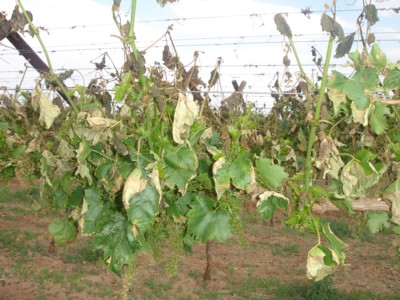 As you can see from the picture on the left, spring frost damage on grapes can cause severe damage and if you grow your grapes in colder climates, you will sooner or later have to deal with spring frost damage.
What makes spring frost damage a big problem is that preventing it, is not easy – economically and practically. Some years you will have no spring frost damage and another year you can loose all your grapes due to spring frost damage.
Even here in South Africa, where temperatures are known to be mild to hot, we sometimes face dangerous Spring temperatures and many grape growers in the lower region of where I live, have suffered crop losses because of spring frost damage.
Most grape growers from the US who grow their grapes in climates colder than zone 6, will definitely know what I’m referring to.
When will spring frost damage occur on grapes?
Generally, there are two type of spring frost. Advective and radiattion frost.
Radiation frost damage happens with clear night skies and calm airflow or wind conditions. With clear skies, radiant heat from the earth moves up into the upper layers of the atmosphere and the calm wind conditions allow the air to mix. An inversion occurs where the a layer of cold air is trapped below the layer of hot air from the dadiation.
Advective frost happens when a cold front moves into an area with gusty winds trapping the cold air on at ground leve.
Spring frost damage – what happens inside the grape vine?
I will not dig too deep into the physiology of the grape vine, but spring frost damage occurs when the water inside the plant cells of the grape vine cools down to temperatures below freezing. Ice crystals form and damage the cell membrane of the plant cells, causing the sap flow to escape from the plant cells once the temperatures increase.
Choosing your site to prevent spring frost damage:
The most important factor that will influence spring frost damage is your site location – not even planting the correct variety, or using the correct pruning methods will fully safeguard your grape vines from spring frost damage.
Cold air is heavier than hot air and will form pockets of cold air in valleys, near rivers and even alongside a tree lines. Avoid planting your grape vines on these location as far as possible; especially if spring frost damage is a problem in your area.
Planting your grape vines on a down slope, will force the cold air to move away from your grape vines, into the lower areas of the land – this could help prevent spring frost damage!.
Trellis & training systems to help prevent spring frost damage
As said earlier, cold air is heavier than hot air, so the temperature close the surface of the ground is colder than a few feet higher. Using a higher trellis system could make the difference between light and severe frost damage.
Cultivation practices to help prevent spring frost damage
Here are a few tips that might just save your grape crop from spring frost damage.
- If you grow grapes on a larger scale, it is advisable to get a frost alert system in place.
- Keep your eye on the calendar for historical frost damage dates. Knowing historical spring frost damage dates can help you plan ahead with irrigation or to cover your vines.
- Use a cover crop on your soil and keep away from bare soil cultivation. Bare soil will loose it’s latent heat much quicker than soils covered with organic material.
- Manage your irrigation correctly – drought stressed grape vines are more susceptible to spring frost damage
- Prune as late as possible. Pruning later will prevent the basilar buds from opening too soon.
- Use cane pruning method.
What to do after spring frost damage occured:
Come to terms with your losses – you will have a lighter crop but not necessarily no crop!
Do not cut off the damaged parts too soon. A grape vine has a composite bud, meaning there are 3 buds within what looks like a singe bud. Chances that the secondary and tertiary buds will open after spring frost damage is good. These buds can produce grapes as well, although not as many as the primary bud.
If only sections of the shoots are damaged, new growing points will appear from buds situated near the base of the shoot.
All I can say; loosing your grapes to spring frost damage can happen within a few hours. Keep a watchful eye on the weather channel and try identify climate conditions that may lead to spring frost damage.
Good luck my friend and hopefully your grape vine will have a better chance to survive the next spring frost!
Danie – The Grape Guy
www.my-grape-vine.com
Get The Complete Grape Growing System Today For Only $29!