subscribe
Who else wants to learn how to grow grapes? This grape growing blog is your free resource to growing grapes.

Archive for December 2006

Help! My Grape vine is under attack!

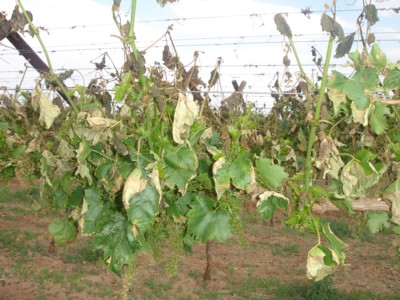
The past few 5 weeks, I have answered almost 450 emails! And most of them were about training the grape vine, pruning the grape vine, what varieties to use and many more. But let me tell you of some the real attack you must be looking out for!

How can you, the home grape grower, put a suit of armor on your grape vine? Just like any other living thing, your grape vine needs protection from outside attacks and you will have to ensure that they are ready. Obliging actions can save your vine from these attacks, which can ruin your grape harvest in a matter of days.

You dare not ignore these five enemies, because the grape vine is their main target and oh boy, are they well trained sharpshooters.

1. Frost / cold damage:

For you to understand the dangers of frost and cold damage, you need to know that you probably will not loose your whole crop, but you will endure losses. The reason I say this, is that there are three growing points inside a grape vine’s node (primary-, secondary- and tertiary buds). The primary node is the normally the grape carrier and shoots first when the growing season starts. If frost damage or kill this shoot, the secondary and tertiary buds will sprout. They also can produce grapes, but normally not as much and not as high quality as the grapes produced by the primary bud.

Without digging to deep into the development of frost and factors that cause the air temperature to drop below frosting point, a rule of thumb is, that if it is a wind free, clear sky, and dry evening and the temperature drops below 2.2°C (36°F), there is a chance of cold damage to the vine. The lower the dew point, the higher the risk

There are a few things a home grape grower can do to lower the risk of cold damage.

Sprinkle irrigation can be turned of when the temperature decrease below freezing point 0°C (32°F), the temperature of the water will rise to freezing point and freeze or ice. The freezing process will generate some heat that will raise the temperature of the atmosphere (heat of fusion).
Choose a late variety to plant where frost is a problem, this will ensure that bud break is later, lowering the risk of damage.

Choose the warmest, sunniest spot in your garden, to plant your grape vine.

Prune as late as possible (near bud break), and cane prune at first and later on, after the dangers of frost is gone prune your short bearers where you want them. Refer to the “Complete Grape Growers Guide” how to cane and short prune.

Sandy soils are more hazardous, because they store less water and therefore some sort of ground cover will lower the risk of frost damage.

2. Birds and Animals:

You have probably know that birds and other animals love your grapes. Allowing them to have a feast in your vineyard, will result in total crop loss. You as a gardener, loves nature, and killing these animals will not do any good.

What you need to do is to prevent them from getting to your vine. Easier said than done, but there are a few things you can do.

Cover the bunches with netting will prevent birds from reaching your grapes.
There are safe, commercial sprays you can spray on your plants, that will prevent animals from eating them.

Buy these products online at Garden Alive, or you can enquire at your local nursery about these items.


3. Rain:

Rain during, or close to harvesting your grapes will have a serious effect on the quality of your grapes. Certain varieties are more susceptible to rain damage than others. Varieties like Flame Seedless and Thompson Seedless are very susceptible to rain damage and should be avoided if summer rain often occur. Refer to the page where you downloaded “The Complete Grape Growers Guide” for a list of varieties you can plant that is not so susceptible to rain damage.

There’s not much you can do to stop rain, is there? But you can dust your vine with a copper sulphar dust to prevent the spread of fungus and to try out the cracks on berries, caused by the rain. Remove cracked berries by hand if you have the time, this will ensure that botrytis will not spread to nearby healthy berries – this is a rime consuming job, but well worth a try.

4. Phylloxera:

The cancer of the grape vine! Never underestimate the danger of this disease. If you plant a Vitis Vinifera variety, DO NOT use cuttings.

Phylloxera is a pest of commercial grapevines worldwide, originally native to eastern North America. These tiny, pale yellow sap-sucking insects, related to aphids, attack the roots of grape vines. The insects and secondary fungal infections can girdle roots, gradually cutting off the flow of nutrients and water to the vine and eventually kill the vine.

In the early 1800, Phylloxera destroyed almost the whole wine industry of Europe and more than 60% of the vines were killed!

Be on the lookout for symptoms of Phylloxera as this desease can kill your vine in no time at all.

5. Too dense vines

Ok, so you might say this is no attack on the vine! Fair enough, but a too dense vine will make your vine a sitting duck. A too tense vine is more susceptible to diseases like downy mildew, powdery mildew, botrytis (grey rot) and many other diseases.

Controlling the growth of your vine is sometime not that easy as a vigorous variety like Sultana on a fertile soil, will grow like mad without any fertilizer. The use of a less vigorous rootstock will help prevent the vine from growing to strong.

Always remember that a dense vine looks lovely, until the first rain!

Preventing these attack is better than trying to cure them and it will save you lots of time, money and frustration. The Complete Grape Growers Guide, helps you to put a suite of armor on your vine.

Have a grape (great) day.

Danie
“The Grape Guy”

PS: Remember that the X-Mas special on “The Complete Grape Growers Guide” ends soon! Don’t miss out on this one!

What to look for when buying a grape vine from your nursery

The are basically two “types” of grape vines you can buy from you nursery and they are grafted and non-grafted vines. The grafted vines has a rootstock from another variety and there are a few reason why breeders do that.

There are a few Vitus Riparia and Vitus Labruska cultivars (with really ugly grapes, if any grapes at all!) that is more resistant to nematodes and phylloxera than some of the cultivars used in the wine and table grape industry. Breeders use these cultivars as rootstock for the non-resitant cultivars, in order to get a more resistant vine.

Sometimes, when a variety is a weak grower, and the grape grower needs a more vigorous growing grape vine for some reason, the breeders then use a more vigorous growing rootstock. Never use a vigorous rootstock on highly fertile soils, but instead use these rootstock varieties on dry-land vines or in very dry conditions.

Many of these rootstock varieties are more resistant to certain soil abnormalities like low pH, very wet conditions or even limestone abnormalities. Make sure you know what is going on inside you soil, before deciding on a rootstock.

I personally never plant a non-grafted vine, because of the danger of phylloxera.

The non-grafted vine is a normal cutting made from a mature vine and and then rooted and planted out. This method is mostly used by the home grape grower as making a scion needs special skills.

In case you are going to buy a grafted vine from your nursery, there are a few things you should look at:

  1. Make sure the graft union has healed properly and that there are no openings between the rootstock and the carrier.
  2. Make sure the union is strong by slightly bending the grafted vine – don’t over bend it, it will break. If the union didn’t attach well, it will brake easily.
  3. The rootstock must have well developed, strong roots, with no signs of defects.
  4. Take a look at the bark of vine, it should be undamaged with a dark brown color – not black as this can be an indication of some fungus spores (from the previous year)
  5. The canes of your vine should have grown at least 8 inches the previous year and preferable there should be more than on cane.
  6. No visible roots should come from the graft union – if there are roots, remember to remove them before planting, otherwise your vine loose its resistance to diseases inside your soil.

Happy grape growing my friends.

The “Complete Grape Growers Guide” explain in detail, the whole process of how to make and root a cutting.

Danie

“The Grape Guy”

Photosynthesis – Why your grape vine needs enough sunlight

You probably know what photosynthesis is, but do you know what really happens inside the grape vine during photosynthesis and why it is so important to expose your vine to enough sunlight?

Photosynthesis is one of the most important physiological processes that take place inside the vine. During photosynthesis, the energy for the salvation of the grape vine is created. This is quite a complex process where sunlight energy, absorbed by the chloroplast inside the mesophyl cells of the vine, is assimilated into CO2 and carbohydrates (mainly sucrose). Water is needed for this whole process to activate and stay active. The following formula explains photosynthesis:

CO2 + 2n H20 + sunlight energy –> chloroplast –> (CH2O)n + O2 + n H2O

All of these carbohydrates are then transferred to the endodermic cells of the vine and transported to the all the growing parts (growing points of shoots and roots), to the reproductive parts (buds and clusters) and some stored in the stems of the vine.

Which factors influence photosynthesis?

1. Environmental factors:

Light intensity: Maximum photosynthesis in a grape vine, takes place when the sunlight intensity is around 25 000 to 30 000 lux. When the canopy of the grape vine is too dense, the sunlight cannot penetrate the canopy enough for photosynthesis to take place. That is why we find yellow leaves inside these kinds of canopies. Photosynthesis can take place from reflected sunlight as well, but the intensity of this light is normally not high enough for optimum photosynthesis. Having a to dense or compact grape vine canopy will reduce the productivity of the vine, because of reasons mentioned above. Canopy control is therefore of utmost importance when growing your grape vine. There are several ways to control canopy growth, like topping of the shoots, removing water shoots, removing (suckering of unnecessary shoots) and the spacing of short bearers. The summer treatments of a grape vine are explained in depth in “The Complete Grape Growers Guide”.

Temperature: Normal photosynthesis takes place between 0 and 60*C (32 * F and 140 * F). The optimum temperature for photosynthesis is between 25 – 28 *C (77 – 82.5*F). During tests in a lab, with controlled environmental conditions, it was found that when the temperature decrease below 20 *C (68 *F) and above 30 * C (86 *F), the rate of photosynthesis drops dramatically. Outside, in nature, many factors influence photosynthesis, and it was found that optimal photosynthesis can take place at an optimum level of 16 *C, if the other factors are in favor of photosynthesis.

Moisture: A grape leaf must have at least 75 % to 85 % moisture to be biochemical active. In the formula of photosynthesis, you will notice that water is needed for the whole process to take place, in other words, the optimal soil moisture, where the grape vine grows, is very important for photosynthesis to take place. The humidity of the atmosphere around the vine influence the effects the rate of photosynthesis – a higher humidity at the same light intensity has a higher rate of photosynthesis.

CO2- and O2 concentration:
Normal CO2 concentration in the atmosphere is around 300 ppm. The rate at which photosynthesis takes place, increase as the CO2 concentration increases up to a point when it reaches 500 ppm, where it slows down and stops at a rate of +- 1000 ppm. Just as the opposite happens when the concentration of O2 (oxygen) increases above 21 %.

2. Internal factors:

The leaf of a grape vine starts to photosynthesize at a very early stage (when it is the size of a matchbox), but only until it is two-thirds of the size of a mature leaf, it is self-supporting. Now you may ask, how does a young grape vine grows with leaves that are self-supporting are non self-supporting? The secret lies in the energy that was stored inside the roots, and stems during the previous growing season. Therefore you MUST make sure that the leaves of the young grape vine reaches at least two-thirds of its mature size as quickly as possible, before the stored energy inside the vine are replenished. Using certain training methods explained in the Complete Grape Growers Guide, this stage of maturity of the leaf would be reached very early.

The need for photosynthetic products increase as the size of your crop increase, therefore you need to control the size of your crop according to the growth of your vine. A young vine with a small canopy and a large crop will not be able to produce enough carbohydrates to ripen or mature the harvest.

3. Genetic factors:

Different varieties react different to the exposure of sunlight from others; therefore, different varieties have different levels of photosynthesis than others. The opening and closing of the stomas of different grape vine cultivars are not the same, and this will influence how much moisture is available for photosynthesis – less moisture, less photosynthesis!

4. Cultivation practices:

As mentioned before; the more leaves exposed to direct sunlight, the better the photosynthesis will and therefore we need to design our trellis system in such a way. Row direction, summer treatments, pruning, planting distances and the irrigation or the vine will all play an important role in photosynthesis.

If we go through this whole process of photosynthesis, there is one thing that stands out – do not let your vine grow out of hand. A too dense vine is an unhappy vine and it will for sure not produce the grapes it should have.

For more information on how to increase the productivity and level of photosynthesis of your grape vine, go visit My-Grape-Vine.

Danie
“The Grape Guy”

The effect Gibberellins (Gib) have on a Sultana berry

On 29 November I shared with you the methods I use to cultivate top Sultana Grapes.

Here is a picture to show the effect Gibberellins (Gib) has a Sultana Berry!

Numbers in above picture:

  1. shows you how the gib has stretched the berries – see that little dimple at the bottom of the berry? – they are gonna be huge berries in a few week! Without gib treatment, Sultana has a normal round berry, not big in size and very condensed bunches.
  2. look how the gib thinned out the bunches to make place for a bigger berry size – in a few weeks, these “gaps” will be filled and you will have a 700 gram bunch with berries of +-21 to 23 mm!

This picture was send by one of My-Grape-Vine friends – he has a lovely Sultana vine, but what I need you to look at, is the difference in berry shape and how compact these bunches are.

With bunches like this, you will probably have a reasonable crop, but you will never have that berry size that will let your neighbor say: WOW! Where did you buy that!

Secondly, controlling diseases in these condensed bunches is almost impossible – you will have a problem if your grapes get some disease.


Have a grape (great) day!

Danie

“The Grape Guy”

Get the Complete Grape Growers Guide and I will give you step by step instructions on how to train and grow your Sultana vine. Your vine will “crank” out bunches of grapes like you have never seen before!!

Downy Mildew – experiment

Hello everyone,

I did an experiment yesterday to show you how devastating downy mildew can be.
Look at these pictures:
Picture taken 19h30 yesterday
Here you can see an “oily” yellow patch on the top side of the leaf. This is the first signs of downy mildew.
Bottom of the leaf – if you look close enough you will see some white hairy fungus growth
I took the leaf and put it in a wet plastic bag, inflated the bag with hot hear and sealed it with a zip tie. This is the perfect conditions for downy mildew to develop – hot, humid conditions
I took the following pictures exactly 12 hours later:
Nevermind the withering of the leaf, although it’s obvious where it started, but take a look at all the fungus growth in just 12 hours! This disease can destroy your grape vine in 48 hours. Be on the look out for those oily yellow patches on the top side op the leaves – if you find them, be warned and take immediate action. Normally a contact/systematic pesticide will do the job, but prevention is better than cure – spray your vine upfront

Have a great, downy milew-free day :-)

I would like to hear what you have to say about downy mildew … leave a comment.

Danie

“The Grape Guy”