
Niel and Suzana’s Grape Vines
As promised, although a bit later than anticipated, here it is: Niel and Suzana’s grape vines.
Niel’s Grape Vine:
Niel is from New Zealand and is a member of the Complete Grape Growing System. A few weeks ago, he send this email:
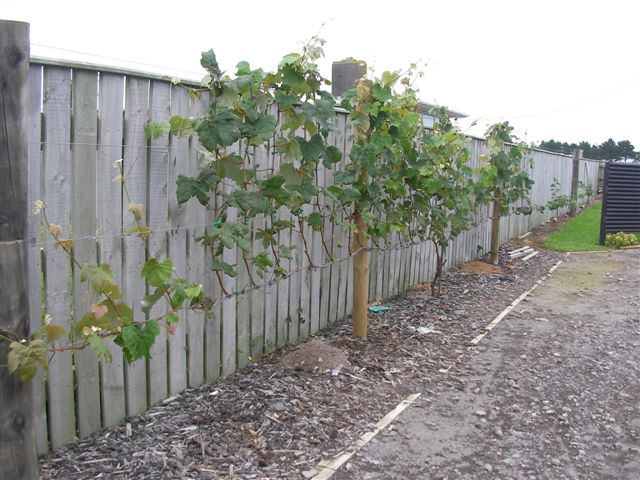
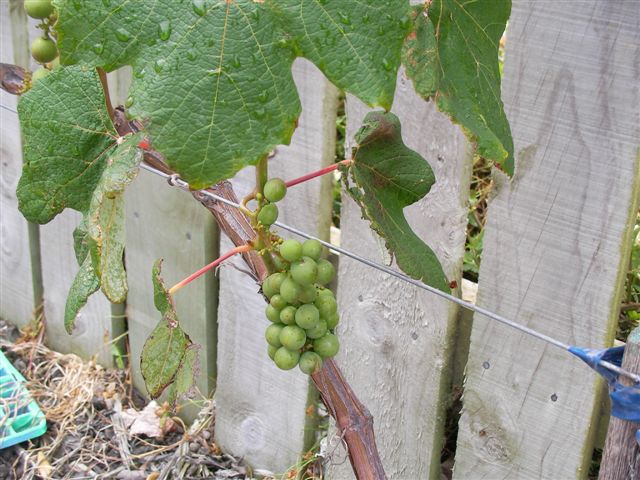
First of all I didn’t upload all the pictures he send me, it’s great looking grape vine Niel got there, especially if you take into consideration that it is only 3 years old – well done!
I can see how he adapted the info from the grape growing system, to suite his specific needs and to develop the framework of his grape vine. This is the beauty of the system isn’t it? It shows you the basics of how it’s done, that will trigger your own creativity for developing ANY grape vine, and then take you one step further into becoming a successful grape grower.
To get to Niel’s questions:
- 7 meters (about 23 feet) to each side is quite a long stretch I must admit. Why? When you start out as new grape growers, you should always keep in mind what the vine will look like in 20 years’ time. Although I think Niel will be fine with the trellis he constructed, this is a mistake so many grape growers make; allowing too little space for a properly developed grape vine.
Another problem with growing a grape vine, the size of what Niel is doing in his backyard, is what we grape growers call “die back”. A grape vine always tends to produce better/more shoots at the end of the structure or cordon – in other words, in Niel’s case, from about 3 to 7 meters.
When the vines are still young, you will most probably not see symptoms of “die back”, but as the vines grow older, and the frame work of the vine gets bigger and more woody, Niel may experience “die back” of canes and buds near the stem of the vine.
This isn’t ideal, because you should always have the option renewing a arm or cordon, in case something happen to it (cold damage, or diseases ect.). There should be canes and renewal spurs of good quality, close to the main stem of the grape vine
My advice to Niel and if you have a similar situation, is to planting a few more vines so you can keep the structure of the vine closer to the main stem of the grape vine.
- Will Niel’s vine produce bigger and more grapes in the future? Well, I certainly hope so, though I can’t see any reason why not! Remember, a three year old grape vine is still considered a young vine, so don’t allow the grape vine to produce a full crop at this age. I know the temptation is big to have a full crop as quickly as possible, but your focus, the first couple years, should be to develop a well balanced grape vine, with a structure that can support a full crop.
Niel, thanks for sharing your pictures with us. You’ve done a great job so far, keep it up!
Suzana’s grape vine:
Suzana if from Torrence, USA, and has been a member of My Grape Vine since who knows when? She and her husband, together with a team of really enthusiastic grape growers are taking care of a project to reestablish a vineyard at their church.
I just love getting emails from Suzana (she even send me a Christmas card this year!). Last week I received a call on my cellular phone from an “unknown number”. Guess what? On the other end of the line was Suzana! Although the connection wasn’t that good, we managed to have a very pleasant conversation and we could share some great grape growing info – it was really a pleasure speaking to this kind lady.
OK, here’s a couple of pictures from their project and some emails she send me. I’ll elaborate a bit more at the end of this post.
Enjoy this lovely project!!
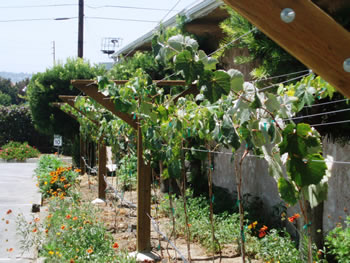
This is awesome results. I’m so proud of you guys. Anyway, planting the vines in pots is a good idea if you work on a small scale. If you plan a bigger vineyard, go for planting bags or bare root cuttings. Moving around 600 pots per acre is quite a job!
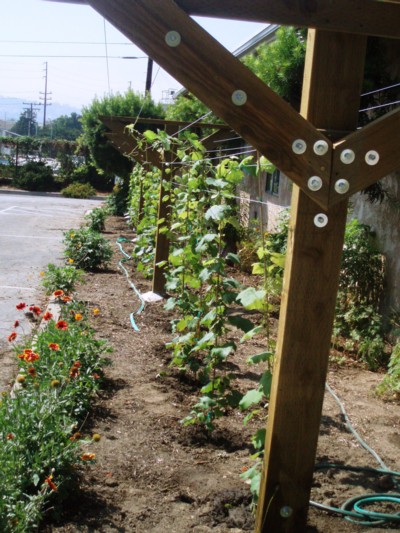
15 Sep ’08
Hi, Danie,
Blessings, Suzana
The vines went dormant (most of them, as it seems to have been a relatively mild winter where she live). And this is how she pruned them.
One very important thing to remember (and this is what we spoke about on the phone as well), is to not try to develop the frame work of the vine from lateral canes if they are to weak. Rather prune the vine back to just above the wire where you want the cordon to be and develop it the next growing season.
Suzana did a great job here
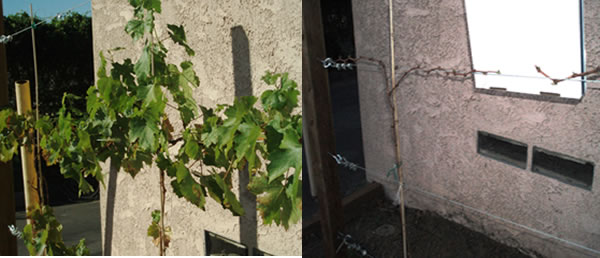
Another question that came up: “When should I prune back a young grape vine to the ground?”
I explained to Suzana, that if you successfully trained the grape vine and followed the training methods I teach closely, the chances of needing to pruning way back to the ground is almost zero.
You should be able to develop at least one shoot to reach the top cordon wire.
If your young grape vine didn’t grow well during the past growing season, and didn’t come close to the support wires, most of the times it is better to prune the young vine back to 3 buds and start over the next growing season.
I hope these pictures and emails gave you some ideas on what can be done if you follow sound grape vine training methods.
Would you also like to become as successful as Niel and Suzana? Then join the Complete Grape Growing System Right now for just $29. If you are outside the US, you can even pay in your own currency.

Thanks for reading and happy grape growing my friend.
Danie
Tagged with: how to grow grapes
Filed under: growing grapes • how to grow grapes
Like this post? Subscribe to my RSS feed and get loads more!

Hi Danie,
I would like to ask some information regarding grape growing. I like to start farm business in the Philippines and i want to grow grapes do you think it will grow in the philippines? we have rainy and summer climate. I appreciate very much any iny information you can give me.
Regards,
Guillermo Alciso
Guillermo, growing grapes commercially in the tropics pose some risk, believe me. The main concern is the fact that disease control is much harder, because of the high humidity and rainfall. Grapes don’t like rain!
Another problem: dormancy! You grape vines will not go fully dormant, and you will need to force dormancy so the vine can go into “rest” and build up energy for the upcomming harvest.
Hi Danie,
Very nice examples with lessons have impressed me a lot. Regarding high distance, we must consider the breaking of apical dominance, as well as, the distances from the root system since, translocation of photosynthetic products possess inverse relation with the lateral distances. For that reason, the question of die back arises towards the peripharial zones. So, I recommend optimum plant to plant distance should be considered with lateral spreading of roots i.e., root zone sized canopy will be most productive.
Regards,
Mohammed
Thanks Mohammed,
Good advice; proof of what I said is true – thanks again.
Danie
Suzana,
Do you have plans for your trellis? Thank you.
Hi Alan,
The plans for the trellis Suzana use, is from the Grape Growing System. It is the same trellis I use on my farm.
Danie
They are nicely planted through a fence. Amazing! Really a great job and hard work.
I have three experimental table grapes which I introduce in the garden a couple of years. I have encountered a disease called ” black rot” or fungus. Since I garden I have never heard of words fungus. I search the internet and have found Danie’s website and luckily I am here a part of the vine. Once, I do it right and succeed I will surely show you some beautiful pictures.
I lived just about five miles from the Chesapeake bay and were sorrounded by water, the bay and the Potomac river. The land are fertile and can grow as many veggies during the spring through fall.As usual, here in the East Coast we have extreme weather fluctuation sometime realy hot and humid.
If everything succeed I will introduce wine grapes such as cabernet of chardonny. Just dream about that it will be nice to experiment.
Have a nice day.
Regards,
Grace
Hi Grace, I’m looking forward to your success story and pictures. Keep us updated
That looks great Suzana!
I just planted 12 Muscadine (Vitis Rotundiflora) hybrid grape vines 16 feet apart in the rows and 12 feet apart between rows. The rows run north-south.
Muscadine vines grow wild on my place in northwestern South Carolina, USA. We are 10-15 miles from the Blue Ridge Mtns. USDA zone 7A. The wild vines grow 100 feet up on oaks and pines in the woods. I estimate the vines are 70-80 years old.
Anyway, the land where my new Hybrid Muscadines are is on a west sloping hill that gives lots of hot sun expusure and bakes out plants in the late summer. Muscadine leaves like the sun, but the heavy clay soil gets too warm for the roots in my opinion. Also, in the winter the grape vines get warmed up by the west Sun, and then after sunset the temperatures drop quickly to below freezing. This makes sunscald. The lowest temperatures we have is 5 deg F to 0 deg F., but usally 20 deg F to 15deg F. This is a harsh summer and winter macro climate situation on that part of the hill.
The recommended way to plant Muscadines is to plant them 20 feet apart in rows and the rows 10 feet apart, on a single wire 5.5 feet high.
To shade the grape roots, however, I want to install a 5.5 foot high T bar trellis system (similar to Suszana) but with 2 wires on the T spaced 6 feet apart. This 6 foot spacing should keep the two cordons apart enough so that the vines will not interfere with each other when they get rampant growth in warm, rainy summer weather. The soil should be cooler, but not as cool as Danie’s beautiful canopy system. Experts say the hot wet soil incourages fungus and spores.
My Question is this: Has anyone had good experiences with Muscadines on a 6 foot wide T bar Trellis system??????? I would like to hear about your experiences.
I also want to plant some Mars and Sunmaster (Concord type) grapes on a different and ideal north sloping hill, using a T bar system or Danie’s beautiful canopy system. I hope to hear from You.
I hope that none of you in Austrailia were in the fire zone areas!!! I hope to hear from you, and we are praying.
Fritz,
Inman, SC
Hi Fritz,
May I ask where you got the Muscadine info from. Those planting distances seems a bit too much! LOL
Hello Danie,
Thanks for your interest and reply. I just noticed a reply from you. Sorry for the delay. Danie, I pray that you and your family & workers are well in your beautiful valley.
Danie, the agricultural extension agents for N Carolina, S Carolina and Georgia & Isons (www.isons.com) recomend the 20 foot spacing between vines in the row on a single wire 5.5 feet high. This allows each vine to grow 10 feet in each direction. A second lower wire has been used also, but it does not pay, according to testing. I have seen pictures of Muscadine wires that looked like they had a top wire about 7 feet high and another at about 4 feet high. Each cordon canopy on a wire creates a bush about 3 feet wide and 2 feet high, or more. I have seen pictures of the top vine branches touching the ground during a wet season. That is not like a Mediteranian vinyard. We have a warm, humid summer climate here and the Muscadines are what God created for this forest region. They resist fungus and Pierces disease, partly by having more reserverol in the plant. Other grapes do not live long here. Many plants from China Japan and Korea grow well here. The red soil here has very fine flakes of mica (eisenglas) in it similar to where I was stationed in Korea south of Seoul (1970-71).
We had a late hard freeze in early March that apparently killed more than half of the grapes I planted in January. I may plant 2 more short (50-75 ft ??) grape rows up the hill on an old terrace this fall, and replant the lower grapes that died. The difference in elevaton is about 5-12 feet.
I will use a single or double wire system with the vines that I planted this early year and an over head system on the more level terrace late fall. As I see it the overhead cordons would need to be about 5-7 feet apart or +/- 2 meters to avoid intertwineing of cordon growth. Pruning and picking needs to be efficient.
I am sending you a large envelope with some pictures and info.
sincerely,
Fritz Quebe
Hi,
Concern, this is the third summer we are having with our small vineyard, 60 plants, I read, I listened to others, even to my
husband, some of our plants were aready 3 years old when we put them in the ground, some only one year.
So, on a sunny day in january, i went out to trim the vines, so,
I cut the vines way back, I left 3 to five which ever seemed to be strongest limbs, but now I cut these to about maybe 4 to 10 inches from the first climbing run, we have it set up as to have 4 lines to run up and then spread out and train the vines as they grow.
now, I hope i have not done the wrong, i will not cut them back next year, hope to have trained and then only trim out the week vines and leave 15 nodes on the trained ones.
? Have I done the right thing or have i knocked us back a year of
grapes yealds
Thanks for your imfor
please reply, I could send out some pics
Robin,
If I understand you correctly; you pruned back the weaker vines to just above the ground? Well, that is exactly what you should have done IF YOUR VINES DIDN’T GROW THAT WELL.
So Robin, I think you made the right choice and hopefully your vines will cover the trellis this summer.
Good luck
Danie