
Japanese Beetles On Grapes
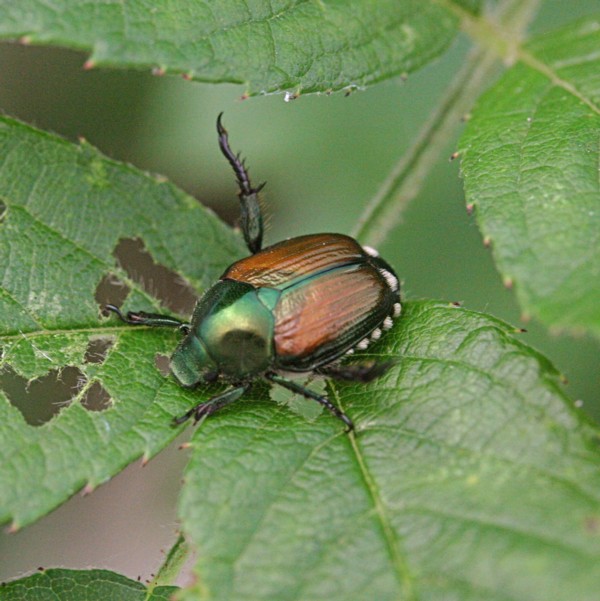
Adult Japanese Beetle
The Japanese beetle (Popillia japonica, also known as the jitterbug) is one of the most visible and most destructive feeders of grape vine foliage out there.
The Japanese beetle attacks most green parts of the grape vine, but mostly feeds on young leaves in the upper part of the canopy. Occasionally, they will feed on fruit also, making it unusable for export or table grapes.
When Japanese beetles feed on the leaves of the grape vine, they will eat the foliage surface material between the veins, leaving only the veins in place, which will look like they were skeletonized. Although mature, vigorous growing grape vines can tolerate quite a bit of defoliation, this insect can cause some serious damage to a grape crop.
The life cycle of the Japanese beetle:
Japanese beetles overwinter as larvae in the soil. They will feed on the roots of grass and other plant material. Adult beetles will become visible in late spring and may be present in vineyards until mid in summer. The adult Japanese beetle (as seen in the picture), has a distinctive, shiny green body and head, with copper-coloured wings. The sides and back of the body is covered with small white hair. The female Japanese beetle is bigger than the male and is approximately ½ inch long.
After mating, the female Japanese beetle will temporarily leave the grape vine, to lay up to sixty eggs in the soil of your vineyard or if you have a backyard vineyard, in your lawn. In midsummer, the eggs will hatch and will reveal small, white grubs or larva, where they will feed and hide up to 8 inches deep into the soil, to wait out the cold of winter.
Japanese beetle control:
Strange enough, in Japan, where the Japanese beetle originally comes from, this insect is not a big problem! Why? The answer is; natural enemies that feed on the grubs.
For the organic grape grower, you can control Japanese beetle by putting out traps with a pheromone that attracts the female and a floral lure, that will attract the male. The disadvantage of using these traps are that you can lure more Japanese beetles to your vineyard, as they can fly quite long distances in a short amount of time.
A program with physical and biological control of the grabs is a more effective method of controlling Japanese beetle. The two nematodes that are most effective against Japanese beetle grubs are Steinernema glaseri and Heterorhabditis bacteriophora. Both these nematodes are commercially available.
Milky Spore (Bacillus popilliae), a naturally occurring host specific bacterium, will also attack the destructive white grubs.
Important: If you are to use chemicals to treat Japanese beetle, then spot treatments with botanical insecticides is advisable. Unfortunately, these chemicals also kill the biological nematodes that help control Japanese beetle. In other words; keep chemical treatments to the minimum. Products like Carbaryl, Malathion, Methoxychlor, Rotenone can be used on adults and Merit (turf), Marathon, Bendiocarb can be used to control grubs. Make sure these products are registered in your country or state before you use them and PLEASE, read the labels of the products BEFORE you use them.
Tagged with: grape diseases • japanese beetle
Filed under: grape insects • growing grapes • how to grow grapes
Like this post? Subscribe to my RSS feed and get loads more!

that’s really a fantastic post ! ! added to my favourite blogs list..
GREETING DANIE
JUSY ANOTHER OT DAY IN FLORIDA. I SHOULD BE RECIEVING MY PLANTS NEXT MONTH AND I LIVE IN THE CENTER OF THE STATE (SUB TROPIC) AND NEED TO KNOW WHAT I AM FACING AS FAR AS PESTS. WE HAVE SUCH A SELECTION OF BUGS I REALLY DONT KNOW WHERE TO START. MY CHOICE IS A SPANISH RED HYBRID THAT HAS BEEN SUCCESSFUL IN THE ORLANDO ARE AND PEST RESISTANT. I HAVE VERY GOODLUCK WITH FRUINTS AND VEGETABLES. IS THERE ONE PESTACIDE TAT I SHOULD ALWAYS HAVE ONHAND?
I ENJOY READING YOUR BLOG VERY MUCH—– GREAT JOB
GEOFF IN THE USA
Hi Danie,
Thanks for the information on control of japanese beetle.
With regards.
Satyajeet
Hi Danie,
Thanks for providing us an excellent information about how to control insects in our vineyard. I wish this blog will open for more discusion on the subject. I have question about prunning, what is the purpose of the short spur and repeat the process every year? I have an arbor trellis and the vines are all on the top. Cut off all this years growth and leave only a few?
Your book provide an excellent information and have good reviews.
I’m in mesa Arizona USA and growing green seedless now for two years on a ramada, over my patio. The weather is holding right now at 102-106 F. pretty hot. My four vines are going good, still don’t have any fruit but read your letters over and over. This blog is excellent, the picture is clear and sharp and the type is clear. Just wanted to say good job on the blog.
waiting for more. Eddie
Hi Eddie,
Thanks, for the positive words (it keeps me motivated to this as well). Hope you will have some grapes next season, just make sure you prune the vine with enough fruiting canes this winter.
Danie
hi Diane,
Geoff here, can you tell me how relevant this pest is to the UK, specifically the North East of England, I have a grapevine (Black Hamburg 27 years) growing in my 20ft x 8ft greenhouse, and, not been bothered by these, What I have been troubled with the last couple of years is a small number of grapes (not on every bunch though) have been turning brown and crinkly almost looking like a sultana, I have tried to find what is causing this to no avail, one other point may be relevant, is that if I cut through the old wood, there appears to be a brown line running the length of the wood, This I assume has been virus damage sometime during the life of the vine, but it doesn’t seem to affect the vine other than the afore mentioned problem. Any reply to rectify this would be most appreciated.
Thanking you,
Geoff
Hi Geoff
I’m not sure if Japanese beetle is even found in the UK? Maybe some other readers from the UK can comment on this.
Isn’t the “brown line” the pith you are refering to? The pith is normally a dark brown, spongy “tube” in the middle of each cane/stem.
From what I read, it seems like your vine has some kind of fungus. Send me some pictures and I will have a look at them.
I’ve seen that bug. Sounds like a May (cockchaffer) bug when it’s flying yes? In my back garden, in Southern England. Looks quite pretty in the sun, I wondered what it was then found your pic at the top. I don’t grow grapes, but I do have most of the plants they don’t like to eat.
Danie: This year our grapes are not consistently turning purple within the bunch. Do we wait till they all turn, or go ahead and pick them? We want to make jelly; do we include those that are not purple, or discard them?
Really enjoy your blogs. Thanks very much. richard
Hi Richard,
If the berries started showing signs of coloring, then I think you should wait a bit longer – off course it depends on the weather (rain) as well. If you decide to go ahead and pick them, I would say remove the “not ready” berries.
Thanks for your excellent professional guidance.
Betty Hartsfield
Hi Betty,
Thanks for the kind words. I really do appreciate it.
Take care
Danie