
New To Growing Grapes | Watering Grapes
“How much water is enough?” or “How often do I need to water my grape vine?” is one of the most asked questions by home grape growers. This is also one of the most difficult one’s to answer, because there are so many outside factors that will play a major role in deciding how long and how much to water your grape vines.
Factors like your climate, soil type, soil drainage, wind speed, rainfall, topography of your vineyard, quality of the water, the irrigation system you use and even the canopy size of your vineyard will influence how much you will water your grape vine. I’m sure you will understand, that for me to tell you exactly how often to water a grape vine, is very difficult. I can only give you an estimates, but you need to experiment and test how much is enough.
To give you an example; during last years’ growing season, one of my friends called me to ask how much I water my Thompson Seedless grapes. I told him the frequency and duration of my irrigation schedule, but decided to go and visit him.
When he took me to his vineyard, I immediately noticed that his soil type was totally different from mine (more sandy), his vineyard was ridged because of impenetrable sub-soil layers (ridging will cause water to evaporate more, because of the greater soil surface) and his row spacing also differed from mine. I advised him (or should I say we came to an agreement) that he needed to water his vine more frequently but for shorter periods of time.
In the end, he nearly gave the same amount of water as I did, but his scheduling was very different from mine – by the way, he had a great crop that year.
Increasing the efficient usage of water in vineyards should be the goal of every grape grower on planet earth, as water is becoming more scares each year – global warming?? Therefore, the correct timing of irrigation and application of the correct amount of water are important to maximise crop production and irrigation efficiency.
Let’s look at what tools you can use …
Measuring available soil water in vineyards:
Class A evaporation pan:
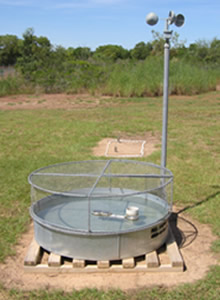
Class A Evaporation pan, is cylindrical with a diameter of 47.5 ” (120.065 cm) and has a depth of 10 ” (25.4 cm). The pan is mounted on a level, wooden base and is often enclosed by a chain link fence to prevent animals drinking the water from the pan.
The Class A Evaporation pan measures the amount of evaporation (the process by which water is converted from its liquid form to its vapour form) that took place during a single day as the depth of water (in inches) evaporates from the pan. The measurement day begins with the pan filled to exactly two inches (5 cm) from the pan top. At the end of 24 hours, the amount of water to refill the pan to exactly two inches from its top is measured. Off course nowadays, there are fully automatic systems available, that takes the readings, store it in a database or even send the it via cellular phone to the farmer – it even refills the pan by itself!
Anyway, the measurement you take from “reading” the amount of evaporation is then used to calculate the evapotranspiration from the soil, grape vines and cover crop.
Tensiometers or Irometers:
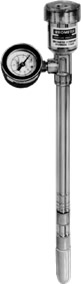
A tensiometer is an instrument that reads the soil water potential (the direct energy needed or availability of soil water to the plant) and consists of a porous ceramic tip (cup), connected through hard plastic tube to a vacuum gauge – they come in different lengths. The tube is filled with distilled water and sealed at the top.
The tensiometer is placed into the soil, in the root zone of the grape vine – the porous tip, acts kind of like a root. When the soil dries out, the pressure on the outside of the tube will decrease and an imbalance between the inside and outside of the tube will occur. In order to equilibrate the pressure, water will move from the tube, through the porous tip into the soil.
As the water moves from the tube into the soil, it will cause a vacuum inside the tube and the vacuum gage will show a reading in bars or kilopascal. Off course, when you water the vine again, the pressure inside the tube will be lower than on the outside and water will move through the porous tip, back into the tensiometer, lowering the reading again.
On the gage, 0 = fully saturated soils and 100 = extremely dry soil. One big disadvantage of using a tensiometeres is they need constant servicing as air is extracted from water under tension and becomes trapped within the tube, reducing the response time progressively until the instrument fails to operate.
Diviner 2000:
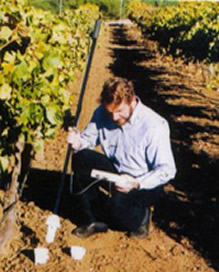
The Diviner 2000 is a portable soil moisture probe, designed Sentek in Australia. At each site, a probe tube is installed into the soil and when you want to take the readings, simply slide the probe down the tube, into the soil. The encapsulated capacitance sensor then measures the soil water of the root zone at different depths. The data is transmit to a handheld logger, which shows graphs of the available water in the soil. You can also connect it to your PC and download the data. With the software provided, it draws graphs of water usage at different levels, making irrigation scheduling much easier.
DFM Probes:
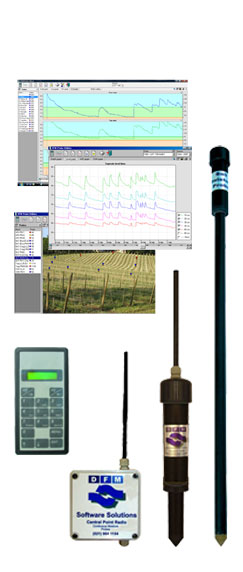
I started using these probes last year, and must say, it is AMAZING what you can do with it! The DFM Continuous Logging Probe is a multilevel soil water content and temperature logging device. The progressive, newly upgraded probe takes readings on 6 depths and at hour intervals and stores it locally for up to 60 days. Data can be downloaded to a mobile logger or to a central computer with the use of 1.2km long distance radio model.
In other words, you don’t have to visit the site where the probe is installed if you have a radio model! On my farm, the sites where the probes are installed is relatively far apart, so this makes the job much easier. You can visit their site at http://www.dfmsoftware.co.za.
Practical tips for the home grape grower:
Even with all of these instruments (and there is hundreds more on the market) to our disposal, you should always physically test your soil water level. You can do this digging a hole 2 feet away from the vine, about 2 to 3 feet deep – this is where most of the roots of a grape vine situated.
From the bottom of the hole, take some soil in your hand and press it as hard as you can …
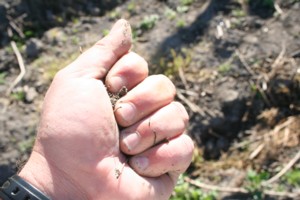
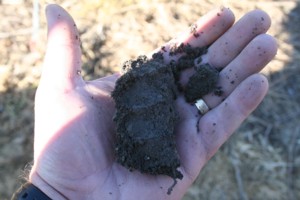
If you open your hand and the soil particles stick to each other like a mud-pie, and you feel your hand getting colder (transpiration of water), you know there are still free soil water available in the soil.
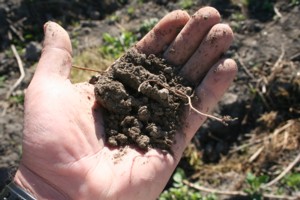
If the soil kind of crumbles after opening your hand, and you feel no transpiration of water, then most of the time, your soil is to dry and you need to water your grape vine.
With the help of the above instruments and physically testing the soil this way, you can easily build knowledge of how wet your soil really is when say for example a tensiometer reading is 30 cu. I do advise you to do regular physical tests.
I hope this article will help you water your grape vine more efficiently in the future. Remember, a too wet soil has too little oxygen needed for normal root functions – grape vines hate wet feet!
Tagged with: how to grow grapes
Filed under: growing grapes • how to grow grapes
Like this post? Subscribe to my RSS feed and get loads more!

I am using a dripper system with two drippers to each plant at this time. The soil is wet on top 6 inches but is dry the rest of the way down. I will try to put on another dripper on each plant and water two or three times a weeks. Thanks for the useful information. Jim
I have just signed up with you on My Grape Vine. com . I live in Mexico about 6200 feet above sea level. I would like to have a good design of how to set up my trellis and how far apart to plant my vines. I saw your design on your pictures but don’t have the measurements of the above. How high do I make my poles how far apart do I put the wires for the plants to cling to? How far apart should the rows be? I have a lot of questions but for now, I just want to get started. Thank you in advance for your input.
Wayne
Hi, when the plants go dormant, do you still keep watering them???
Bert B
As the fall progresses I now need to know how and when to trim back my vines for the winter season.
Thanks,
Roger
Roger,
There is no need to trim back the vines before winter. Wait until the vines are dormant or until close to next spring, then prune them back.
i havw just a few vines in my back yard but you have been helpfull so far with your information
Hi Stan,
You’re welcome.
Hi Danie
Thanks for the blog, most helpful,I tried to get some local imfo, as there is an old vineyard and winery 100 year old or more here in Roma, Bassets, but most of the vines are negleted.
Look forward to E-mails
Cheers for now, work safe
Bert
Thanks Bert
Hello Danie, I look forward to your emails and I learn a lot reading each one. The only problem I am left with is how to stop pheasants, yes pheasants not peasants, eating all my grapes even after netting and seeing the poor creatures slowly walk off my vineyard with a confident swagger? Have a good weekend and look forward to the next email.
WOW Peter,
Never heard of that! Maybe someone else on the blog can reply to this question
The only good solution to the pheasant problem is lead poison!!! A good pellet gun or .22 would do the trick….plus the benefit of pheasant under glass.
Thank you for the article about irrigation and the different tests
that we can do to have better grapes.
Willie
HI Willie,
It’s a pleasure my friend
I recently moved into my parents home. Although a surgeon by trade, my father was quite the horticulturist. I have approximately 18 different varieties of grapes. Some of the plants are more than fifty years old but still produce well. I think they need drastic pruning as many of the spurs are 1-2 in diameter. He used the kniffen system. Where do I start or should I just start layering next year? Also can I prune this fall? Your assistance will be greatly appreciated. Bonnie Thurston
Hi Bonnie,
If your vines are still producing well, then why start a new vine from layering. You can prune back the older part of the cordon if you have a cane that developed from near the stem of the vine. This way you can construct a new cordon.