Growing grapes from seeds

As I mentioned in the previous post, I will do a series of posts about questions new grape growers ask.

Today I want to discuss another question asked by so many grape growers: “Can I grow grapes from seeds?”

Because it is very hard to get hold of planting material or cuttings, in some parts of the world, grape growers are forced to try and grow grapes from seeds extracted from the grapes they buy in supermarkets or grocery stores.

Growing grapes from seeds is not the ideal way of reproducing a grape vine as the genetics of a variety is not completely carried over by the seeds – in other words, if you plant a Concord seed, and you successfully get the seed to germinate, the chances are good that the new grape vine will not have all the true Concord characteristics!

This is a very time consuming process as it can take up to three years to propagate a new grape vine from seeds.

Another big problem with growing grapes from seeds is the fact that a very low percentage of the seeds will germinate.  The grape seed is covered with a very tough seed coat that keeps the seed dormant until ideal conditions for germination.  The seeds from grapes, needs to go through a process called stratification to obtain a higher germination percentage.

Stratification of grape seeds:

The stratification or cold treatment of grape seeds is essential if you want to succeed with growing a grape vine from seeds. 

After extracting the seeds from the berries, you need to put the seeds in peat moss or damp paper towel, inside a refrigerator for at least 2 to 3 months.  The peat moss must be kept damp throughout the whole process, but not too wet (soggy).  The ideal temperature for stratification is 35 – 40 ºF (1 – 3 ºC) and should be kept at this temperature throughout the whole process.

Grape seeds can be held in stratification for a long time (even years), as the seeds will not germinate under these cold conditions.

Planting out the seeds:

After stratification, take the seeds from the refrigerator and plant them in seed pots and ensure the temperature is about 70ºF (20ºC) during daytime.  If your climate is cold, you can use heat mats to increase the minimum temperature.  Heat up the seed pots at night if your temperature is lower than 15ºC.

After a few weeks (if you are lucky), then some of the seeds will germinate.  After the seedling is about 1 – 2 inches high, it can be planted out in a bigger pot.  Make sure you keep the soil moist, but not too wet.  It is advisable to grow the seedlings in the pots for a full year, before planting them out.

If you have successfully grown grapes from seeds, let us know about how you did it by adding a comment below.

Take care

Danie
New to growing grapes?

From the tons of emails I receive at www.my-grape-vine.com, there seems to be many newcomers to growing grapes each year.  Most of them struggle with more or less the same problems and ask me the same questions.  I’ve been trying to reply to most of them, but surely cannot reply to all – there is just so many hours in a single day. 

I’ve made a list of what the problem areas are, when you are new to growing grapes and will briefly discuss each of them over the next couple of weeks.  I cannot go into too much detail about each of them, that is why I wrote the Complete Grape Growers Guide off course J. but I will try to shed some light on a few problems areas. 


Okay, let’s have a look at what new grape growers find difficult…

  • Pruning 

It seems like pruning grapes is still the number one headache for new grape growers.  The fact that pruning is one of the most important manipulations of growing grapes, and that so many people do not understand or know how to prune grapes, is why so many new grape growers tragically fail.  I get the feeling that people don’t realize how important pruning really is!


You must have some sort of structure or plan you follow each year.  Most new grape growers just randomly cut off canes to make grape vine smaller – big mistake!  What is very important to remember is; a grape vine reacts to the way you prune. 


In other words, if you prune for fruit, you will have fruit; but if you prune for shoots, you will have only shoots!  The “self-taught pruning methods” of new grape growers are normally “to prune for shoots” and that is in most cases why their grape vines do not produce grapes!


Developing a pruning method or structure, start the very first year of training a grape vine.  Without developing the framework of your young grape vine will make pruning much harder in years to come.


We develop what we call cordons or arms, with spurs (short bearers) situated on the arms to be the fruiting zone of our vines.  You cannot simply cut canes left and right, and expect your vine to produce grapes – it simply doesn’t work that way.  In most cases, if you get your pruning done properly, your grape vines will produce grapes.

  • Training

As said earlier, the key to having a productive grape vine starts with training a grape vine from year one.  Many new grape growers just plant the grape vine and then expect it to climb to the trellis or arbour by itself.  Although sometimes this happens, it is not the ideal way to train a grape vine.


You need to make sure that you train only one training shoot the trellis or arbour – if you prefer to have two main stems one day, then train only two shoots to the trellis.  Your vines will reach the trellis or arbour in half the time – I promise.  The methods I use and explain in the Complete Grape Growers Guide, get my grape vines to the top of ANY trellis within one year.  The second year I develop the framework and then BOOM!!! Tons of grapes!  The key is – “Train your grape vine with one goal in mind – to reach the trellis wire in year one!”

  • Soil pH

The third most asked question is about the pH of the soil.  Strange enough, but so it seems, new grape growers are more concerned about soil pH than about planting the correct variety and training the vines.  Don’t get me wrong, soil pH is very important, but just as important is planting a variety that suits your climate, suits your needs and suits your soil type.


To answer the pH question; grape vines can grow in a relative wide range of pH soil. The best pH for growing grapes is slightly acidulous; between 6.0 and 7.2, although you can go as low as 5,5 and as high as 7.8.   Soil with a pH outside these ranges are not suitable for growing grapes – or should be corrected first. 


Hope this gives the new grape growers some guidance to where they should focus their attention on. 


Take care,

Danie

www.my-grape-vine.com

Japanese beetle update – amazing!

This is an amazing video that makes allot of sense.  Maybe if some you can try this out to see if you can stop Japanese beetles from attacking your grape vines.

Would love to hear your comments!

Take care

Danie

Japanese Beetles On Grapes

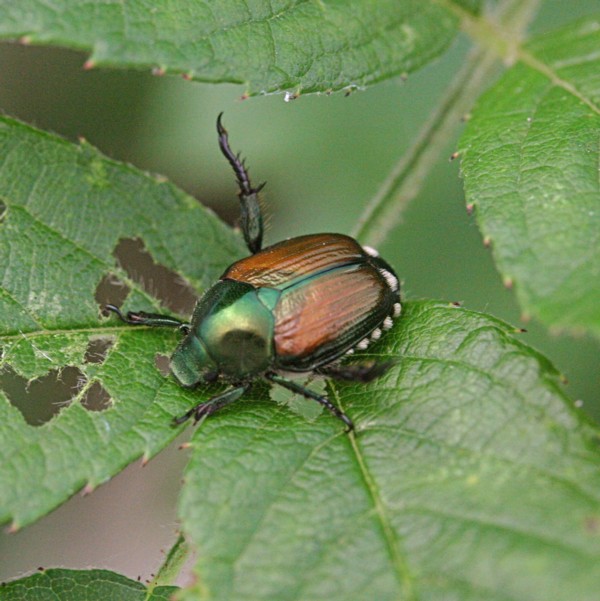
Adult Japanese Beetle

The Japanese beetle (Popillia japonica, also known as the jitterbug) is one of the most visible and most destructive feeders of grape vine foliage out there. 

The Japanese beetle attacks most green parts of the grape vine, but mostly feeds on young leaves in the upper part of the canopy.  Occasionally, they will feed on fruit also, making it unusable for export or table grapes. 

When Japanese beetles feed on the leaves of the grape vine, they will eat the foliage surface material between the veins, leaving only the veins in place, which will look like they were skeletonized.  Although mature, vigorous growing grape vines can tolerate quite a bit of defoliation, this insect can cause some serious damage to a grape crop. 

The life cycle of the Japanese beetle:

Japanese beetles overwinter as larvae in the soil.  They will feed on the roots of grass and other plant material.  Adult beetles will become visible in late spring and may be present in vineyards until mid in summer.  The adult Japanese beetle (as seen in the picture), has a distinctive, shiny green body and head, with copper-coloured wings.  The sides and back of the body is covered with small white hair.  The female Japanese beetle is bigger than the male and is approximately ½ inch long.

After mating, the female Japanese beetle will temporarily leave the grape vine, to lay up to sixty eggs in the soil of your vineyard or if you have a backyard vineyard, in your lawn.   In midsummer, the eggs will hatch and will reveal small, white grubs or larva, where they will feed and hide up to 8 inches deep into the soil, to wait out the cold of winter.

Japanese beetle control:

Strange enough, in Japan, where the Japanese beetle originally comes from, this insect is not a big problem!  Why?  The answer is; natural enemies that feed on the grubs. 

For the organic grape grower, you can control Japanese beetle by putting out traps with a pheromone that attracts the female and a floral lure, that will attract the male.  The disadvantage of using these traps are that you can lure more Japanese beetles to your vineyard, as they can fly quite long distances in a short amount of time.

A program with physical and biological control of the grabs is a more effective method of controlling Japanese beetle.  The two nematodes that are most effective against Japanese beetle grubs are Steinernema glaseri and Heterorhabditis bacteriophora.  Both these nematodes are commercially available.

Milky Spore (Bacillus popilliae), a naturally occurring host specific bacterium, will also attack the destructive white grubs.

Important:  If you are to use chemicals to treat Japanese beetle, then spot treatments with botanical insecticides is advisable.  Unfortunately, these chemicals also kill the biological nematodes that help control Japanese beetle.  In other words; keep chemical treatments to the minimum.  Products like Carbaryl, Malathion, Methoxychlor, Rotenone can be used on adults and Merit (turf), Marathon, Bendiocarb can be used to control grubs.  Make sure these products are registered in your country or state before you use them and PLEASE, read the labels of the products BEFORE you use them.

Planting a grape vine

You have prepared your site; you have decided what variety to grow; now it is time to plant your grape vine! Well, unfortunately, this is where many home grape growers terribly fail!

Planting a grape vine is not hard, if fact, it is one of the easiest fruits to get started, but there are a few key things to remember when planting your grape vine.

1. The planting hole

In the early days, before research proofed this method wrong, planting grape vines, by adding fertilizer and all kinds of stuff into the planting hole, was a well-known practice? Research showed, that a grape vine sprouts from energy within the vine itself, and do not actually use any fertilizer until the vine reach about 2 to 3 inch shoot length. By adding fertilizer directly into the planting hole, or directly on the roots of the vines could damage (scourge) the roots.

With knowledge/information you gained from soil samples, you should fertilize and correct all mineral shortages BEFORE you prepare your vineyard site and then plant your grape vine. This will mix all the fertilizer with the soil and will not damage the roots of your grape vine.

Make a large enough hole to accommodate all the roots from the cutting and do not cut or remove any roots – the more roots, the better the chance of successfully planting your grape vine.

2. Preparing the new vine before planting

Before planting your grape vine, you should plunge the complete vine into a bucket of water for at least six hours. Under no circumstances, let the roots of the vine dry out – this is very important! If you are planting a few hundred vines, cover the vines not planted yet with a damp gunny bag or something similar.

3. Watering the vine

Before you plant the grape vine, you should thoroughly water the planting hole and ensure that the water deeply penetrates the sidewall of the planting hole.

Constantly add water to the planting hole while filling the hole with soil, to ensure that no air pockets forms near the roots of the vines. Water your grape vine once a week for at least a month after planting the grape vine.

Following these simple rules when planting a grape vine, will guarantee a much higher success rate.

How to deal with deer in your vineyards

Hallo again my friends.

I received this email from Casey yesterday, and would like to share it with you…..

Danie,
Let me first say that I absolutely love your book (The Complete Grape Growers Guide), and I want to express how helpful it was in starting my first few vines. The information was very a relief as many other books I’ve read lacked the quality information about pruning. Following your instruction I was able to get my vines on track and they were growing very well.


Unfortunately, I’ve had a run in with a few deer that really took a lot of my vines out. The deer proceeded to eat all of the leaves on my main shoot and they’ve nearly stopped growing completely. I was wondering what my plan of attack should be next, should I choose a new shoot to train or should I wait for a new growing point to start on the main shoot I have now.


Also, is a good trick to keeping deer away? I’ve tried spreading my dog’s hair around the area, and it seems to keep them away for a bit of time, but my dog can only shed so much haha. Any information will be helpful.

First of all…


Thanks Casey, and all of you, for so many kind words I so often receive in my emails. Showing your appreciation really makes my day and motivates me to keep on sharing useful grape growing information – Thanks a million and I will try my best to keeping it up! 😉

To get to Casey’s email …

Problems with deer in vineyards is becoming a bigger problem year after year, since we all strive to preserve mother nature and all wildlife. On the other hand, as much as most of us love the wildlife and working outside, we also love our grape vines and anyone who is having problems with deer, rabbits and other leave eating animals in their vineyards, can tell you how much damage they can cause to new vines – even devastate a young vineyard.

Rock Dassie or Hyrax is a huge problem where I live,
because my farm lies at the foot of the a big mountain range.

I once read an article about the proliferation of deer in North America because of the so called “Bambi Syndrome”. We all know the movie Bambi and how cute the little deer is and how his mother was killed by a hunter and the struggle to survive.

The result was, humans started preserving these deer at all cost and even lured them to their houses by feeding them. Unfortunately, more and more suburban home owners started having problems with deer destroying their gardens as their numbers increased dramatically.

The point is; no matter what your feelings about deer are, it is a fact that you can’t allow them in your vineyard as they will for sure damage the vines (especially when young). I think you will agree that if it wasn’t for the fact that deer devour young vines right down to the the cuttings, it would actually be nice having them around!

So now what? You have problems with dear, like Casey has, but you also don’t want to loose deer?

There are a few other option available except stripping your dog from all it’s hair 🙂 LOL

1. Fencing

Although the best way to keep deer out, it’s also the most expensive method as deer can jump as high as 8 feet you will need a fence of about 8 feet high. If your land (vineyard) is quite big, this method will cost you a significant amount of money, not to mention the labour involved.

2. Electric fences (single strand and multi-wire)

Electric fence is much cheaper than other styles of fencing and is much easier to setup as well. The only problem is the availability of power, but solar chargers are also available these days.

A single strand of wire is stretched 3 to 4 feet above the ground and supported with a non-conducting material poles. Once the deer touch the wire a non-lethal electric impulse will shock the deer and spook it.

Milti-wire electric fences is also used and is about 5 feet tall. A slanted support will stretch the wires at different angles which will confuse the depth perception of the animal. The deer can easily jump over the fence, but the angles of the wires confuse the deer as they approach to jump and will touch the electrified wires before they actually jump – clever hey?

3. Animal repellant sprays

Using repellents is another option you could consider. There are many products on the market but I’ve heard that some grape growers are sceptical to use these products as they are affraid that the smell and taste products could be picked up in fruit and wine in the end. There is however no proof (as far as I know) that this is the case. In fact, if your vines are still young, it won’t bear any fruit so this is an option for young vineyards.

Products you can try are:


4. Egg spray or garlic juice

Although I never tried it myself, there are grape growers that claims to get great results from this method.

A mixture of 20% blended eggs and 80% water is sprayed on the vines. It is said that the eggs contains a sulfur compound that is chemically close the sent that alarms deer when they feed. If all fails, try this method.

5. Electronic Deer Repellers

I haven’t tried out this method, but some gardeners have great success with this product. Simply place a few drops of the acorn scented deer lure onto a cotton ball and stake it in your yard. When the deer repellent is properly placed near a deer path, the lure will attract deer to the posts. Upon contact, the deer receive a gentle static shock (likened to static electric shock received from carpeting, etc.), conditioning them to stay away from your vineyard!


6. Hunting

For most people this is not an option (me as well, as I love wild animals). If you do decide to hunt the deer, just keep within the laws of your state or country.

Okay people, this is all for now, but I would like to hear some comments about how you keep deer from YOUR vineyards. Click on the comments link below this post and leave your 2 cents value.

Will talk to you soon.

Danie

http://www.my-grape-vine.com/


I would like to express my thanks to you again, as some of my vines have already reached the bottom wire on my trellis, and I have another month or two left in the growing season!!

Thanks again.
Casey

What to do about new growth on a grape vine

Hi grape growing friends,

I received this email from John and Randi, so I decided to reply to their email on my blog so everybody can have a look at it.

Here’s the email:

What to do about the new growth? I think about 20 bunches/plant is recommended, under the best circumstances, either red or white varieties. Do I pinch back the new growth at the mature stem, pinch back below the lowest bunch (I assume the plant needs leaves to produce nutrients for the grapes), let the new growth continue – removing only the bunch buds: how to balance roots with fruits?

OK here we go …

Although John and Randi didn’t mention the age of their grape vines in the email, I assume it is mature vines. New growth on a grape vine is easily managed by starting to remove water shoots.

Water shoots (as I call them) are shoots that develop from the old parts (arms and stems) of the grape vine – older than 2 years. These shoots normally do not produce grapes and only compact the vine and prevent proper sunlight penetration and air flow. Although water shoots can be used to renew a cordon (arm) when a cordon dies or become unfruitful, they are normally useless on a grape vine and should be removed.

Determining the crop size you want on your grape vines beforehand, is important and you should experiment with your own vines to see what the best load for optimum quality is.

Depending on how strong your grape vines are and off course the trellis system you use, 20 bunches per vine (like in the email from John and Randy) is okay, but with a well developed grape vine structure, good exposure to sunlight, correct bunch sizes and proper canopy management during summer, I succeeded in ripening up to 32 bunches per vine.

Some “grape growers/consultants” might tell you that this kind of crop sizes will result in lower quality grapes. Yes, that is true IF you do not look after your vine. I successfully prepare and pack grapes crops of this size year after year.

Now you might think: “What a windbag this guy is?” No, actually I’m no windbag, in fact I’m a rather quiet guy!

I’m telling you this because it is possible to grow grapes that produce that kind crop sizes. By removing all unnecessary shoots on the grape vine before flowering and even by reducing the number of flower-clusters at that stage, will unbelievably improve the quality of your grapes.

Like I said, decide on the crop size and count the number of bunches before flowering starts. Here is the formula I normally use.

Say for instance I decide on a crop size of 30 bunches per vine, I then ad 60% to that number

30 bunches + 60% = 48 bunches per vine (the rest will be removed after fruitset, when you will be able to choose the 30 best bunches from the total)

If I have say 70 bunches on the vine at that stage (which is possible!), I will remove 22 of those bunches. I start by removing inferior shoot, even if they have bunches on them. I remove all double shoot that developed from the same bud (remember that a bud on a grape vine is actually 3 buds combined) and then I remove individual clusters from shoot that produced more than one cluster per shoot.

KEEP ON COUNTING THE GRAPE CLUSTERS AS YOU PROCEED!

Once I’ve reached 48 clusters, the grape vine is now ready to go into flowering.

You see my friend …

By removing unnecessary clusters before flowering, the vine is under much less stress – when the clusters start flowering, the grape vine is under an enormous amount of stress.

I never remove leaves at that stage. Rather leave the grape vine until after fruit set and then remove leaves. If you feel that some of the shoots is growing out of control, you can set them back by removing the growing point of those shoots.

I tried to explain this in simple terms, so I hope this will help you grow your grape vine the correct way.

Good luck and if you have any questions, just add a comment below this post.

Take care

Danie

The Grape Guy


For the wine lover …..

For any wine enthusiast wine is more than just a liquor, it is a valuable beverage that triggers a certain chemistry and plays a fundamental role not just from the commercial point of view but intellectually, universally and socially speaking. The very history of wine is dating back to times when only the most well educated and wealthy people enjoyed it plentifully.

However, a wine enthusiast found among the poor and the illiterate was not rare either, as the pleasure of this sense stimulant is widely applicable to anyone, regardless of personal and social status. Presently, wine relates to so many areas that it is almost impossible to exhaust it as an object of study.

First and foremost, wine has a chemical composition that makes it the perfect accompaniment for food: fatty dishes would not be the same without the mild acidity and the taste contrast that wine creates. You don’t have to be a passioned wine enthusiast to actually be aware of the way it complements the taste of food.

Furthermore, since meals are often a pretext for social interaction, wine is often the bond or the missing link in faulty communication. It relaxes the mind, eliminates the tension and stimulates creativity. Any wine enthusiast knows that as long as drinking remains rational, the pleasure is maximum.

The taste buds are the ones to sense the pleasant sensations triggered by wine and the combination of sweetness and acidity is the balance on which wine quality actually relies. It is not seldom that a wine enthusiast is happy to discover some fruity flavor in the liquor; usually such flavors contribute to the sweetness of the wine, depending on the general characteristics of the fruit that create them. Rich dimensions can be found in wine owing to the possibility to combine the taste of grapes with that of certain other fruits like pears, strawberries, elderberries and the like.

If for an amateur it is difficult to tell how white and red wine varieties are created, a wine enthusiast will most certainly know the difference. If red wine is made by the fermentation of the entire grapes, the white wine is the fermentation product of grape juice only: there is no fruit meat or skins left to the composition. Such knowledge may seem basic, but there are lots of other details that a wine enthusiast will share with others, since the topic is so wide and comprehensive that it could not be covered easily.

Take care
Danie
The Grape Guy
www.my-grape-vine.com

Because we cannot see the roots of the grape vine without digging into the soil, many grape growers often make the mistake of not ensuring a well balanced, properly formed root system of the grape vine.

Tests have shown that a grape vine with well developed and well distributed root system contains lots of fine roots. These fine roots are responsible for the uptake of food and water, which will ensure a well developed canopy throughout the season. It is a known fact that for a good eating quality grape or a good quality grape for wine, active growth during the ripening of the grapes is essential.

A grape vine with an underdeveloped root system, especially fine roots, has a poor buffer capacity against unfavorable conditions, like drought, heat waves and even unwanted rain. The absence of these fine roots will result in less young leaves to form or develop throughout the season.

There must be a proper balance between old and newly formed leaves on a grape vine, because young leaves continue to feed the grapes and the root system of the vine. When an imbalance occurs, the grape vine goes into “stress” and will not be able to sustain the composition of the grapes during the later stages of ripening.

In short; the root quality and quantity of a grape vine is essential for good quality grapes, therefore proper soil preparation and the correct chemical substance of the soil must be determined and corrected before you plant the grape vines.

Without any doubt, there is a direct correlation between the canopy development and quality of the root system and in the end the quality of the grapes and wine.

Ensuring a proper root system, will make canopy management easier and your grape vines will not easily go into “stress” when unwanted climate and external conditions occur.

Have a grape day!
Danie
“Author of the Complete Grape Growers Guide”

Bird damage on grapes

Hi Grape Friends.

Hope you had a wonderful festive season and that 2008 will be a great grape growing year for you.

In this post, I would like to talk about birds damaging (eating) your grapes. If you are like me, a true nature person, fond of all wild animals (birds included), it is hard not to hate these feathered friends when you are a serious grape grower.

All over the world, grape growers have problems with birds ruining grape crops and the extent of damage to crops, caused by birds of varying types is often significant. Birds damage grape crops by either pecking or consuming whole grapes from bunches.

The former feeding method causes secondary spoilage as bacteria, moulds and insects attack the damaged berries, which may ruin an entire bunch , like in the picture below. Further more, in the table grape industry, which is my speciality by the way, grape bunch appearance is an important feature of the produce and even minimal feeding by birds cause cosmetic damage, making the fruit unsuitable for the export market.
Secondary infection because of bird damage

Now the Million Dollar Question is: “How can you prevent birds from damaging your grape cop?”

Studies showed that strategies to try and eliminate birds species, that damage grape crops have a poor record of success and the fact that environmental consciousness is on everybody’s mind these days (as it should be), makes killing these birds not an option anymore.
There are a few methods, you as a grape grower, can use to try to reduce damage to grape crops.
Grape growers use bird netting to drape the grape vines with a special net developed to keep out birds. Although bird netting give some sort of protection, it is not fool proof. Draping the netting over grape vines is a time consuming job and no mechanical manipulations (like mechanical harvesting) can be done before the netting is removed again.
2. Propane Gas Cannon
The Propane Gas Cannon is a bird scarer, controlled by an electronic timer and 12V battery and create periodic load explosions in an effort to scare birds from the vineyards. These Cannons are quite costly and should be placed at strategic places throughout the vineyard. Some grape growers where I live tried to use these cannons, but it seems like birds become acclimated in time to new sounds introduced into the vineyard and tend to ignore the cannon shots after a while.

3 Visual Repellents
I’ve seen grape growers use shiny streamers and other shiny and fluttering objects like small mirrors hanging from strings, to repel birds, but as with the propane gas cannon, birds acclimate to these objects quickly. Some grape growers stretch plastic strings over the vineyard and these strings will vibrate in the wind and make a low irritation sound that could (notice I said “could”) repel unwanted birds.
4. Chemical Repellents
No proven chemical repellent (to my knowledge) has been successfully used in vineyards. Normally, the grapes are almost ready for harvest and applying chemicals to the grapes, could lead to artificial flavour to grapes and in the end to the wine – and it could be dangerous to humans! I do not recommend this!
In the end, there isn’t much else we can do – sadly. As my dad always say: “Danie, always remember, you planted the rows on the sides of the vineyard for the birds and grape thieves to eat!” 🙂 LOL , thanks Dad, maybe I should design a vineyard without any side rows!
Hope you enjoyed the post, try some of these methods, even if they work only for a week or two – it could just be enough to save some of your grapes.
Have a great day
Danie
 Page 7 of 12  « First  ... « 5  6  7  8  9 » ...  Last »