
Growing Grapes In Shallow Soil
This seems to be a topic of great concern to many vineyard owners all over the world, and there is a good reason for that as well. A too shallow soil will for sure have an influence on how well your grape vine grows and how productive the vines will be.
To determine if your soil is too shallow for growing grapes, you need to know what the roots of the grape vine look like and how the root system develops over the years. Another very important fact to keep in mind is that a grape vine don’t like wet feet. In other words, the grape vine’s roots must develop in a well-drained soil with enough oxygen for normal nutrient uptake. I wrote an article about this a while ago, so if you are interested, head over to the following web page: The Importance Of Oxygen In The Soil When Growing Grapes
With that said, what does the root system of a grape vine look like?
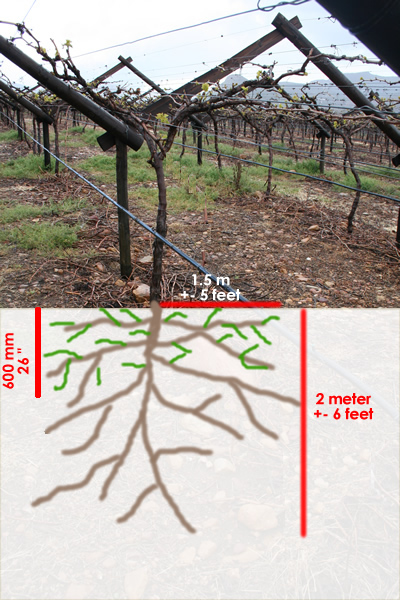
On deep soil, the roots of a well developed grape vine can easily reach a depth of 15 feet and spread like a fan. On the other hand, grape vines that grow on compacted soils or soils with an impenetrable layer, have roots that are poorly distributed, shallow, and stubby ended and grow horizontally, rather than downwards.
The optimum soil depth is about 2 meters or 6 feet and deeper. The most active roots for food uptake are found in the top 600 to 800 mm (2 to 3 feet). The roots below this area is responsible for oxygen intake and other respiratory actions. Any shallower soil, will prevent proper root development. However, this doesn’t mean you cannot grow grapes on a 1.5 meter deep soil. There are vineyards that produce a reasonable crop on 4 to 5 feet deep soils, but I would say that 4 feet is about the minimum depth for growing grapes.
What will determine the depth of your soil.
Basically there are three types of obstacles that will determine the soil depth. The first, and most obvious, is an impenetrable layer of rock (reef) or clay. If possible, the reef can be cracked with a bulldozer and toe-plough, that enables the roots to grow down in the cracked reef. To obtain the best results, it’s best to plough the land sideways and from top to bottom – this however is pretty expensive!
The second, and less obvious is a high water table. If you live in an area where the water table is close to the surface of the soil, you can know for sure that the roots of the grape vine will not grow below that point. There’s not much you can do about lowering the water table, except if can install a drain system, that will channel the water away from your grape vines – again, this is pretty expensive as well.
The third and probably the least obvious is an impenetrable chemical layer. A chemical layer normally consist of a layer of soil with a very high or low pH, but can also be a layer of salt, because of year and years of fertilizing a soil, without proper soil management. The roots of the grape vine will avoid these layers and rather grow sideways than into them. Correcting these layers can be done with proper soil analyses and soil preparation and management.
My viticulture lecturer in collage, always said that the root system of a grape vine, will be as big as the canopy above – interesting statement isn’t it, but that’s why a too shallow soil will prevent good canopy development.
If there’s not much you can do to increase the soil depth of your vineyard, there is one final thing you can do before planting your grape vines – it’s called ridging.
Like farmers ridge potato lands, a vineyard can also be ridged (just on a bigger scale). Ridging the soil along the length of the planting row, will increase the soil depth with about six to twelve inches. I know this is not much, but could be enough to ensure a better root development.
Unfortunately I don’t have a picture of a ridged vineyard right now, but I will try to upload one soon. The ridges are about 8 to 10 inches high and about 4 to 5 feet wide and stretch from where the one end post will be planted, to the other – in other words, ridging should be done BEFORE planting your end post or canopy support posts.. The most practical way make a ridge, is to use turn plough several times on the same row or with a back-hoe. Just ensure the plateau, where you will plant the vines and posts, is more or less lever.
Off course ridging has many disadvantages as well, such as …
-
Ridged soils will dry out quicker because of a bigger soil surface exposed to sunlight and wind.
-
Normally, the planting rows need to be wider to make space for tractor movement between two adjacent ridges.
-
Working (harvesting, thinning out bunches, suckering etc.) in ridged vineyards will be much harder, as the canopy will be higher above the normal ground level.
-
Weed control is more difficult because of the higher planting row.
-
Expensive way or soil preparation
Hopefully, with these tips you will know what to do.
Good luck and happy grape growing my friends
Danie
For the most complete grape growing reference and training manual out there,online and off-line, join the Complete Grape Growing System today.

The complete grape growing system is an online membership site,where you get instant access to all the grape
growing info needed to help you succeed. Join now for only US$29 (or pay in your own currency). All transactions are securely handled by ClickbankTagged with: how to grow grapes
Filed under: growing grapes • how to grow grapes
Like this post? Subscribe to my RSS feed and get loads more!

Dear Danie
Always found to have the real problem disscussed in your blog,soil limitation is a good piece of advice for grape growers,and ld you please to send me a copy of(soft or hard)as a referance material for my post graduate students at University of Agriculture Faisalabad,
hope to hear positive soon
Thanks for the info. I have a good stand of grapes on my 10 vines I planted about three years ago. However, I do not have much of a canopy. I think I will try to check for the rootes under one of the vines. I know that I do not have a drainage problem as the ground gets dry very quickly after a large rain. Thanks for the info. Aklso do you have for sale,, the instrument for checking the sugar in the grapes to determine the correct time to pick them. My concords are starting to turn color now and are normally ready around the 10th of Sept. Tha nks, Jim Gardner
I’m in the vineyard building stage and your advice of ridging is what I was planning to do on my 12% Grade hillside. I have about 8-12″ of top soil with 16-24″ of soft clay/sand loam as subsoil. The base is hard rocky clay 🙁 I will be making a 10′ plateau with 2′ of it sloped of 30 degree. This will increase soil to about 3-4′. To ensure deeper root penetration, I will be drilling with an 8″ dia. earth agur another 2′ or so into hard clay and adding gypsum to back fill to help break-up hard clay without changing its pH. (will this work ?) Drainage on site excellent.
Thanks so much for the info…question.whats your advice on transplanting two yr old vines to a sunnier location ? whats the best method for removal and replanting? thanks, Alan Davis
Good morning from Colorado. Asking assistance! I have 70 vines that were planted in Apr this year. I’m growing them in shelves for the first winter. All have grown above the shelves and some have been attached to the first wire. Then two nights ago we have a destructive hail storm the beat the vines down breaking and stripping the leaves. Most have leaves down in the shelves but the vines above are really beaten. WHAT SHOULD I DO NOW. Our frist freeze comes in mid Oct usually. I can send pictures if they would assist. thanks
fayne