
Why aren’t there any grapes on my grape vines?
At least one out of every ten emails I receive, has something to do with either “no grapes on a grape vine”, or “too small berries”, or “not enough grapes”.
This is for sure the most common question asked by new grape growers. Unfortunately, it is on the most difficult to answer as well, because there are a couple of reasons why this happens. I’ll try my best to give you some tips on how you can improve the fruitfulness of your grape vines.
The first and most important thing you should always remember;
A grape vine needs proper sunlight to initiate the development of flower clusters inside the buds. When you look at a the green shoot of a grape vine, you will see hundreds of buds situated between the leafstalk and the shoot itself.
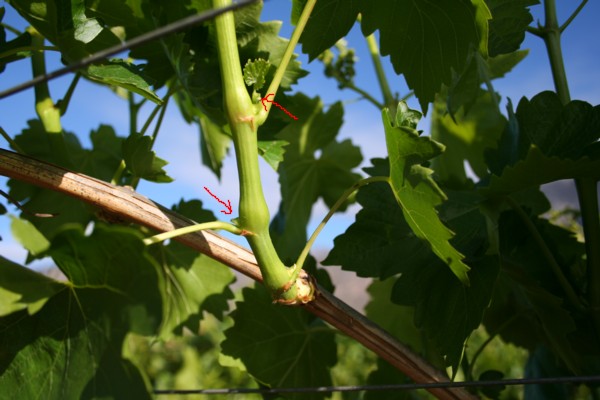
The grape vine bud is actually a compound bud, with a primary, secondary and tertiary bud situated next to each other.
Generally, the primary bud contains leaf and bunch primordia that produce 6-10 leaves and two bunches, respectively. If the primary bud develops into a new shoot in spring, the secondary and tertiary buds remain small. Anything that cause the primary bud to under develop or die, is what we call Primary Bud Necroses (PBM) and will greatly influence how many grapes your grape vines will produce.
Have no clue what I have just said? Right, let me explain in laymen’s terms.
The green shoot with buds shown in the picture above, is one-year-old growth from the current growing season. These buds will produce shoots in next years growing season. In other words, the small shoots and bunches that will appear next year, is initiated inside the buds during the current growing season.
The following pictures shows a bud on a shoot that is starting to go dormant. This bud will produce grapes next year.
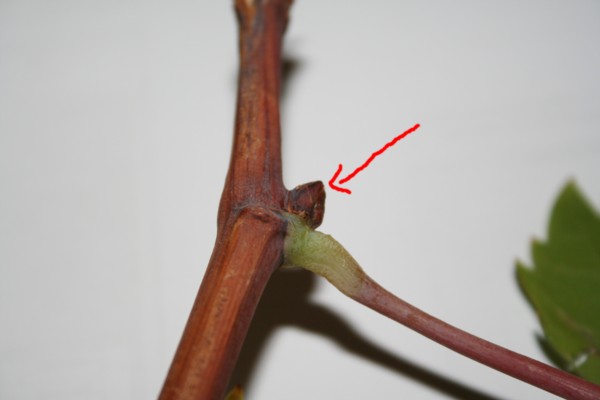
So, if your grape vine grows in the shade, or is too compact, and no sunlight can penetrate the canopy, then next years crop will be lighter. That is why I always keep hammering on proper canopy management and choosing the right spot to grow your grape vines.
One of Crimson Seedless vineyards is situated close to my garden. On average, the grape vine closest to the garden, produce only half the number of bunches it is suppose to have because of an over shading tree that grows in my garden.
Incorrect Pruning Methods
I didn’t mention this first, but it is just as important as having proper sunlight penetration into the grape vines.
Remember, the fruitfulness of varieties differ, that is why some grape varieties are pruned with spurs and some pruned with canes. The buds on variety like Crimson, initiate flower clusters from the 4th bud onwards (counting from the base of the shoot). If you prune the dormant cane back to 2 or 3 buds, you remove the most fruitful part of the cane where most of the grapes are!
I’ve seen pictures of grape growers, who prune almost all of the previous growing season’s growth away. Remember, without properly planning your pruning actions and by simply pruning everything away, you will reduce the crop size.
Too vigorous growing grape vines
Over fertilization or a too vigorous growing grape vine, will cause problems in the blooming stages. Just like any other plant with flowers, the grape vine produce flowers as well, that needs to be pollinated to reproduce – the basic instinct of the grape vine is to survive and reproduce new grape vines.
If your grape vine grows too vigorous, the vine will get the “message” , “Okay, I’m doing fine, so there is no need for too many grapes!”. The grape vine then shed flowers to make the crop lighter – not what YOU want isn’t it?
Another problem with a too vigorous growing grape vine, is sunlight penetration into the vine – mentioned above.
Diseases
Not only will diseases like powdery mildew and botrytis attack flower clusters, causing the flowers to abort, but there are mites that attack the buds on the grape vine themselves. Rust mites feed predominantly in the outer bud scales and bud mites feed on internal bud tissue, causing damage to the small flower clusters inside the buds.
The use of Gibberellic acid (GA3)
Gibberellic acids are naturally produced plant growth hormones that affect cell division and cell elongation in stems and leaves. Commercial grape growers use GA3 to increase berry size and also for thinning out of bunches with varieties like, Thompson Seedless, Flame Seedless and many more.
Unfortunately, GA3 cause unfruitfulness to the grape vines, so proper use of this product is of the utmost importance.
Male grape vines
Most of the commercial grape varieties grown these days, produce male and female flowers, so no cross pollination is needed.
However, some grape species like vitis Reparia, produce only male flowers. For the average grape grower, this looks promising during flowering, as they produce literally thousands of flower clusters, but these flowers will never produce grapes, they will only fall off.
Some nurseries sell these grape vines to people who wants to cover a pergola for the beauty of it alone, and not for grapes. If you bought a house with a grape vine on a pergola or fence, that doesn’t produce grapes, then the chances are good that it is a male grape vine.
If your grape vine produce no grapes, then I do hope that this article gave you some insight on how you can correct the problem.
Remember, correct pruning and canopy management is crucial!
Take care,
Danie
Was this helpful. Now learn how to grow your grape vine the correct way.
For only $29, you get instant access to all the grape growing information you need, PLUS get some bonus videos of how to prune and train a grape vine. The Complete Grape Growing System is a digital product. You will not receive any physical products.
Tagged with: how to grow grapes
Filed under: growing grapes • how to grow grapes
Like this post? Subscribe to my RSS feed and get loads more!

Hi Danie
I just love your site and all the helpful info. I have around 200 vines on a hobby vineyard in the North Island of New Zealand. The vines are around 6 years old and are vigerous and healthy in growth. My husband sprays for mildew and has sprayed Boron for flower set. However, this year quite a lot of the bunches have just gone brown and the flower clusters have fallen away. This problem always occurs early on in our season. We have a variety of vines as we are not sure yet which will do best in our location.
Regards, Jeanette
Hi Andy,
Glad you like the info – it’s great to know that it is actually read in the end LOL 🙂
These little bugs are very clever, they feed at night. So if you really wanna do some bug-hunting, do it after dark.
I’m 99.9% sure it isn’t the bonemeal Andy.
Happy bug-hunting 😐
Danie
http://www.my-grape-vine.com
Hi Danie,
Many thanks for all the useful information on how to grow grapes and the maintenance of it too.
I have grown my grape plant for a year plus now. Initally all the leaves were broad and healthy… although I have not seen any berries yet. Lately, I noticed that all the leaves are now full of holes leaving only the stem left. I have checked and there are no insects on the leaves and even the new leaves are affected. Could it be the bonemeal fertilizer that I use that is causing the problem?
Thanks and look forward to your advice.
Regards
Andy
Sir, with regards to the problem of powdery mildew in grapes I use growmore products like Calbozinc + General purpose + 4-0-48 or 20-5-30 to prevent this from occuring to my vines.I have not use any chemical pesticides ever since I use this products. I believe that thru proper plant nutrition plant will grow as healthy as it was..
Hi Carmelo,
Too some extend I agree with you, but feeding on it’s own woun’t make your grape vines imune to a devistating disease like powdery mildew.
Off course, a healthy growing vine, will be more resistant – just don’t let the vines grow too vigorous, as this can lead to diseases as well.
Thanks so much, Danie, for another good article. I have learned soooo much from your Complete Grape Growing System and your blogs. I am still confused as to which grape varieties need to be cane pruned and which ones as spurs. Also, sometime could you elaborate more on canopy control….for instance, if I have a vigorous vine that has 2 clusters on it and it has grown 3 to 6 feet long, should I cut it off, say 2 feet from the last cluster?
Hi Terry,
Thanks for the kind words. You didn’t mention the age of your grape vines, but as I show in the Grape Growing System, your goal the first year and for most grape growers, the second year as well, is to develop the framework of the grape vine.
Some varieties produce grapes on spurs or canes, and unfortunately, the climate and the growing conditions will influence how your grape variety will react to your pruning methods. It’s a matter of trying and testing if you are not sure.
Normally, when you spur prune and your grape vines produce only a few grape bunches, then you have nothing to loose to try cane pruning on some of the vines.
Changing from spur pruning to cane pruning can be done is a single year – use one of the spurs closest to the stem of the vine as the starting point of the cane.
Hi Danie,
Thanks, This is the article I am waiting for. What are we going to do with the canes that are unproductive and bear no flowers at all?
Do we have to cut them off? Love to hear more of it.
Have a great day!
Grace
Hi Grace,
Depending on what stage your grape vine is in, you can remove some of the unproductive shoots, especially if it is compacting your grape vines.
Grace, remember that you need some pruning wood during the dormant season, so removing shoots on spurs during this growing season, will have an effect on how you will prune in winter.
Danie