Merry Christmas To You All

Hi grape growers.

Can you believe that it’s Christmas again. Last year, the same time, we were a small community of grape growers, but since then grew exponentially!

Thanks for being part of the My-Grape-Vine experience.

A merry Christmas and lots of blessings to you.

Danie
The Grape Guy

Razak’s grapes in the tropics

Hi Grape Viners.

I would like to show you some pictures of grapes from a subscriber in Malaysia (tropics). Razak, is doing a fine job growing grapes there! Remember, there is no dormant season in Malaysia, so they have to “force” dormancy by removing leaves, stop fertilizing and watering the vine a month before their dry season and as soon as they are ready, they will “kickstart” the vine by start watering and feeding the vine again.
Growing grapes in the tropics is not easy, I promise you, so Razak is doing a fine job!
Well done my friend!!
Did you know it is actually possible to have to grape crops per season in the tropics!


Here is the email he send me:

“Dear Sir,

1. I would like the express my gratitude and thanks for
being able to get informations and guidance about
grape growing from your blogs.
2. Actually sir,I am from Malaysia, a peninsular
country between Thailand and Singapore. We are in
such a pure tropical atmopheric country and never have
been experiencing grape growing. It is just for the
fun in planting fruit trees in the garden that led me
read a lot of articles on viti culture.
3. After 3 years I began to see the bunch on my
vines. Yes those are my grapes but not as sweet as
what I use to buy at the supermarkets – the imported
grapes.
4. You can see my vines which I grow on the belcony
of my small house with the backdrop of coconut and
banana trees. MY TROPICAL GRAPES.


Your articles have been most helpful.
Thank you sir.

New growing season – at last!

Thought I share some pictures with you. Our growing season started a bit later than normal because of the abnormal cold & wet winter winter we had.

The early varieties has about 20 – 30cm (7 – 10 inches) of new growth so we will be securing the shoots to the trellis wire probably next week. Will keep you updated and show you some pictures how we do that.

Three inches of growth and already some bunches visible!

4 inches of growth
Removing suckers
During this time of the year, we mainly prepare the vineyards for flowering – a very important stage of growing a grape vine!
What we want to achieve BEFORE the vines go into flowering, is to reduce the number bunches on each grape vine. Why? During the process of flowering, the grape vine is under tremendous stress and could influence the growth of the grape vine. And if the grape vine’s growth is under stress, it will not have a enough vegetative growth when cell division starts (a few days after full bloom). Off course you want your grape vine to be in tip-top condition when this happens, because it will have a huge influence on the berry size.
One of the methods we use to reduce the number of grape clusters at this stage of growth is to remove suckers. No what on earth is a sucker?
If you look at the picture below, you will notice two shoots developed from the same bud on the cane – one on the side and one straight up.
We will keep the one that is growing straight up and remove the other shoot by hand (where the red line is). You can see the bunch on the shoot that we will keep (red arrow)
VERY IMPORTANT
  • Count the number of bunches on the grape vine, BEFORE you sucker. If you don’t have enough grapes on the vine, do not remove the suckers with grapes on
  • Don’t wait until the vine flowering to sucker – do it beforehand
  • Remove suckers ONLY if you have an established vine – 3 years and older (it will influence the amount of pruning wood you will need for a younger vine)
  • The earlier you do suckering, the more effective it will be. By removing the suckers at an early stage of growth, will improve the vines growth because more nutrients is available to the shoots you want to use on your vine.
  • The earlier you do suckering, the smaller the “wound” where the sucker was, will be.

OK that’s all for now …

Danie

http://www.my-grape-vine.com

Winter Protection for grapes

How to you protect your grape vines from the cold?

If you are in the unfortunate position to live in an area with constant sub zero temperatures, it is important to take note of this article.

Most of you people in the USA are nearing winter now and your grape vines will be preparing itself for the winter (dormancy). The leaves will turn their color and will fall, exposing only the canes and old wood on the grape vine.

The grape vine going dormant doesn’t mean you as a grape grower can go dormant as well! There are lots of work to be done before the real winter starts, so therefore I decided to prepare you for this winter by giving you some tips on how to protect your grape vine from cold damage.

Now you might be asking yourself: “What will a guy from South Africa know about cold damage?” and yes you are absolutely right, the temperatures in the far north drop much lower than here down south, but that doesn’t mean I know nothing about the prevention of cold damage! 🙂

Okay, lets look at winter protection for grapes.

Protecting your grape vines from cold damage starts when you plan your vineyard or when you decide to buy a few grape vines. Carefully planning the location of your vineyard and choosing the right variety is probably the most important steps you can take in preventing cold damage.

As soon as you have harvested the grapes from your vines, no more carbohydrates is send to the canes of the vines and will start going dormant and prepare it self for winter (hardening off). The earlier this happens, the more time there is for the grape vine to harden off and the more resistant it will be to extreme cold weather.

In other words, if you live in an area where early frost is a problem, you should choose a variety that ripen early in summer, so your grape vine will have enough time to go completely dormant before the frost.

Both internal soil drainage and external air drainage are very important. Cold air is denser than warm air and tends to sink and flow down hill just as water does. Vineyards must planned beforehand and planted on sites where cold air is deflected, and any barriers to movement of cold air out of the lower side of the vineyard should be eliminated. Low areas and flat areas collect dense cold air. These should not be planted to cold sensitive varieties. These low areas were cold air accumulate, we call cold pockets and this is normally where the most cold damage occur.

Now what cause the damage on the grape vines?

The whole grape vine consist of plant cells filled with sap and if the temperature drop below the freezing point of the sap inside the cells, will freeze and eventually kill the cells. Most damage on grape vines occur near ground level where it much colder than a few feet above the ground, so protecting the trunk of the grape vine in very cold climates is imperative for the survival of your grape vine. This is especially important during a cold, still, clear night when heat is radiated rapidly to the dark sky and the temperature near the ground drops dramatically.

During mid-winter spells of above 32 degrees Fahrenheit, the biochemistry of the grape vine will change and might cause the grape vine to temporarily de-harden making it susceptible to a sudden drop in temperature. It is therefore important to cover the trunk of the grape vine during relatively hot winter days (as strange as it might sound!).
Burial is a most practical solution. In very cold regions, whole vines are buried. The most common practice is to “hill-up” the vines with a mound of earth in the fall. The earth should cover the graft union to ensure that some scion buds will survive if the above ground tissues is damaged. Remember to remove the hill once the danger of cold damage is over, otherwise scion roots will develop from the scion and will counter effect the advantages of having a rootstock.

The effect pruning can have cold damage. It is a well known fact that pruning stimulates the grape vine and will almost “force” the vine out of dormancy earlier. In areas where early spring frost is a problem, you should prune very late – even after the first signs of bud break is visible. The buds furthest on the canes of a grape vine will normally break first, because it will be the gathering point of newly transported carbohydrates that reached the end of the canes. If the buds at the end of the cane is damaged by a sudden spring frost, the half dormant buds near the old wood, will most probably survive the cold. You will notice, that as soon as you prune canes that has sprouted on the ends, the buds left on the vine will start sprout almost immediately.

Another method some grape growers in the very cold areas use, is to have multiple trunks on their grape vines. If cold damage kills one trunk of the grape vine, another one can produce a crop the coming summer, so no total crop loss will occur (except if both trunks are killed off course).

These are some basic tips when you prepare your grape vine for winter, so get to work before the winter cold hits your area.

Good luck!

Pruning an overgrown or never before pruned vine – Part 2

As the new grape grower learns more and more about the grape vine and how to develop a grape vine cordon or arms, they normally face a gigantic task of pruning away hundreds of canes and old wood.

If you have a neglected or overgrown (call it what you want) grape vine, there is only one way to “reconstruct” the grape vine and that is to prune back hard – really hard. The next question I get is: “How hard is really hard?”.

To be honest, you will not like what I am going to tell you now!

If your vine has some kind of structure (usable I must ad), and a relative straight trunk, then you can try and structure the vine from a few one year old canes and remove all the old wood and unusable canes. Even if you have to prune back so that only the trunk and a few canes are kept, that is OK too, because this gives you the opportunity to start all over again – the correct way.

If your grape vine don’t have a usable structure at all and many trunks without usable one year old canes, then it is best to prune back the whole grape vine to one usable trunk and to keep only one healthy cane that you can tie to the trellis or support wire.

The worst case scenario is when your grape vine has no structure at all and no main trunk to speak of, then most of the time it is best to cut off the vine just above ground level. And NO, this will not kill the vine, in fact the vine will probably reach and cover the trellis within one season, because of the vigor from a well developed root system that is all available to the new growth. You might think that I’ve gone mad, I know, but trust me on this.

If you have no clue where to begin and if your vine is a real mess, then cutting the wine back to the ground, is probably the best option for you. Off course your grape vine will not bear fruit next year (or very little fruit), but you can start a new grape vine and train this new vine the correct way. If you have a grafted vine, then you must cut back the vine at least six inches above the graft union – remember this! We allow this 6 inches to prevent the graft union from drying out.

A week or so ago, on the 9th of August to be exact, I posted a blog about Leslie’s grape vine and how she managed to reconstruct her grape vine. I received a few emails from subscribers of My-Grape-Vine asking me how she did that, so I have decided to post the pictures and emails we send eachother: Here we go.

The first picture I received from her asking help.
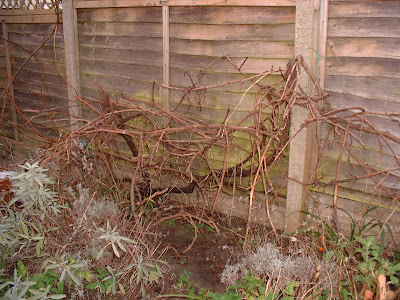
As you can see, this grape vine (Black Hamburgh) is a real mess.
Notice the multiple trunks and tangled canes all over the place!
Here is the email from her:

“My reason for making enquirers to you was to try and gain information on pruning my vines as I know they are in a bad state, and I have now received your wonderful book as you know and have started reading it and looking at ways to improve my knowledge and my vines. I find the book very easy to understand and would recommend it to other vine growers. I truly value your help to get me started in the right direction.
I was beginning to wonder why you do this service for free and after your comment can only appreciate what help you give me far more than you know.”

Leslie

From the UK.
My reply to her was the picture below. Now, blogger don’t show the text on the first picture very well so I will explain what I told her.

“Leslie, remove the trunk on the left. It is difficult to see where the canes come from, but what you need to do is prune your vine with 4 to 5 long bearers (canes) and leave 4 to 5 spurs close to the main stem. It should look something like a fish bone when you are done. First, try to restore the trellis as it will make your job a bit easier. Prune the canes 8 to 12 buds long; it looks like your vine is growing way too vigorous.

Email me if you have any questions

Danie”Her reply:

“HI Danie.

Yes the pictures are great and it is something that I wanted to do original but was afraid.
………

I cannot thank you enough, but will be in your dept?

Leslie.”


Hi Danie

Hope you had a great weekend.

I have now trimmed my vine as per your drawing and instruction all that remains is to fix the wires and tie the branches back. I will take a picture for you to see as soon as I am finished.
I had to cut away some dead wood so I am just hoping I have done it all correctly, I’ve no doubt that it will sprout out whatever I have done. I have also put some of the cuttings in a container to see if I can grow a new tree.

my best wishes.

Leslie.

Being afraid to “hard prune” a grape vine is one of the reasons many home grape growers’ grape vines grow out of control.

Well, Leslie pruned her vine as I told her, constructed the trellis and in the end the results were marvelous. I received a further email from her asking why the vine don’t have fruit this year and this was my reply:

“Hello Leslie!

You pruned your vine the correct way don’t worry about that. You will have to remember one thing Leslie – the grapes a grape vine produce, comes from buds on last year’s growth. In your case, your grape vine was very compact and probably no, or little sunlight penetrated the vine during last year’s growing season and could be reason why you don’t have grapes this year.

Now, what I am trying to say is, that the shoots on your grape vine as it grows now, will be much more fruitful and you will probably have a good crop next year. We did some serious reconstructing to the vine, so hopefully this will pay off next year. As you said, the weather also plays an important role in the development of grapes bunches, so Yes, the weather could have influenced the vine as well.

Good luck
Danie”

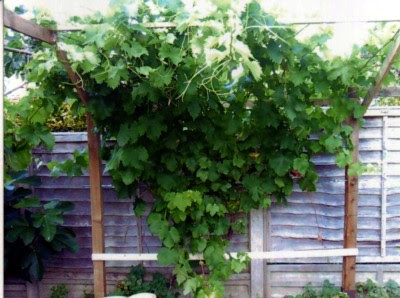
Here is what her vine looks like now..
Wine cellar secrets

Most of us only dream of building our own wine cellar where we can process the grapes that we have been working so hard on during the season. But what not many grape growers realize, is that many private wine cellars and wine makers, made their first wine in their backyard or garage. They started out small and build their way up to a point where their wine is actually in demand!

Have a look at this short video – these guys build their cellars inside a cave!

If you are serious about making your own wine or even if you are passionate about collecting wine, then there are a few things you need to know before you invest money in this. You don’t have to spend allot of money to make your own wine, or even build your own wine cellar!

One of the best books on cellar construction is How to build your own wine cellar. This is must reading for anyone considering building their own cellar.

This book will help you to build your own wine cellar. It is a construction guide for home wine cellars and invokes modern readily available materials and standard construction techniques.

This is the edeal for the “do-it-yourselfer” or hired carpenter and isn’t difficult to do. The book also reviews wine purchasing, bin construction and design, wine tasting groups and much more …

How to build your Own Wine Cellar” is a full guide for your wine cellar. If you are going to build your wine cellar you must read it first.

Why set up an arbor or trellis beforehand

How important is the construction of a trellis or arbor really? Many home grape growers use their grape vines not only to produce grapes, but to ad that something special to their garden and that is understandable, because often grapes are referred to as “the fruit of the gods”.

When the novice home grape grower first plant a grape vine, they passionately dig a hole in the first best place they can find; water the grape vine and soon see some life as new shoots develop from the tiny buds on the canes. The fact that a grape vine is VERY adaptable and not difficult to start, makes growing grapes even more fun.

Soon, the new shoots will be a foot long, and this is even more satisfying, thinking that you have successfully started a grape vine, but then the uncertainty crawls in. What now? What should I do with the new growth? Why isn’t there grapes on my grape vine? I’ve heard about “training” a grape vine, but what on earth does “training” mean?

These are common questions a new grape grower face, and it is understandable, because there is much more to growing grapes than just planting the them!

One article is excessively short to explain the whole process of growing grapes; in fact, 50 or even a 100 articles would not be enough! Therefore, I will try to shed some light on the most common mistake of all – the trellis or arbor.

After a month or so, the newly planted grape vine grows out of control and starts looking more like a shrub than a grape vine. Because of poor airflow and sunlight exposure and the fact that the new shoots is lying on the ground, even more uncertainty crawls in, as diseases starts to take over the grape vine.

Discouraged, the new grape grower tries to save the vine by pruning away shoots and then, thinking that they have successfully managed to keep the vine in shape, they will soon find out that the “new” grape vine now grows even more vigorously. The grape vine will grow even more out of control, as side shoots (laterals) develop because of the tip action that took place.

Even more frustrated, the grape grower starts to do research, desperately seeking for a solution to his/her problem. They do research in magazines, visit some vineyards and even try the Internet (as you did) seeking for answers. They find tons and tons of information on how to grow grapes, and after weeks and weeks of sifting out all the crappy information there is out there, they finally realize that they must have some kind of trellis or arbor to grow their grapes on.

Luckily, they found the answer, but there is another problem! By this time, it is almost the end of the growing season and constructing the trellis or arbor then, will do little or no good! You see, the real disadvantage of constructing the support too late, is the fact that you will have to prune the grape vine back to two or three buds and start all over again, loosing a whole year’s growth!

The real solution to the problem is constructing the trellis or arbor beforehand, before you even plant the grape vine. You should construct the support system during winter, so when the growing season starts in spring and the grape vine starts developing shoots, the support is already in place. This will ensure that you can train and evenly spread your grape vine’s shoots on the trellis or arbor wires and minimize the time it takes for your grape vine to produce grapes!

Danie
“The Grape Guy”
http://www.my-grape-vine.com/

PS: For some detailed pergola and sun trellis plans and how to construct them, you can visit

Greenhouse Grape Growing

Have you ever considered growing grapes in a greenhouse?

Growing vitis vinifera grapes for some of you guys in the colder climates is something you can only dream of. Vitis vinifera, as you probably know by now, is susceptible to cold damage when the temperatures drop below 0 *F or -15*C. Now this is really cold, but even at higher temperatures, most vinifera grapes will not do well in your area.

However, there are a few grape growing techniques used by viticulturists that can prevent the grape vines from getting hurt by these extreme temperatures, like covering the vines, late pruning and even in some cases removing the vines from the trellis and burying it!

There is another way, not so well known to people in the USA. The people from Europe and especially the UK use greenhouse gardening quite often in their backyards and successfully grow grapes in cold conditions.

Why grow grapes in a greenhouse?

First of all, let’s take a look at what a greenhouse really is. Greenhouses come in all shapes, sizes and materials. They range from conventional types that have vertical sides and include a traditional span, to those with one side against a wall (a sunny one is best, and the wall provides extra warmth.) A lean-to is ideal for limited space and excellent where a decorative show is required. Mini, low cost greenhouses are good for beginners new to gardening and greenhouse keeping, and also small gardens.

During the Victorian times, greenhouse grape growing was used to produce crops out of season, or to make the grape crops much earlier than the natural ripening season, by heating up the greenhouse. Today, greenhouse fruit and veg growing is done a lot more sophisticated with the introduction of hydroponics, alternate sources of energy like solar heat panels, airflow controllers and even mist control to regulate heat in the greenhouse. Over the years, the art of growing veggies in a different medium than soil, has been fine-tuned to such extend, that it is used commercially to grow out-of-season products.

Now, it is important to know that not ALL grapes are suitable for greenhouse grape growing. Varieties like Thompson, that is known as a unfruitful variety, will probably need some extra source of light in order to grow it in a greenhouse. Too vigorous growing varieties are also not suitable for greenhouse grape growing, because of the extra work that needs to be done to keep the vine’s growth under control.

Many greenhouse owners grow their vines directly in the ground, and will open up the greenhouse during winter to satisfy the grape vine’s cold units for dormancy and then close the greenhouse just before spring. During this time, they heat up the greenhouse and force the grape vines out of dormancy, without the danger of cold damage to the vines. When the danger of cold damage is over, they will open up the greenhouse to let the heat from the sun into the greenhouse and the grapes will normally ripen. One very big advantage of growing grapes in a greenhouse, is that you can close the greenhouse when rain or bad weather is expected and therefore lower the chances of getting botrytis rot (grey rot) and downy mildew.

Growing grapes in pots is not ideal, as the root system of a grape vine is enormous, but there are greenhouse grape growers that prefer to grow their grapes in pot, and successfully do this as well. The reason for growing grapes in pots is the fact that the grape vine can be moved in and out of the greenhouse as they please.

For sure there are some obstacles when growing grapes in a greenhouse. For one, if the airflow, temperature and humidity in the greenhouse is not regulated, then diseases could become a headache. Even pollination will be a problem, as most grapes are pollinated by wind. Insects that penetrate a greenhouse, normally thrives on the plants because of the lack of predators in this controlled atmosphere. In other words, you will have to have a strict disease and insect control plan.

A greenhouse increases the productivity of your garden but making that decisions about the type of greenhouse you want to add to your garden, even if it’s some way off in the future, needs special planning. There is lots of help available out there, but make sure you do your homework before you start growing grapes in a greenhouse.

For a detailed and proven system for greenhouse veg and fruit growing, I do recommend the following website

Growing grapes and dogs!

Grape Growers, have a look at this!

It is amazing what some poeple do. They now use Golden Retrievers to find Mealy bugs!

Have a look at this video, it is quite amazing how they treat those dogs!

Click here to watch this video

Enjoy
Danie

PS: Have you joined the My Grape Vine Forum? If you have grape growing questions, go to the forum and ask for help there – regularly check all new posts and answer them myself.

Click here for the forum

Pruning a never before pruned grape vine.

For those of you who has a grape vine that has never been pruned before or that was pruned the wrong way; this post will help you allot.

Look at Leslie’s grape vine before she joined My-Grape-Vine and became an owner of the Complete Grape Growers Guide and before I showed her where the structure of the vine should be.


From the picture above, you can see that there is no real structure of the grape vine. Only canes and stems that grew everywhere, without any purpose. Now, grape vines that grow like this, normally bears only fruit on the outer ridges of grape vine, as they are too compact inside, with no or very little sunlight penetrating the grape vine. These vines will never produce optimum crop sizes and will almost always have diseases.

The most difficult thing to teach a newbie grape grower is to construct a well balanced grape vine. It is something you must learn to “see”, before you prune the vine. Seeing or recognizing usable canes and the best place to prune spurs and what canes to leave, is a skill you will have master first, before you will be able to prune the vine the correct way.

What I normally teach people and also the workers on my farm, is to stand in front of the vine, look at the vine and identify and point out the canes you want to use (keep). As I said before, it takes practice, but isn’t difficult once your grape vine has been correctly pruned once.

Now, pruning a grape vine that looks like Leslie’s vine once looked, isn’t easy. You will have to remove lots of canes and even some parts of the old wood and stems – this requires “hard pruning” (as we call it).

Look at the end results below. I am so proud of what she has achieved.

Well done Leslie, your grape vine looks great!


Normally, when you “hard prune”, do not expect to have massive grape crops the following year because you are using canes and spurs that was on the inside of the grape vine didn’t have any sunlight exposure during the growing season and will most probably be unfruitful or very little fruitful.

Your goal should be to construct the vine correctly, let it grow the following growing season (even if it bears little fruit the following year), prune it again and enjoy a good, healthy crop the following year.

I hope you now realize how important it really is to construct your grape vine the correct way.

 Page 8 of 12  « First  ... « 6  7  8  9  10 » ...  Last »