Sunburn Scald On Grapes

Those of you who are members of the Complete Grape Growing System will know, I often speak of sunlight penetration into the grape vine.  Most new grape growers I met don’t really understand or take note of the importance of having enough sunlight inside the vine.

Now when I speak of sunlight, I don’t necessarily speak of direct sunlight but more about the UV rays of the sun, as direct sunlight can damage grapes.  Not all grape varieties are susceptible to sunburn, but there are a few varieties that really can’t take any direct sunlight, especially if you live in an area where the summer temperatures reach the high nineties (ºF) or high thirties (ºC).

To protect these grapes from sunburn, you need to have a well-planned vineyard, a well-developed canopy, a practical but effective trellis system, proper canopy management and also some knowledge of when and what grapes are most vulnerable to sunburn.

The layout of the vineyard:

Properly laying out the vineyard will ensure that during the hottest time of the day, the leaves on the canopy will protect the grapes from hanging directly in the sun.  Many factors will determine the “perfect” layout of the vineyard; things like the path of the sun in your area, the topography, slope, over shading trees, prevailing winds, altitude and even the variety.

The trellis system:

Having a trellis system that expose as many leaves possible, to direct sunlight is ideal, but at the same time, that trellis system should allow you to train the grape vine so the canopy will also protect the grapes from direct sunlight.

The canopy:

As said so many times before; managing the grape vine’s canopy is one of the most underestimated cultivation practices when you grow grapes.  You MUST do canopy management, no matter what variety you grow, if it is for wine or table grapes, or where you live.

You must know when to tie down the shoots, when to pull leaves, when to open up the canopy to allow direct sunlight to penetrate the row and how to manage a too vigorous grape vine.

Grapes are most susceptible to sunburn from pea-size to just before veraison (colouring).  During this stage you must ensure your grapes are protected.  Handling or touching the grapes of susceptible varieties during this stage should be minimized.  Naturally, the grape berries have a was layer to protect them from sunlight and diseases, but will rub off when you touch the berries, making it more susceptible to sunburn.  Please note, that is only true for really sensitive varieties, the less sensitive varieties can be handled during this time of the growing season.

Here you can see the sunburn on the grapes because of a poor canopy on this vine
Opening up the canopy for direct sunlight to penetrate the vine is well known practice throughout the world and will do wonders for the colouring and ripening of your grapes, BUT it needs to be done at exactly the right time.

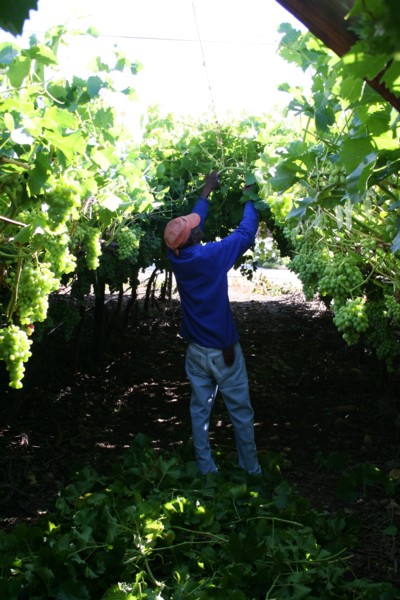
When your grapes start to turn colour, the sugar content within the berries will increase and the acid levels will start to drop.  During this stage, the grapes become less susceptible to sunburn but is not sacred from sunburn, so you must still keep the grapes protected.  Opening up the canopy at this stage is done by pulling more leaves or on the gable trellis system I use on my farm, it can easily be done by removing (pruning) overlapping shoots from the top of the structure like in the picture below.  This will create a 5 to 8 inch tunnel where the sun can shine through. 
Variety:

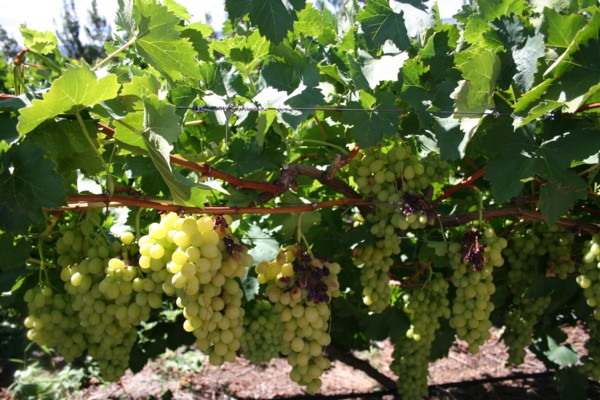
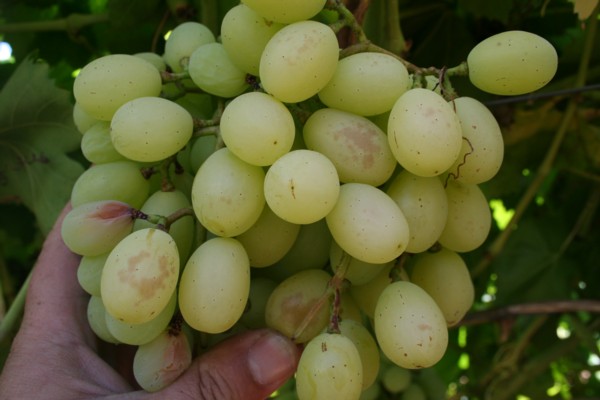
It’s a known fact that most of the white grape varieties are more susceptible to sunburn than the black or purple varieties are.  Whether it is because you can more easily see the sunburn damage or if it is a genetic thing, doesn’t matter.  I found that white grapes that hang in direct sunlight can suffer what I call sugar stains (like in the picture below).  The fact is; if you grow a white grape variety, you need to take special notice of this article.
Right, I hope you’ve learned something from this article.

Enjoy the day and happy grape growing!

———————————————————————–

Get all the info you need to grow your grape vines like a seasoned pro by joining the Complete Grape Growing System Membership Site. 

For only $29, you get free instant access to all the information PLUS 2 videos to show you how to prune a spur and how to cane prune your grape vine.

Please note, that the Complete Grape Growing System is an online product that you need to download to your PC. 
There is no physical product that will be posted to you.  The great thing is you get instant access, no matter where you live or what time it is;  even if it is 2am in the morning!

Grape Growing – The Climate

It seems like I’ve touched a nerve with yesterday’s post about Global Warming.  Got some really aggressive replies!  Anyway, let’s look at what the ideal climate for growing grapes is – with or without global warming  😉 ….he he

The ideal climate for growing grapes can be devided into three components:

  • The messo climate
  • The micro climate
  • The macro climate

In this article I will mostly focus on the macro climate; the one that will determine if your climate is suitable for growing grapes or not.

The messo climate:

The mesoclimate describes the climate within smaller areas such as a region or valley. The climate conditions of a mesoclimate is normally calculated over shorter periods of time (using hourly data) and is influenced by the topographic factors of elevation or altitude, slope inclination and aspect, and proximity to bodies of water.  Within a grape-producing region, the mesoclimate of a specific vineyard site has a profound influence on susceptibility to spring freezes and the ripening of your grapes.

The micro climate:

In short,  the ideal microclimate is the climate immediately within or surrounding your grape vine canopy and differences occur within a few meters / centimeters and minutes or seconds.  It is influenced by the vigor of the grapevine, irrigation, soil management, how you manage the canopy of your grape vine, the row orientation you use, the row spacing etc. 

The ideal micro climate influence how successful you will grow grapes, as this will determine the vine’s health and productivity, but will also improve grape quality.  Unlike the messo and macro climate, the micro climate is something we have 95% control of and this is where the importance of using the correct viticultural practices comes in (the one’s I teach in the Complete Grape Growing System).


The macro climate:

The macro climate describes the climate of a region, extending over hundreds of kilometers (e.g. the South Western Cape where I live) and is studied over a long time-period (usually 30 years or more), using annual, seasonal or monthly data. The macro climate is influenced by the geographic location (latitude) and proximity to large, climate-moderating bodies of water. The weather may differ from year to year, but the climatic situation over a long period of time is relatively stable in terms of temperature and rainfall patterns.

Various factors, combining various climatic components like minimum temperature, maximum temperature, rainfall, humidity, sunshine duration etc., may be used to describe the viticultural potential of a macro-region. Some use monthly data or daily data only, while others are a combination of different scales (daily with monthly data). They are usually summed for different periods of time (growth season or whole year), but can also use a single month. They are established for a specific country or region, and then may be adapted to other regions or used for a systematic global classification of the climate.

The length of the growing season of grapes differ from variety to variety and studies shows that at least 170 days of active, frost-free, growing is needed for grape vines to ripen a crop (remember, this figure will not be same for all varieties). But not only the length of the growing season is important; the heat accumulated during the growing season will determine if your grape vine will successfully ripen the grapes or not.

You will have to find out how many days of full sunlight with a temperate above 10°C or 50°F is measured where you live. This is called the GDD or “growing degree days”. Studies made on the physiology of the grape vine, determined that the grape vine is not very active below these temperatures.

The GDD is measured by using the following formula:

(HT + LT) / 2 – 50°F or -10°C=GDD *

HT = highest temp; LT= lowest temp

By adding up all the GDD points, you can measure your regions suitability for growing grapes and should be more than 2000 GDD (Fahrenheit) or 1200 GDD (Celsius) points. The closer your macro climate is to these numbers, the more suitable it will be for growing grapes.

As said earlier, the macro and messo climate cannot be changed, but the micro climate is the one you have control of.  Use this advantage to grow your own grape vines more succesfully, even if your messo and macro climate isn’t 100% ideal.

For help with creating the perfect micro climate, get the Complete Grape Growing System for only $29!

Global Warming And Growing Grapes

This is a question I often ask myself: “How will global warming effect my grape business in the future?” I know there are some of you that think this whole “global warming” thing gets way to much attention and there is nothing to worry about.

Whether you believe in or worry about global warming or not, the facts are that earth’s temperature is rising!

I certainly noticed climate changes since I’ve started farming way back in ’92 (wow, scary to think I’ve been growing grapes for 16 years 😐

When I spoke to my dad about his early days on our farm, he said that they packed Barlinka grapes (an old black seeded variety) until week 24 to week 26! I still grow a patch (about 0.8 hectares) of Barlinka, but the latest I pack them in recent years are +- week 18! That is quite a difference!  It is a known fact that grapes mature quicker in hotter climates, so could this be an indication how much global warming is affecting our business?

Read this article I found on the Daily Green website:

—————–

What scientists believe will happen at the end of this century

Thanks to global warming, well established wine-producing regions such as California’s Napa and Sonoma Valley as well as Northern France’s Burgundy region may be facing tough times ahead. The frequency of extremely hot days across the globe is beginning to redefine wine production as we know it and could prove disastrous for many famed wine grape growers.

Too hot days are wreaking havoc on grapes and growing conditions. Grapes used in premium wines need a consistent climate; even the smallest changes in temperature can mean the difference in taste and quality between an expensive wine produced by century old vines and those used for some ubiquitous cooking wine. Findings in a paper published in The Proceedings of the National Academy of Sciences earlier this year state that within the U.S., regions that are suitable for growing premium wine grapes may be reduced by 50% and quite possibly by over 80% by the end of the century if warming trends continue on as expected.

No where has this been felt more than by winemakers in California’s Napa Valley. According to an article in USA Today, “In Napa, the minimum temperature has gone up nearly 5 degrees over the past 75 years, while growing season has increased by more than 50 days.” Because of increased temperatures, a grape’s necessary natural fermentation is advanced thus making them harvest-ready all the sooner.

Crush season is happening earlier for many as a result. Once seen as a September ritual, grapes are now ripening at a faster rate and a month earlier than normal and require harvesting during the night when temperatures are cooler. Those vineyards set in climates more conducive to wine grape growing in the U.S. are faring well and may usurp some of Northern California’s claim to the multi-million dollar wine industry. Upstate New York’s Finger Lake region, Long Island’s North Fork as well as Washington State’s Puget Sound and both Michigan’s coastal zone and Virginia wine-making regions aren’t as affected by the warming trends just yet.

Article from the Daily Green Website http://www.thedailygreen.com/healthy-eating/6296

——————-

Is global warming all bad for growing grapes?

Nope, some areas are actually benefiting from this.  If we look at countries like Canada, some wine growers there now plant grape varieties that would previously never survive their cold winters!

In the northern province of Champagne in France, the annual average daily temperature changed from 10.3 ºC to almost 12ºC over the last couple of years and this temperature changes, actually improved the quality of the champagne made there.

In the end, the rising temperatures may force growers to manage vines differently to produce similar wine styles or quality, or to plant different varieties better suited to the changing climate.

What should we do?  I really don’t know, but one thing is for sure; we grape growers need to adapt to these climate changes to keep us in the game!  We need to constantly look at things like canopy management, disease control and vine vigour, to keep our grape vine in the best shape ever.

Enjoy the weekend.

Danie

Facing the changes in the climate alone isn’t fair!

Get your copy of the Complete Grape Growing System Today and I will help you be a more succesful grape grower for only $29!

Thanksgiving Message To All Grape Growers

For those not from the USA:  Thanksgiving, or Thanksgiving Day, is celebrated on the fourth Thursday in November in the USA, and this year, the 27th of November.  On Thanksgiving day all our friends from the USA express their thanks for their material and spiritual well being.  It symbols the start of the holiday season and is an annual American Federal holiday.  Most people celebrate by gathering at home with family or friends for a holiday feast, with a turkey or two, roasted to perfection!  🙂

Although we here in South Africa and many other countries, do not celebrate Thanksgiving like the people from the USA, I think we all have so much to be thankful for.  Therefore, I’ll be thinking of each and every one of you during this season of Thanksgiving, even though we may be separated by thousands of miles. 

I’ll pray for every loyal member of My Grape Vine; for your well being, safety and prosperity.  That you will be close to me, in my heart. 

I give thanks for you all, customers, friends and close loved ones.  You have touched my life in so many ways; you brought me closer to my inner-self;  I have grown in so many ways, that would have never been possible, if it wasn’t for you.  I’ve met so many wonderful new “grape growing friends”, some even came to visit me on my farm!  It’s great to have friends and “e-palls”, who share the same passion!

This is my message to you on this Thanksgiving Day and thank you ALL for being part My Grape Vine.

Take care and God Bless…

Danie

Grape Vine Dormancy

Hi grape growing friends.

Yep, it’s weekend again and I’m surely looking forward to sit back, put my feet up and enjoy the a nice cold one after a tough week – I’m sure most of you feel the same way

🙂

Well, this article is about the dormancy and the post-harvest treatment  of the grape vine, since most of you guys and girls from the northern hemisphere is close to winter now and you vines are most probably dormant already.  Okay, so enjoy this article…

The post harvest treatments when growing grapes, is very often overlooked by grape growers. Since picking or harvesting the crop is over and you probably already enjoyed the fruit of you labour, you stop looking after your grape vine – BIG MISTAKE!

Not taking care of your grape vine in the post-harvest period, could result in big problems during winter or the next growing season. When done harvesting, the grape vine is still physiologically active, although it might look like there is no active growth!  The roots of the grape vine is still active, long after the shoots stop growing.

The post-harvest period, is where you prepare your vine for the winter and the next growing season.  During the first stages of dormancy, the roots of the vine takes up nutrients to store as energy, needed for the developing shoots in early spring, the following season.

Yes, the grape vine actually goes through a phase called “root flux” where more than normal root development takes place and this is the time when you would want to apply a post-harvest fertilizer.

In dry conditions or climates, you should not stop watering the vine, although much less water is needed. As the grape vine slowly goes dormant, the ripening the shoots will take place and the vine will get ready for winter (harden off).

Very little people actually knows what dormancy is, so here is an article I wrote a few months ago.

The three dormancy stages a grape vine goes through – by Danie Wium

1. Summer rest

Yes, there is something like summer rest. From the time the buds were formed until fall, many buds that don’t sprout, are in what we call summer rest, and because of the presence of grapes, leaves and growing points, these buds will not shoot or sprout. To proof this, you will notice that after a vine is hale damaged or a heavy top action, these buds starts to shoot. In some hot subtropical and tropical areas, only a small prune wound is enough to let the vine break out of dormancy and it will start to shoot, if the winter temperatures in these areas are high enough, a second yield can be harvested!

2. Winter rest

After the first cold nights during fall, the vine will go into what we call winter rest. This is a deep state of dormancy. Experiments on vines revealed that the artificial breaking of this dormancy would result in a very uneven shoot of the buds.

3. Normal rest

During normal rest, the vine has come out of winter rest because of the rise of the average temperature when spring is about a month away. Many grape growers will artificially break the rest period of the vine with a RBA chemical. Earlier and more even sprouting occurs, and harvest time will most of the times be a week or even two weeks earlier.

In the tropical, hot areas of the world, the grape vine seldom goes dormant as the temperatures are too high, these areas can produce two crops per year, but special care must be taken to feeding and watering the vine.

Where the winters are cold, it is normal for a grape vine to loose it’s leaves and many newbie home grape growers, think there is something wrong with the vine or the vine is dying. The vine losing it’s leaves, is preparing to go into dormancy and this is when energy is accumulated for next year’s growing season. Applying a light N fertilizer (20 kg per ha or 300 ounces per acre) during this stage has many advantages, as the roots of the vine are still active. These N is stored in the roots, canes and framework of the vine. When spring arises, the vines use this N to sprout. Little to no watering is needed during dormancy, depending on how dry the winter is. If you live in an area where no rain occurs during winter, you can water the vine once every two weeks.

Right, so be sure to look after your vines, even if you already enjoyed the fruit of your labour!

For members of the Complete Grape Growing System, I’ve added a new download link from you membership site, where you can get more info about the post-harvest treatments of the grape vine.  Simply log in at www.my-grape-vine.com/members/ or if you decide to join us now for only $29, simply click here.

This is the start of what you can expect from the New Complete Grape Growing System – surprise bonus articles and downloads!

Hope you have a wonderful weekend and will talk to you on Sunday, where I will show you some pictures of how we are doing, repairing the flood damage.

Take care

Danie

P.S  Won’t you feel much better, knowing that the next time you go out into your vineyard, you will know exactly what to do? Secure the lowest price by clicking here to order.

P.P.S  Don’t forget to download your Bonus videos after you ordered the Complete Grape Growing System.  This will forever clear all the mysteries there are about pruning grapes!

P.P.P.S  Also remember, that you are ordering this product at absolutely no risk to you. So grab this special price while you can! If the Complete Grape Growing System isn’t everything you were expecting, simply notify me within 60 days and I will refund your money immediately.

Click Here To Place Your Guaranteed Secure Order Now!

Leaf pulling video

Hi again grape growing friends.

Just a quick update on the “leaf pulling a grape vine” blog post from yesterday.  This video I found on YouTube will confirm what I’ve said in the previous article about leaf pulling.

See how the guy (the farm worker, not the actor) is removing the basilar leaves to expose the grapes to more sunlight.  As said earlier, this is hard work and takes up allot of time.

I’ve had a question about sunburn when you do leaf pulling.  Some varieties are more susceptible to sunburn than others, so if you have one of those, you need to do leaf pulling very carefully.  Do not open up the roof of the canopy so the grapes will hang in direct sunlight, but remove leaves touching the grapes.

Take your time, and do leaf pulling properly.  As said earlier, you will reap the rewards.  I promise.

Take care …

Danie

Click here to join our Grape Growing System for only $29

You will never again go out into your vineyard or backyard, not knowing what to do!

Leaf Pulling A Grape Vine

Leaf pulling or the removal of leaves is one of the summer manipulations you simply cannot just ignore, if you are serious about growing good quality grapes.


Why leaf pulling?


Not only will leaf pulling improve the coverage and penetration of your spray applications, but it will also improve sunlight penetration and airflow into the vine, which on the other hand makes your grape vines less susceptible to diseases.  As the UV-rays and air penetrates the vines, it will create less ideal conditions for the inoculation and spread of fungal diseases.  Remember for fungus diseases to spread, a hot humid climate is needed. 


The removal of leaves will allow the vines to dry off much quicker after rain or heavy dew and thus will make the vines less susceptible to the spread of fungus diseases.


Many grape growers ask me why their vines don’t have any grapes and the first question I ask them is how they do summer manipulations.  In 90% of the cases, they don’t do leaf pulling.  I will almost go as far as to say that, leaf pulling is just as important as proper pruning techniques!  I know, this is a bold statement, but without proper sunlight penetration, the chances are good that your vines will only have shoots and leaves and no grapes!

When to do leaf pulling?

Leaf pulling is done just after flowering, when fruit set is complete so you won’t disturb the pollination process.  In the southern hemisphere, it is round about middle to end November and in the northern hemisphere in May (off course this may vary from climate to climate).


If you grow table grapes or dessert grapes, then leaf pulling will improve the overall cosmetic quality of the grapes, as it will minimize the bruising of the grape skins from leaves scratching it’s surface.  For wine and table grapes, it will improve the overall grape and wine quality, as the vines are using the nutrients available more efficiently. 


Tests done with a light sensitivity meter shows that the first layer of leaves on the grape vine canopy, get the most sunlight and will use the sunlight to produce more than 90% of the carbohydrates inside a vine.  They are the most efficient leaves on the canopy, which is obvious as it gets the most exposure. 


The second layer of leaves inside the canopy, only gets about 7 – 10 % of the sunlight and will contribute only that percentage to overall carbohydrates.  The third layer only receive about 3% of the sunlight.


How to do leaf pulling?

Now, the following is important; your grape vine needs leaves to produce carbohydrates, but on the other hand use up nutrients for normal assimilation processes.  Therefore, some leaves are using energy they produce to create more energy but some are only using energy and do not produce enough energy themselves.  These are the leaves that will make less energy available for grape development and they need to be minimized at all cost.


The leaves at the base of each shoot (leaves 1 to 3, counting from the spur or cane) are the ones that are not contributing to improve grape quality.  By only removing those leaves, you will improve the sunlight penetration into the base of the canopy and will also improve the airflow by up to 40%!  Leaves touching the structure or cordon of the vine and those touching grapes clusters needs be removed. 


Don’t forget leave pulling, I know it’s a time consuming job, but you will reap the rewards in the end. 

Take care..

Danie

P.SIf you are serious about succeeding and wants to grow your grape vines the correct way,  then join us at The Complete Grape Growing System and get all the in-depth grape growing information that helps hundreds of others to produce great looking, productive grape vines – every year!

Click here to join our Grape Growing System for only $29

You will never again go out into your vineyard or backyard, not knowing what to do!

P.P.S. Don’t forget to watch the 3 grape vine pruning and training videos, after you have joined!

What a week!

Hi grape growing friends.

This isn’t the regular grape growing blogs I usually send out, but I thought I’d share my week with you :-/

On Monday, I launched the new Complete Grape Growing System and as said in the previous blog, not without some hick-ups 🙁 , so I had to extend the promotion to give everybody a fair chance to get into the program.  I’ve since had some very possitive feedback about what the system offers and will continue to add valuable grape growing info to it in the future.  I’m glad to report that the problems, has been sorted out and things are moving allong just fine now – a perfect day, until …

it started to rain which isn’t good, because most of my grape varieties are flowering right now! 

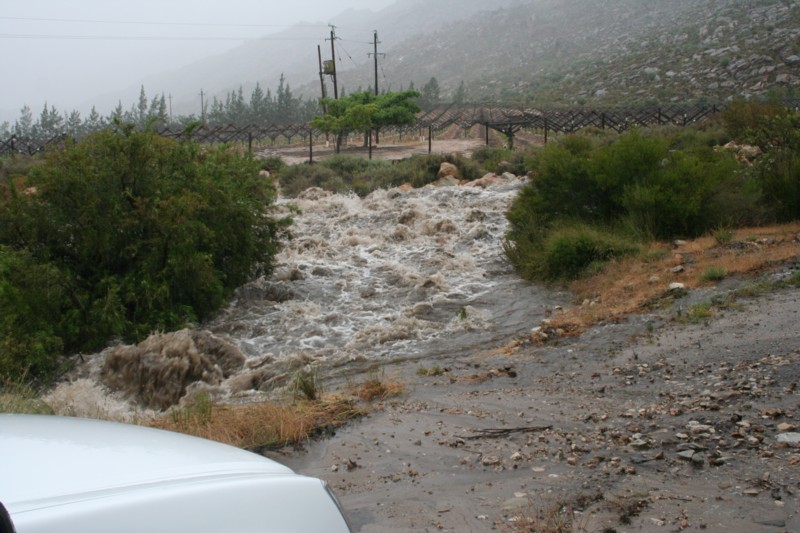
It kept on raining like I haven’t seen in our valley for as long as I have been living here.  The whole night it went on bucketing down and continued Wednesday morning.

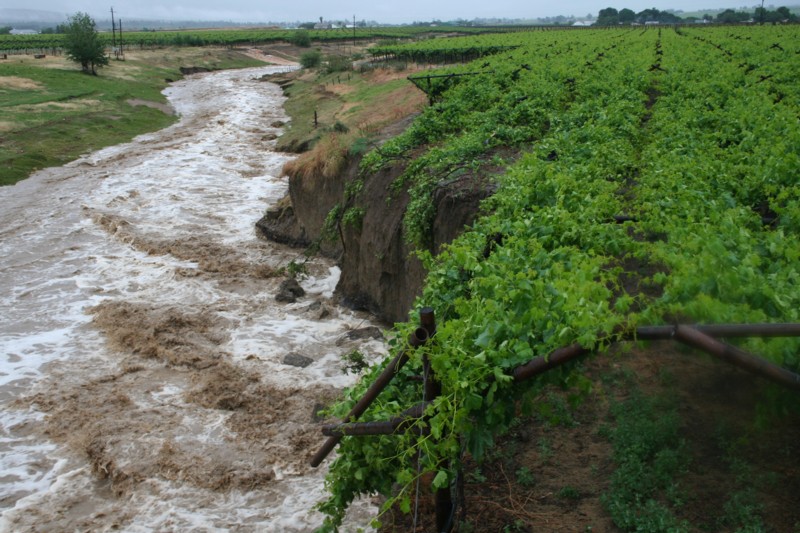
Our mountain stream by Wednesday morning (+- 09:00 am)

 – we never could imagine what was about to happen ..

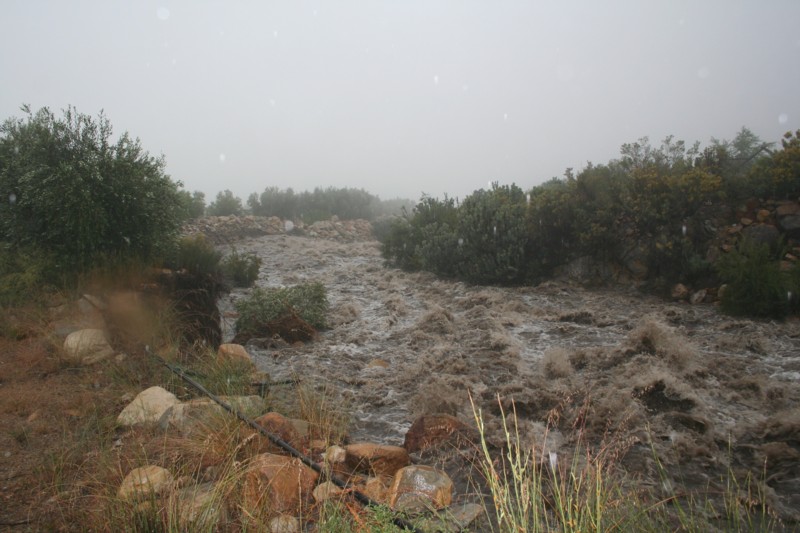
Things started to look bad by Wednesday afternoon as the rivers started to flood the banks, but it kept on raining and raining and raining.

By Wednesday evening things started to look REALLY bad…

Thursday morning after a night of destruction here in our valley, it seemed like the weather was finally clearing up – we were mistaken…

A new flood of rain poured down in the mountains surrounding the valley, feeding the already flooded rivers even more water!  

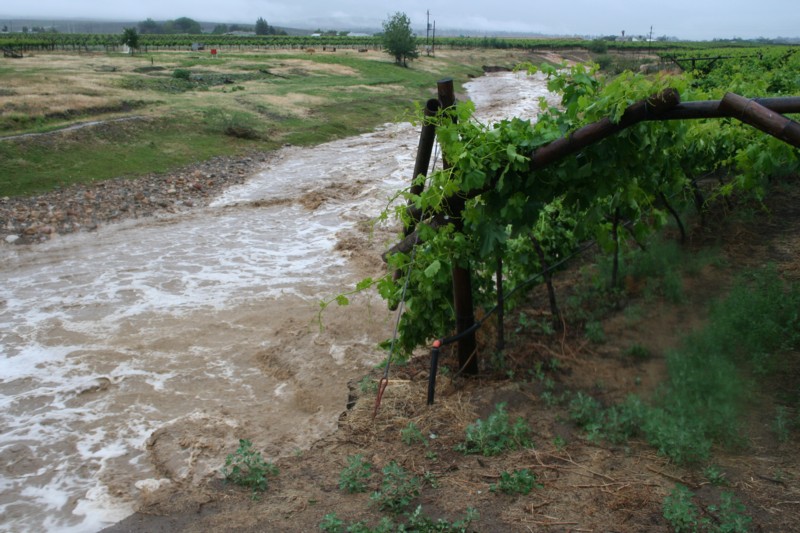
Slowly the flooded river started carving into the river-banks feet by feet – getting dangerously close to my vineyards

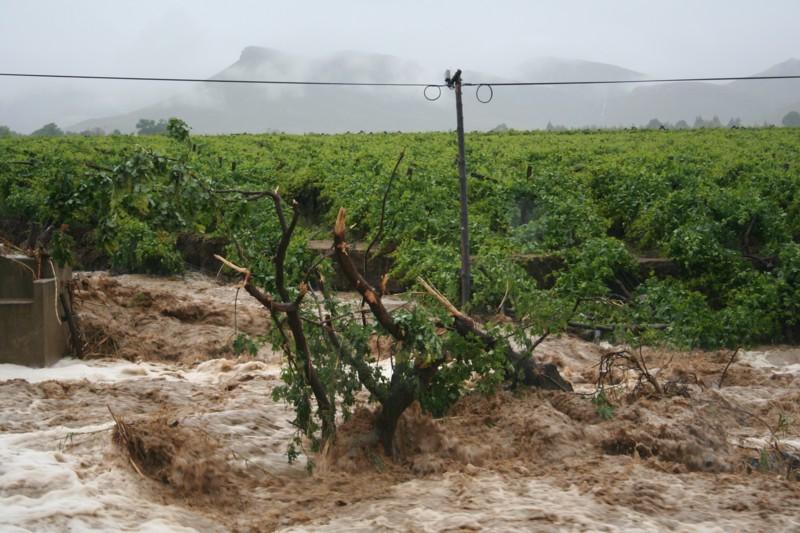
By lunch we already had 215 mm (+-9 inches) of rain and finally the weather started to clear up (at last!) but not without huge losses …

Some vineyards on the river-banks were totally washed away, and others suffered trellis structure losses as the soil was so wet, the supports simply gave way.

What a week it has been? 

Luckily it is weekend and it seems like the rivers are setteling down.  Thankfully we are all still alive and well, but next week will have it’s own challenges as we will start to do damage control.

I really hope your week was better than mine, but surely we appreciate the “drier” weekend here.

I hope and pray you will have a great weekend.

Thanks for all your support

Danie

Replanting A Grape Vine

Replanting A Grape Vine – Can It Be Done Successfully?

Because so many grape growers ask me about replanting a grape vine, I though it would be a good idea to write this article as part of the “New To Growing Grapes” series of posts on my blog. 

The reason why so many new grape growers are replanting a grape vine these days are poor planning, incorrect soil preparation and choosing the incorrect site or spot to plant their grape vines in the first place.  Choosing the correct site location for your vineyard, is one of the most important choices you as a new grape grower have to make as this will be the future home for your grape vines in years to come.

Let’s get something straight; replanting a grape vine is not ideal, especially if it is older than two years.  Therefore you need to do proper planning before you establish your vineyard.

So, your grape vines were not planted in the right spot or you are moving to another house and wants to take your grape vine with you – now what?

Replanting a grape vine pose some risk!

There is no doubt about that, but it can be done if you follow the instructions I am going to give to you now.  Do not deviate from this too much as you could loose your grape vine.

The first problem with replanting a grape vine (2 years and older)

The root system and structure of the vine gets bigger each year and makes the removal of the vine much harder.  When replanting these grape vines, you will eventually damage some roots, as it is impossible to take them out of the soil intact.  Damaging the roots of the vines will result in the lost of moisture through the wounds and could result in the roots drying out too much and die.  When taking the vines out of the soil, make sure you dig up as many of the roots as possible – the more roots you can save, the more successfully you will replant your grape vines.

The second problem with replanting a grape vine

The loss of water through the leaves (evaporation).  After replanting the grape vine, the roots of the vines are in a state of shock and for a week or two will not be able to take up water from the soil.  If the climate is hot, the grape vine will loose water through the leaves which will result in too little water in the vine and the leaves will start to wither.

You therefore need to minimize the apical growth in order to ensure there is enough available water in the vine itself by reducing the number of shoots to a maximum of three.  I would recommend you prune back hard and leave only one strong cane from the base of the lowest cordon.  You can develop the new structure of the vine from there.  Rather loose one or two year’s growth and have healthy vine, than trying to retain the old structure and have a dead vine!.

The third problem with replanting a grape vine

Because you have a much bigger root system than a normal rooted cutting, you will have to make a much bigger planting hole.  Make the planting hole large enough to accommodate ALL the roots and do not prune back any roots to fit the planting hole – rather make the hole larger.

It is important that you understand, that when replanting a grape vine, these vines needs allot of water the first few weeks (as explained before).  After removing the vine from it’s old position, place the roots of the vines in a bucket of water for at least six hours, prior to planting it in the new location.  This will ensure the roots stay moist and the vine will not loose any water through the wounds on the roots.

Do not put any fertilizer in the planting hole when replanting a grape vine, it will damage the roots.

I have successfully done replanting a grape vine this way, and there should’t be any reason you cannot do it yourself, but it is always better to avoid replanting a mature vine.

I hope this gave you more insight on replanting a grape vine – remember, the key to successfully replanting a grape vine is:

  • Keep as many of the roots as possible,
  • Minimize apical growth for at least a month
  • Make a large enough planting hole
  • Keep the vine well watered.

Good luck with replanting a grape vine!

Danie

Get your copy of the Complete Grape Growing System today!

Growing grapes has never been this easy! 


Update on layering a grape vine

In the previous post, “Layering A Grape Vine“, I showed you how to layer a grape vine.  As your grape vine starts showing signs of new growth, you need to manage these layers in order to maximize the shoot growth of the new grape vine and to develop the frame work (cordons) of the new as quickly as possible.

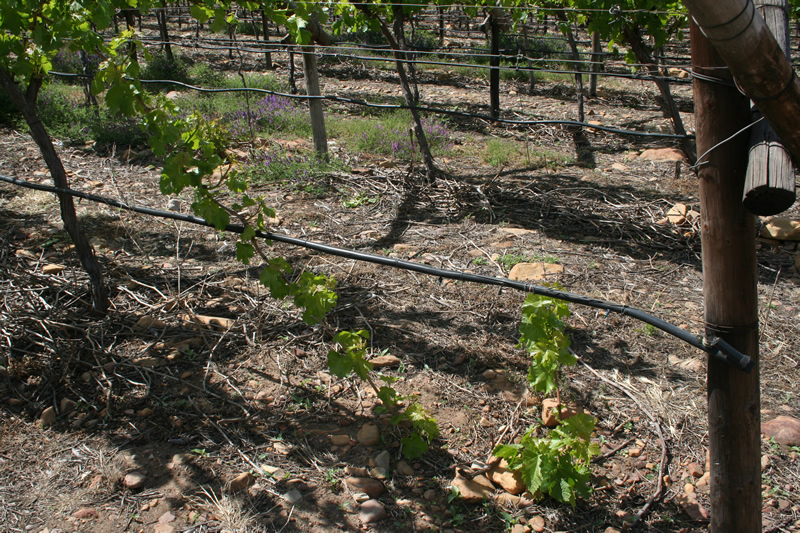
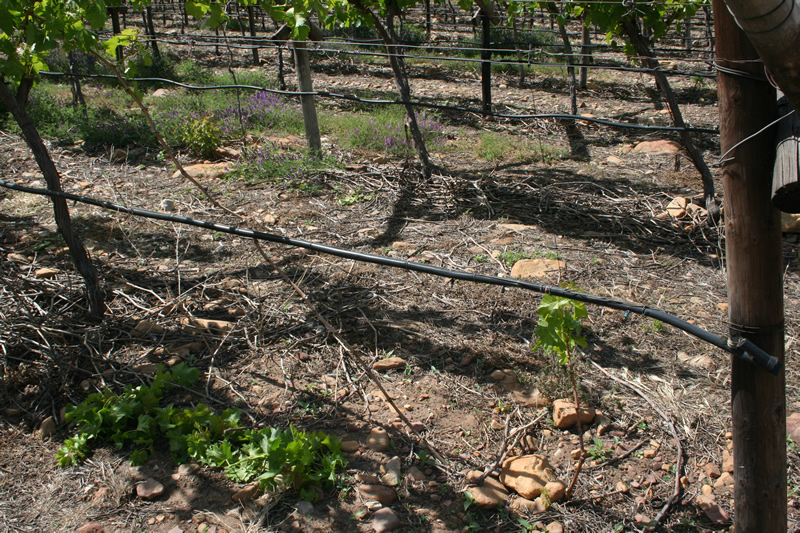
This is what the new layer looks like after just a few weeks.

When the new shoots start developing from the buds on the cane you layered, you should remove them as soon as possible.  This is a very simple process; just break them off by hand. 

For those of you who has the Complete Grape Growers Guide;  keep an insurance shoot and new training shoot as shown in the guide and train them up the training string as the pictures in the e-book shows you.  Once the vine reach the trellis wires, you can split it (if your training system requires it) or simply train it to the cordon wires and start developing the frame work (as shown in the guide).

You will notice that a training shoot from a layered grape vine grows much faster than from a newly planted cutting.  This is because it gets energy and nutrients from the original (old) grape vine.

I do hope this will help you manage your layered grape vine. 

Take care

Danie

P.S  For your own copy of the Complete Grape Growers Guide, you can simply click on the picture below.

Click Here To Order Your Copy For Only

You can use your PayPal account to buy the e-book!

This is an e-book that gives you instant access to all the information.  You will have to download the ebook after you make the payment, so you will NOT receive a physical book.

 Page 5 of 9  « First  ... « 3  4  5  6  7 » ...  Last »